


Saying that the referendum will serve as a great opportunity for people to voice in unison their desire for peace and opposition to China's missiles aimed at this country, Chinese dissident writer Cao Chang-ching (曹長青) on Sunday questioned the pan-blue camp's boycott of the referendum.
"These people aimed their target at a president who was elected through a popular vote as if he were scarier than the missiles aimed at Taiwan," Cao said at the "People's referendum, Taiwan's Voice" forum in Taipei organized by Taiwan Advocates.
Cao was referring to the series of marches across the nation last Saturday organized by the Chi-nese Nationalist Party (KMT)-People First Party (PFP) alliance. The marchers protested against President Chen Shui-bian (陳水扁), with the slogan saying "Change the President, Save Taiwan."
Cao said the threat to Taiwan today lies not with Chen but with China's 496 missiles targeted at Taiwan.
"China is a regime of bandits. As long as its 496 missiles aimed at Taiwan do not go away, it is useless even if Taiwan has changed 100 presidents," he said.
The nation's first referendum will ask voters whether they support enhancing the nation's defensive capacities should China refuse to withdraw its missiles targeted at Taiwan, as well as whether the government should hold talks with China on cross-strait peace and stability.
The pan-blue alliance says the referendum is illegal and has called on its supporters to boycott it.
Cao defended the referendum, noting that it was called in accordance with Article 17 of the Referendum Law (
"What would you call them if China's 496 missiles pointed at Taiwan are not considered a threat?" Cao said. "How can you say that Taiwan's sovereignty is not being violated when China has been obstructing Taiwan's participation in international organizations such as the UN?"
Academia Sinica research fellow Joanne Chang (
Chang said the people of Tai-wan have never been consulted about their future -- going back as far as 1895 when the Qing dynasty gave the island to Japan and as recently as the Sino-American communique concerning Taiwan.
Chang said that taking part in the referendum would show everyone that the people of Taiwan will no longer let others decide their future but will decide it for themselves.
Chang said the referendum would not only help encourage the Chinese Communists to adopt peaceful means to resolve cross-strait problems, but it would also increase Taiwan's bargaining chips in cross-strait negotiations.

The military has spotted two Chinese warships operating in waters near Penghu County in the Taiwan Strait and sent its own naval and air forces to monitor the vessels, the Ministry of National Defense (MND) said. Beijing sends warships and warplanes into the waters and skies around Taiwan on an almost daily basis, drawing condemnation from Taipei. While the ministry offers daily updates on the locations of Chinese military aircraft, it only rarely gives details of where Chinese warships are operating, generally only when it detects aircraft carriers, as happened last week. A Chinese destroyer and a frigate entered waters to the southwest

The eastern extension of the Taipei MRT Red Line could begin operations as early as late June, the Taipei Department of Rapid Transit Systems said yesterday. Taipei Rapid Transit Corp said it is considering offering one month of free rides on the new section to mark its opening. Construction progress on the 1.4km extension, which is to run from the current terminal Xiangshan Station to a new eastern terminal, Guangci/Fengtian Temple Station, was 90.6 percent complete by the end of last month, the department said in a report to the Taipei City Council's Transportation Committee. While construction began in October 2016 with an
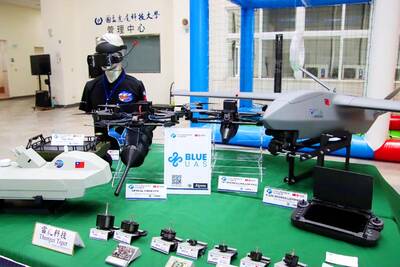
NON-RED SUPPLY: Boosting the nation’s drone industry is becoming increasingly urgent as China’s UAV dominance could become an issue in a crisis, an analyst said Taiwan’s drone exports to Europe grew 41.7-fold from 2024 to last year, with demand from Ukraine’s fight against Russian aggression the most likely driver of growth, a study showed. The Institute for Democracy, Society and Emerging Technology (DSET) in a statement on Wednesday said it found that many of Taiwan’s uncrewed aerial vehicle (UAV) sales were from Poland and the Czech Republic. These countries likely transferred the drones to Ukraine to aid it in its fight against the Russian invasion that started in 2022, it said. Despite the gains, Taiwan is not the dominant drone exporter to these markets, ranking second and fourth
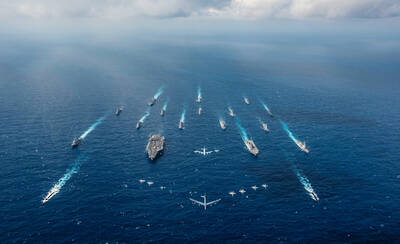
Japanese Prime Minister Sanae Takaichi’s comment last year on Tokyo’s potential reaction to a Taiwan-China conflict has forced Beijing to rewrite its invasion plans, a retired Japanese general said. Takaichi told the Diet on Nov. 7 last year that a Chinese naval blockade or military attack on Taiwan could constitute a “survival-threatening situation” for Japan, potentially allowing Tokyo to exercise its right to collective self-defense. Former Japan Ground Self-Defense Force general Kiyofumi Ogawa said in a recent speech that the remark has been interpreted as meaning Japan could intervene in the early stages of a Taiwan Strait conflict, undermining China’s previous assumptions


 RSS
RSS