


Opinions were mixed yesterday over the kneeling in public of Chinese Nationalist Party (KMT) Chairman Lien Chan (
First Soong knelt with his wife at a rally in Taichung. Shortly after Lien and his wife prostrated themselves at a rally in Taipei.
It was the third time Soong has knelt in public, while it was Lien's first performance. Lien, however, stole the show.
"It is a very touching scene," KMT Legislator Apollo Chen (陳學聖) said. Chen who participated in the rally said he had not known about the act beforehand, and only saw it on TV afterwards.
Emile Sheng (盛治仁), an associate professor of political science at Soochow University, said that the kneeling might be positive for the pan-blue camp, and was the most important moment in the rally.
"If the kneeling today was just Soong again it might have had a negative effect. But this time Lien and Soong both knelt down to kiss the earth, and the meaning becomes different," Sheng said.
"Lien and Soong's show of their love for Taiwan is not less than the pan-green camp supporters', and counters the pan-green camp's appeal in the `228 Hand-in-hand rally.' I believe the act was pre-planned, and that they may have moved pan-blue supporters."
Meanwhile Hsu Yung-ming (徐永明), a political analyst and an assistant fellow of politics at Academia Sinica, thought that Lien's kneeling was, in fact, impromptu damage control.
"If it had only been Soong who knelt, then it would have brought negative effects. But Lien's prostrating himself made Soong's act not so prominent," he said.
Democratic Progressive Party (DPP) politicians showed contempt for the pan-blue ticket's double act.
"Soong kneeling before Lien showed again that he was trying to capture the limelight, to obtain more political clout in preparation for a post-election power struggle," DPP campaign spokesman Wu Nai-jen (吳乃仁) said.
"He has been trying to obtain more power even before the election takes place, and this kind of act cannot get the voters' trust," he said.
Soong's first public kneeling happened on Dec. 5, 2002 during the Taipei mayoral election campaign. He knelt down at a campaign rally in Taipei's Ta-an Forest Park in the evening, asking the voters to give Taipei Mayor Ma Ying-jeou (馬英九) a second term.
He knelt again about one year later, on Nov. 9, 2003, when he visited Yunlin County Commissioner Chang Jung-wei (
Soong got emotional and knelt down after he talked with Chang about a water-resources budget cut by the central government.

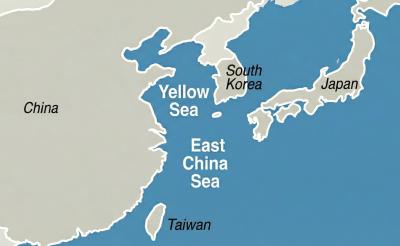
China has reserved offshore airspace in the Yellow Sea and East China Sea from March 27 to May 6, issuing alerts usually used to warn of military exercises, although no such exercises have been announced, the Wall Street Journal (WSJ) reported yesterday. Reserving such a large area for 40 days without explanation is an “unusual step,” as military exercises normally only last a few days, the paper said. These alerts, known as Notice to Air Missions (Notams), “are intended to inform pilots and aviation authorities of temporary airspace hazards or restrictions,” the article said. The airspace reserved in the alert is
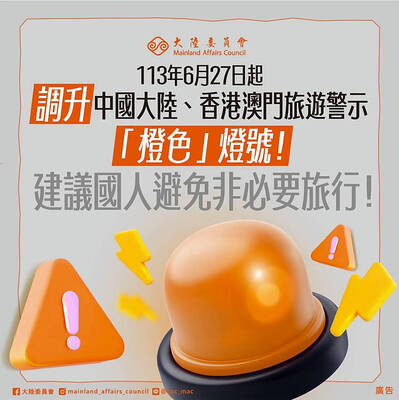
More than 6,000 Taiwanese students have participated in exchange programs in China over the past two years, despite the Mainland Affairs Council’s (MAC) “orange light” travel advisory, government records showed. The MAC’s publicly available registry showed that Taiwanese college and university students who went on exchange programs across the Strait numbered 3,592 and 2,966 people respectively. The National Immigration Agency data revealed that 2,296 and 2,551 Chinese students visited Taiwan for study in the same two years. A review of the Web sites of publicly-run universities and colleges showed that Taiwanese higher education institutions continued to recruit students for Chinese educational programs without

A bipartisan group of US senators has introduced a bill to enhance cooperation with Taiwan on drone development and to reduce reliance on supply chains linked to China. The proposed Blue Skies for Taiwan Act of 2026 was introduced by Republican US senators Ted Cruz and John Curtis, and Democratic US senators Jeff Merkley and Andy Kim. The legislation seeks to ease constraints on Taiwan-US cooperation in uncrewed aerial systems (UAS), including dependence on China-sourced components, limited access to capital and regulatory barriers under US export controls, a news release issued by Cruz on Wednesday said. The bill would establish a "Blue UAS
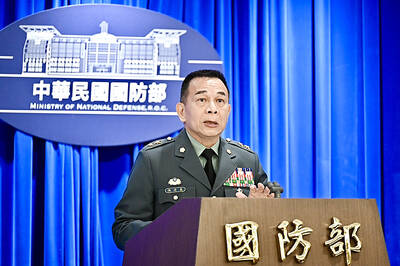
The Republic of China Army Command yesterday relieved Kinmen Defense Battalion commander after authorities indicted the officer on charges connected to using methamphetamine. The Kinmen District Prosecutors’ Office on Wednesday detained Colonel He (何) after the Coast Guard linked him to drug shipments and proceeded to charge him yesterday for using and possessing crystal meth. The man was released on a NT$50,000 bail and banned from leaving Kinmen, the office said. Army Chief of Staff Lieutenant General Chen Chien-yi (陳建義) told a news conference yesterday that He has been removed and another officer is taking over the unit as the acting commander. The military


 RSS
RSS