


Presidential Office Secretary-General Chiou I-jen (邱義仁) is often described as President Chen Shui-bian's (陳水扁) No. 1 counselor, while Chiou himself, referring to former legislator Chou Po-lun (周伯倫), says the cleverest man in the Democratic Progressive Party (DPP) is jailed in Hualien. Most DPP members, however, consider the cleverest politician with the fastest response to be Kaohsiung Mayor Frank Hsieh (謝長廷).
"Very often when others have thought things over once, Frank Hsieh has already thought things over three times," deceased former DPP legislator Lu Hsiu-yi (
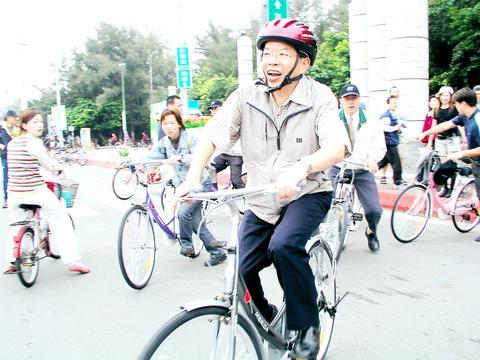
TAIPEI TIMES FILE PHOTO
Hsieh, 57, is often compared with the 53-year-old Chen. Both were both born to poor families. They were both hardworking students and passed the bar examination with the highest score among their competitors when they were only in their junior year.

TAIPEI TIMES FILE PHOTO
Both began their political careers with the Kaohsiung Incident in 1979 when they decided to defend the accused dissidents.
Strategist
"Looking back to their performances at that time, I feel that Chen Shui-bian focused on the details of the incident and related papers as evidence. It looked complicated and trivial, but it also showed Chen's sincerity and devotion," said former DPP chairman Shih Ming-teh (
"But Frank Hsieh adopted an attacking strategy. He revealed the prosecutors' flaws by playing on the prosecutors' responses and words and catching their contradictions. This shows that he indeed has a better grasp of a comprehensive strategy."
Early on in the two men's careers, political observers thought Hsieh would advance further than Chen because of Hsieh's tact and emphasis on building relationships and trust with other participants in the democratic movement.
They saw Chen as having a heroic air and basing his political ideology on justice and anti-corruption.
Based on that ideology, Chen would attack his own alliance or supporters if they were involved in illegal matters.
When non-Chinese Nationalist Party (KMT) democracy groups held an event called "Looking for a Leader" in 1985, over 60 leading figures of the democratic movement voted Hsieh to be their top leader and Chen their No. 2.
When Hsieh and Chen were running against each other for the Taipei mayoral nomination in 1994, each formed his own faction within the DPP.
Chen's Justice Alliance (正義連線) was seen as a single-person faction while Hsieh's Welfare State Alliance (福利國) consisted of elites from both northern and southern Taiwan.
"A strong A-bian [Chen] won support from the grassroots with his personal style, and a gentle Frank Hsieh had support from the party," said Chen Sung-shan (
"Finally A-bian, who looked for support from the people, won the nomination and became the DPP's candidate for Taipei mayor. Hsieh, who imitated the Japanese-style interaction among political factions, chose to become the executive director of A-bian's campaign and to try to go a step forward from there," Chen Sung-shan said.
Hsieh's political philosophy probably stems from his education background.
With a master's degree from Kyoto University in Japan, he stresses hierarchy and seniority in office, and treats well-educated people with respect. But he is also known to unconsciously show arrogance toward blue-collar workers.
community awareness
"Compared with the grassroots support and aggressive style of other DPP figures, Hsieh is one of the few among the elite who paid attention to culture, religion and recreation at an early stage," DPP Legislator Hung Chi-chang (
"Issues such as community awareness, Taiwan fellowship of destiny, a gentle party and the third way were all first proposed by Hsieh," Hung said.
The ability to see the big picture and present a vision shows that Hsieh can learn and adopt international perspectives and theories earlier than others. But because Hsieh is walking ahead of society, he becomes a target in political circles.
While Chen is following Taiwan's political development closely and gaining political clout, Hsieh is slowly losing his chips as he tries to secure top positions.
When Hsieh tried to win the nomination for vice president in 1996, friendly factions within the party split with him. When he tried to win the nomination for Kaohsiung mayor in 1998, he offended his friends within his own faction.
During the Kaohsiung mayoral race last year, Hsieh got little support from the party and fought battles with his own people.
With his record of cleaning up three major rivers and the start of MRT construction over the past three years as Kaohsiung mayor, he won votes from neutral voters and KMT supporters. He won a second term and is expected to aim for the presidency in 2008.
internationalized
"The mayor travels abroad four times a year because he is thinking about the future, trying to open more channels for Taiwan," said Albert Lin (林耀文), director-general of the Kaohsiung City Government's Department of Information.
Leading members of the KMT of the same generation appear to have placed a greater emphasis on international relations. Taipei Mayor Ma Ying-jeou (
Among the DPP's potential future leaders, however, only Hsieh is doing his homework about globalization and international relations. As his competitor Chen Shui-bian has already realized the dream of becoming president, in the post-A-bian era, Hsieh's tenacity and vision make him the one who is most likely to take over Chen.

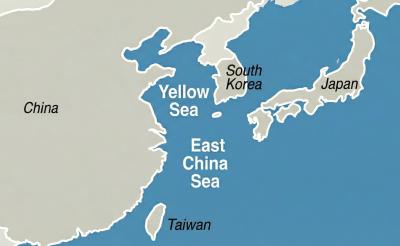
China has reserved offshore airspace in the Yellow Sea and East China Sea from March 27 to May 6, issuing alerts usually used to warn of military exercises, although no such exercises have been announced, the Wall Street Journal (WSJ) reported yesterday. Reserving such a large area for 40 days without explanation is an “unusual step,” as military exercises normally only last a few days, the paper said. These alerts, known as Notice to Air Missions (Notams), “are intended to inform pilots and aviation authorities of temporary airspace hazards or restrictions,” the article said. The airspace reserved in the alert is

South Korea is planning to revise its controversial electronic arrival card, a step Taiwanese officials said prompted them to hold off on planned retaliatory measures, a South Korean media report said yesterday. A Yonhap News Agency report said that the South Korean Ministry of Foreign Affairs is planning to remove the “previous departure place” and “next destination” fields from its e-arrival card system. The plan, reached after interagency consultations, is under review and aims to simplify entry procedures and align the electronic form with the paper version, a South Korean ministry official said. The fields — which appeared only on the electronic form
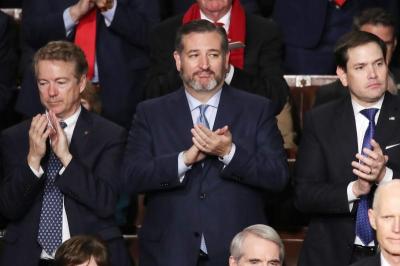
A bipartisan group of US senators has introduced a bill to enhance cooperation with Taiwan on drone development and to reduce reliance on supply chains linked to China. The proposed Blue Skies for Taiwan Act of 2026 was introduced by Republican US senators Ted Cruz and John Curtis, and Democratic US senators Jeff Merkley and Andy Kim. The legislation seeks to ease constraints on Taiwan-US cooperation in uncrewed aerial systems (UAS), including dependence on China-sourced components, limited access to capital and regulatory barriers under US export controls, a news release issued by Cruz on Wednesday said. The bill would establish a "Blue UAS

More than 6,000 Taiwanese students have participated in exchange programs in China over the past two years, despite the Mainland Affairs Council’s (MAC) “orange light” travel advisory, government records showed. The MAC’s publicly available registry showed that Taiwanese college and university students who went on exchange programs across the Strait numbered 3,592 and 2,966 people respectively. The National Immigration Agency data revealed that 2,296 and 2,551 Chinese students visited Taiwan for study in the same two years. A review of the Web sites of publicly-run universities and colleges showed that Taiwanese higher education institutions continued to recruit students for Chinese educational programs without


 RSS
RSS