


A festival atmosphere pervaded Wanchin Village (萬金村) in Pingtung on a sunny Dec. 7 as Wanchin Basilica (萬金聖母聖殿), Taiwan's oldest Catholic church, celebrated its 142nd anniversary with a grand mass.
With nearly 10,000 believers from across the country at the ceremony, local villagers set up food and grocery stalls alongside the narrow street leading to the old church.
Traffic police, rarely seen in the village situated at the foot of Tawu Mountain (大武山), had been directing cars and buses carrying pilgrims to appointed parking lots since early in the morning.
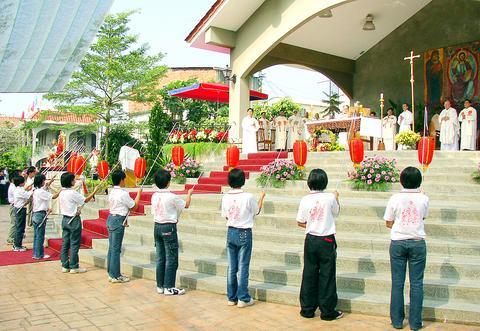
PHOTO: MELODY CHEN, TAIPEI TIMES
The mass started at 10am. A long line of people, each holding a rose, queued outside the church waiting to enter.
The basilica was built in the style of a Spanish fortress. A flower-decked statue of the Virgin Mary stood at the entrance of the church. People prayed to the statue, put roses at the feet of the statue and proceeded to the mass.
Some touched the statue's clothing and wept. Feng Chun-chin (馮春琴), 56, a Saisiyat Aboriginal woman, said she has attended the mass celebrating the church's founding every year.
"But this year we have fewer people here," said Feng, wearing traditional tribal clothing and a colorful headband. "I remember this place was packed with people for last year's mass."
The church building was too small to accommodate the huge congregation, so tarpaulins and thousands of stools were set up in the spacious garden behind the basilica for the service.
Tu Hsiu-ling (
While followers of Taoism and Buddhism number more than 8 million in Taiwan, only some 298,000 Taiwanese are Catholics, according to the latest statistics from the Government Information Office (GIO).
The number of Protestants in Taiwan is nearly double the Catholic population, standing at 593,000. In Taiwan, Protestantism and Catholicism ranked No. 4 and No. 5 in terms of religious populations, according to the GIO.
While major religions in the country have been expanding their influence through the media by launching TV channels, radio programs and newspapers, conservative Catholic congregations have been silently aging and struggling to retain young people.
The acute need for more clergymen is another problem facing the nation's Catholics, said Ching Mei-sheng (景美生), 32, who is of Han-Paiwan origin and serves as a church secretary in a village in Machia.
A priest from the Philippines has been tending the seven village churches in Machia. Ching said the priest, having learned the Paiwan dialect, can only preach in a single village church every Sunday.
"Therefore, the other six churches were left without a priest on most Sundays. They can only have our priest in turn, which means they hear him preach only every one or two months," Ching said.
Reverend Ruben Martinez, a Spaniard appointed as the 25th priest for Wanchin Basilica last year, recognized the shortage of Catholic clergymen in Taiwan, but stressed evangelization is a task that must be shared by all believers.
Martinez, like his 24 predecessors, speaks fluent Hoklo, commonly referred to as Taiwanese, but knows little Mandarin. All Wanchin residents, consisting primarily of the Pingpu people, or plain-dwelling tribes, speak Hoklo, Martinez said.
Coming to Taiwan 14 years ago, Martinez learned Hoklo in Kaohsiung and served in Tainan for eight years. He started working for the basilica four years ago.
"All services in our church, including mass and children's catechism classes, are conducted in Taiwanese [Hoklo]," Martinez said.
Outreach activities in Wanchin and neighboring villages are easier because Catholicism has a solid historical background in the area, he said.
Local Aboriginal people said that in the past food and household goods delivered by Catholic priests created a strong incentive for them to go to church and accept the faith.
Martinez said Catholic churches in the country, though lacking financial support, have always been thinking of how to reach more young people.
"We have to first find out what people of this generation need and provide help," he said.
Many people in modern society suffer family problems, Martinez said. "We will think about how to help these families."
Supporting the 80-year-old Cardinal Paul Shan (
A nun in her 60s who wanted to be known as Sister Yang said the traditional Catholic approaches to attract young people were time-consuming and ineffective.
Responsible for the outreach ministry of her church in Kaohsiung, Yang, who became a nun at the age of 20, said the church needs to lead the young generation in ways they can accept.
Born to a Catholic family, Yang said she started yearning for the life of a nun after reading the autobiography of Saint Teresa of Lisieux when she was a high school student.
As a young girl, Yang did not like to dress up or watch movies.
Yang said her difficult life as a nun has given her the patience and capacity to help others.
"My church also lacks young people and the congregation is aging," she said.
Nevertheless, she vowed to keep looking for ways to bring young people back to the Lord.

A magnitude 6.1 earthquake struck off the coast of Yilan County at 8:39pm tonight, the Central Weather Administration (CWA) said, with no immediate reports of damage or injuries. The epicenter was 38.7km east-northeast of Yilan County Hall at a focal depth of 98.3km, the CWA’s Seismological Center said. The quake’s maximum intensity, which gauges the actual physical effect of a seismic event, was a level 4 on Taiwan’s 7-tier intensity scale, the center said. That intensity level was recorded in Yilan County’s Nanao Township (南澳), Hsinchu County’s Guansi Township (關西), Nantou County’s Hehuanshan (合歡山) and Hualien County’s Yanliao (鹽寮). An intensity of 3 was
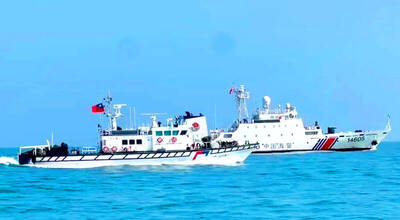
Instead of focusing solely on the threat of a full-scale military invasion, the US and its allies must prepare for a potential Chinese “quarantine” of Taiwan enforced through customs inspections, Stanford University Hoover fellow Eyck Freymann said in a Foreign Affairs article published on Wednesday. China could use various “gray zone” tactics in “reconfiguring the regional and ultimately the global economic order without a war,” said Freymann, who is also a nonresident research fellow at the US Naval War College. China might seize control of Taiwan’s links to the outside world by requiring all flights and ships entering or leaving Taiwan
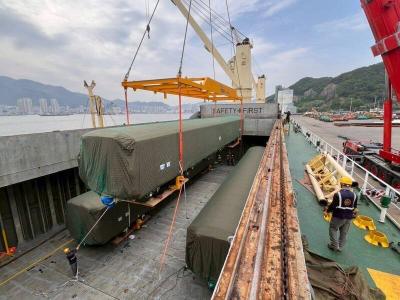
The first of 10 new high-capacity trains purchased from South Korea’s Hyundai Rotem arrived at the Port of Taipei yesterday to meet the demands of an expanding metro network, Taipei Rapid Transit Corp (TRTC) said yesterday. The train completed a three-day, 1,200km voyage from the Port of Masan in South Korea, the company said. Costing NT$590 million (US$18.79 million) each, the new six-carriage trains feature a redesigned interior based on "human-centric" transportation concepts, TRTC said. The design utilizes continuous longitudinal seating to widen the aisles and optimize passenger flow, while also upgrading passenger information displays and driving control systems for a more comfortable
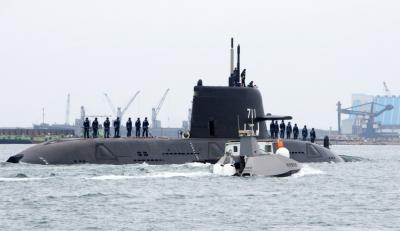
Taiwan's first indigenous defense submarine, the SS-711 Hai Kun (海鯤, or Narwhal), departed for its 13th sea trial at 7am today, marking its seventh submerged test, with delivery to the navy scheduled for July. The outing also marked its first sea deployment since President William Lai (賴清德) boarded the submarine for an inspection on March 19, drawing a crowd of military enthusiasts who gathered to show support. The submarine this morning departed port accompanied by CSBC Corp’s Endeavor Manta (奮進魔鬼魚號) uncrewed surface vessel and a navy M109 assault boat. Amid public interest in key milestones such as torpedo-launching operations and overnight submerged trials,


 RSS
RSS