


In his keynote speech at the opening session of a technology conference in Taipei yesterday, former US vice president Al Gore cited Taiwan's recent suspected cases of bank fraud to highlight the importance of vigilance and precautionary actions in today's "e-society."
"This [bank scam] would be solved, no doubt," said Gore, referring to the series of fraudulent cash withdrawals at automated teller machines [ATMs] around the nation starting Thursday, the beginning of a long weekend.
Costly scam
Finance Minister Lin Chuan (
"But it serves as an illustration of the need to have security in financial transactions and security in exchanges of information in order to protect the privacy of individuals and in order to protect the integrity of the business and financial system upon which we all depend," Gore told participants at the 37th International Carnahan Conference on Security and Technology.
Held at the Grand Hotel in Taipei, more than 400 specialists in security technology from 14 countries took part in the three-day conference. The theme of the conference is "e-security."
Noting that security questions will become tougher to deal with as e-society develops, Gore said, "It is yet one more reason why the deliberation of this ongoing conference is so important to the welfare and well-being of people in Taiwan, people in the United States and people all around the world."
Gore said that making good use of existing information is more important than collecting additional information about potential security threats.
Taking the attacks of Sept. 11, 2001, as an example, Gore said the tragedy could have been avoided if officials had taken precautionary measures to organize and analyze the information they already had about the hijackers. Gore said the authorities already had plenty of database information about the hijackers.
According to the event organizer, Gore, wishing to keep a low profile in Taiwan, had requested that his name not be mentioned on the conference's official schedule sent to the media.
Meeting with Chen
Prior to the opening session yesterday, Gore had exchanged a hand-shake and brief greetings with President Chen Shui-bian (陳水扁), who took the podium ahead of Gore as another keynote speaker at the event.
Gore's whirlwind trip was his first visit to Taiwan since he lost the presidential election in 2000.
Gore had planned to visit Taiwan in November 2001 to give a speech at the opening of the World Religion Museum, but the trip was canceled at the last minute following a warning by the US that terrorists might launch a wave of attacks.
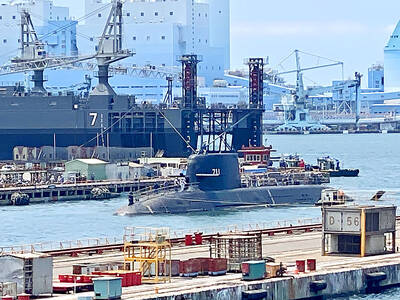
AGING: While Japan has 22 submarines, Taiwan only operates four, two of which were commissioned by the US in 1945 and 1946, and transferred to Taiwan in 1973 Taiwan would need at least 12 submarines to reach modern fleet capabilities, CSBC Corp, Taiwan chairman Chen Cheng-hung (陳政宏) said in an interview broadcast on Friday, citing a US assessment. CSBC is testing the nation’s first indigenous defense submarine, the Hai Kun (海鯤, Narwhal), which is scheduled to be delivered to the navy next month or in July. The Hai Kun has completed torpedo-firing tests and is scheduled to undergo overnight sea trials, Chen said on an SET TV military affairs program. Taiwan would require at least 12 submarines to establish a modern submarine force after assessing the nation’s operational environment and defense
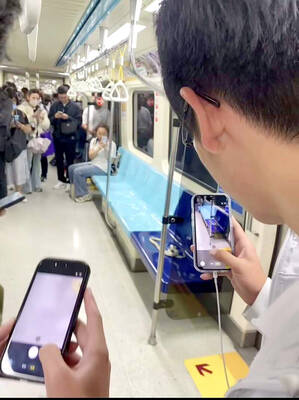
A white king snake that frightened passengers and caused a stir on a Taipei MRT train on Friday evening has been claimed by its owner, who would be fined, Taipei Rapid Transit Corp (TRTC) said yesterday. A person on Threads posted that he thought he was lucky to find an empty row of seats on Friday after boarding a train on the Bannan (Blue) Line, only to spot a white snake with black stripes after sitting down. Startled, he jumped up, he wrote, describing the encounter as “terrifying.” “Taipei’s rat control plan: Release snakes on the metro,” one person wrote in reply, referring
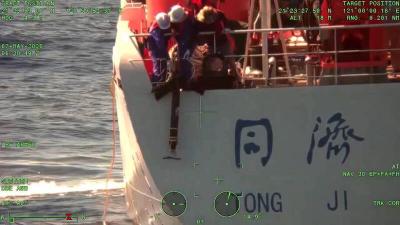
The coast guard today said that it had disrupted "illegal" operations by a Chinese research ship in waters close to the nation and driven it away, part of what Taipei sees a provocative pattern of China's stepped up maritime activities. The coast guard said that it on Thursday last week detected the Chinese ship Tongji (同濟號), which was commissioned only last year, 29 nautical miles (54km) southeast of the southern tip of Taiwan, although just outside restricted waters. The ship was observed lowering ropes into the water, suspected to be the deployment of scientific instruments for "illegal" survey operations, and the coast
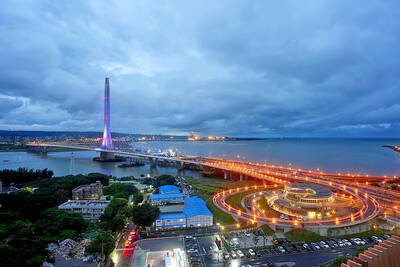
An inauguration ceremony was held yesterday for the Danjiang Bridge, the world’s longest single-mast asymmetric cable-stayed bridge, ahead of its official opening to traffic on Tuesday, marking a major milestone after nearly three decades of planning and construction. At the ceremony in New Taipei City attended by President William Lai (賴清德), Premier Cho Jung-tai (卓榮泰), Minister of Transportation and Communications Chen Shih-kai (陳世凱) and New Taipei City Mayor Hou Yu-ih (侯友宜), the bridge was hailed as both an engineering landmark and a long-awaited regional transport link connecting Tamsui (淡水) and Bali (八里)


 RSS
RSS