


Legal professionals monitoring the confirmation of 15 grand justice nominees breathed a sigh of relief that the process ended smoothly and without confrontation.
"The legislative performance in confirming the 15 grand justice nominees alleviated the anxiety generated by the lawmakers' annoying boycott last year of confirmation votes for Control Yuan members, a grand justice nominee and leaders of the Examination Yuan," said Ku Chung-hwa (
"Lawmakers, on average, acted moderately in wielding their legislative power to examine these nominees during the weeklong interpellation," Ku said after the confirmation vote concluded last night.
Ku's association, comprising six prominent legal, academic and women's rights groups, sent delegates to monitor each day of the legislative confirmation process.
The delegates observing the interpellation completed an assessment of the legislators based on the questions they asked.
People First Party (PFP) Legislator Shen Chih-hui (
Last Thursday, Shen asked 40 oversimplified true or false questions of six nominees, the association said in describing her performance as "low class."
Lee Yuan-deh (
"It is extremely dangerous to treat constitutional debates as a matter of yes or no," Lee said, adding that the oversimplification was helpful neither for judging the competence of the nominees nor examining potential Constitutional disputes.
Democratic Progressive Party (DPP) Legislator Cheng Kuei-lien (鄭貴蓮) was judged the second worst among the legislative inquisitors.
"Her interpellation centered on criticism of Hualien District Chief Prosecutor Yang Ta-chih (
The association regretted seeing Chinese Nationalist Party (KMT) Legislator Chiang Yi-wen's (
"It is improper to force the examinees to answer questions according to the lawmaker's personnel preferences," the assessment said.
Other lawmakers judged by the association as performing poorly were Lee Ching-hua (李慶華), Fu Kun-chi (傅崑萁), Chung Shao-ho (鍾紹和), Sheu Yuan-kuo (許淵國), Chao Liang-yen (趙良燕) and Liu Wen-hsiung (劉文雄) of the PFP, Chang Tsai-mei (張蔡美) and Hsu Shu-po (許舒博) of the KMT and Hou Shui-sheng (侯水盛) of the DPP.
"Even though Taiwan Solidarity Union Legislator Chen Chien-min (
The association said that DPP Legislator You Ching (
"You fully respected his examinees as he gave them enough time to respond to his questions," the association said.
You also performed excellently on choosing questions for individual nominees in accordance with their legal specialities, the assessment said.
Another DPP lawmaker, Chiu Tai-san (邱太三), was graded as second best. DPP legislators Parris Chang (張旭成), Lin Yu-sheng (林育生), Jao Yung-ching (趙永清) and Lai Chin-lin (賴勁麟) were also rated in the top 10.
Cho Po-yuan (卓伯源) was the only KMT legislator deemed by the association members as doing a professional job during the interpellation. The association also praised PFP lawmakers Lin Te-fu (林德福) and Hwang Yih-jiau (黃義交) for asking high-quality questions.
Two independent lawmakers, Su Yin-kuei (蘇盈貴) and Cheng Yu-cheng (鄭余鎮), were endorsed by the association for their preparation.
DPP Legislator Lin Yu-sheng (林育生), who ranked sixth, said he appreciated the assessment. He said he was convinced that lawmakers will perform better in future confirmation tasks after furthering legislative reforms such as modifying electoral rules.
"But I regret that the grand justice nominees bypassed questions involving politically sensitive issues. Some of these questions are not really controversial topics and, as their duty is to judge legal controversies, they should fulfill the role in explaining to the public about what is right and true," Lin said.
The evaluation summarized that lawmakers on average maintained a rational attitude in examining the nominees.
"But it is arguable that the legislators still brought too many trifling issues and political battles into the weeklong interpellation of the grand justice nominees," it concluded.

NATIONAL SECURITY: Authorities are working to confirm the identities of the military personnel involved and investigating possible illegal conduct and regulatory violations Authorities are probing possible national security implications after Kinmen police and immigration officers on Sunday found a Chinese woman allegedly posing as a tourist while engaging in prostitution involving more than 10 military personnel. The woman, surnamed Chen (陳), has since been deported, authorities said, adding that investigators are still working to confirm the identities of those implicated, as the records only listed code names and aliases. The case stemmed from a report received by the Kinmen District Prosecutors’ Office on Friday last week from the Jinhu Precinct of the Kinmen County Police Bureau. On Sunday, police, along with the National Immigration

GLOBALGIVING: ‘ Caving to external pressure is not acceptable for an organization that has cultivated justice reform and human rights for 30 years,’ one NGO said A slew of non-government organizations (NGOs) have withdrawn from the GlobalGiving fundraising platform after it announced it would use “Chinese Taipei” instead of “Taiwan” from next month. The Taiwan Good Rice Association wrote on Facebook on Friday that it was informed on April 28 via a teleconference call of the change, which was made because the platform wanted to operate in China. Taiwan Good Rice is to terminate all cooperative relationships with GlobalGiving in response to the platform’s “unilateral and non-negotiable” decision to remove references to Taiwan, the NGO said. “Taiwan is in the official name of Taiwan Good Rice Association and the

HEAVY WEATHER: Typhoon Jangmi is due to crash straight into the Ryukyus as airlines look to shift flights to larger aircraft or cancel flights to Okinawa entirely Taiwan’s international air carriers announced flight adjustments over the weekend as Typhoon Jangmi is forecast to hit the Ryukyu Islands today and tomorrow. The Central Weather Administration (CWA) upgraded Jangmi from a tropical storm to a typhoon at 8am yesterday, with the eye located 580km south of Naha city. It was moving north at 19kph. Today, China Airlines’ CI-120, CI-121, CI-122 and CI-123 flights between Taoyuan and Naha, Okinawa, have been canceled as well as CI-132 and CI-133 between Kaohsiung and Naha. EVA Air’s BR-112, BR-113, BR-186 and BR-185 flights between Taoyuan and Naha are also canceled. Low-cost carrier Tigerair Taiwan canceled IT-230,
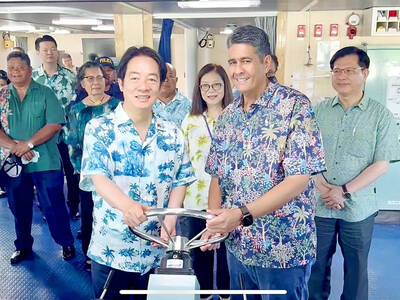
MULTIPRONGED APPROACH: China has sought to pressure Palau across a number of fronts, but the island nation has staunchly resisted overtures to ditch Taiwan Palau has been firm in backing Taiwan despite Chinese pressure that uses tourism economics, cyberattacks and criminal infiltration as tools to threaten the Pacific ally into renouncing its recognition of Taiwan as a sovereign state. The Presidential Office yesterday announced that Vice President Hsiao Bi-khim (蕭美琴) would visit Palau from Saturday to Wednesday next week at the invitation of Palauan President Surangel Whipps Jr. Whipps in April said in an interview that China had outspokenly asked Palau to “denounce Taiwan.” “And we have said: ‘We have no enemies, but nobody tells us who our friends are,’” he said. Whipps has told reporters multiple times


 RSS
RSS