


It tops the list of the nation's most instantly recognizable songs, but starting next month Mariden's Prayer will have company.
The Environmental Protection Agency (EPA) has signed up Any Empty Bottles for Sale? (
In addition, a rock version of the 20-year-old local favorite, arranged by Harlem Yu (庾澄慶), will be played at hundreds of fast-food chain stores across the country starting from next Tuesday.
The two artists agreed to allow the EPA to use their work for free.
"It's my pleasure to do so," Hou said yesterday at a press conference organized by the EPA. "The level of civilization in a country can partly be judged by reviewing its achievements in environmental protection."
In 1983, Hou married a segment of a Taiwanese slogan commonly used by recycling service peddlers to a major pentatonic scale, the basic scale of Chinese music. The song turned out to be one of Hou's best-loved pieces. Over the past two decades, the song has been translated into a number of different languages, including French and Japanese.
EPA Administrator Hau Lung-bin (
Hau said the rock arrangement will be played at 600 fast-food chain stores, where more trash cans will be installed for customers to recycle leftovers and paper containers.
Hau said the 400 million customers visiting fast-food chain stores annually were the target of the EPA's environmental education program.
"The six-month trial will be an ideal model of the cooperation between the government, the industry and the public to practice recycling on a daily basis," Hau said.
Hau said the recycling push is part of a follow-up to the EPA's policy of limiting the use of plastic bags and disposable dinning tableware.
Beginning Jan. 1 next year, officials said, the trial will become a compulsory regulation for all fast-food chain stores.
According to Chen Hsiung-wen (
"Paper tableware will be sent to paper factories for pulping and leftovers will be used to produce fertilizers or pig feed," Chen said.
Officials said yesterday that this year the EPA is aiming to increase low recycling rates of used batteries, fluorescent lamps and paper tableware.
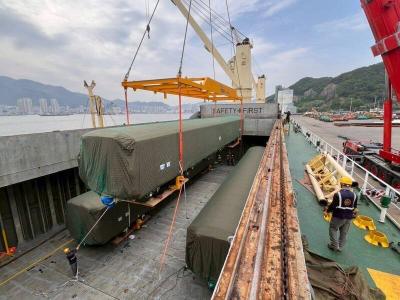
The first of 10 new high-capacity trains purchased from South Korea’s Hyundai Rotem arrived at the Port of Taipei yesterday to meet the demands of an expanding metro network, Taipei Rapid Transit Corp (TRTC) said yesterday. The train completed a three-day, 1,200km voyage from the Port of Masan in South Korea, the company said. Costing NT$590 million (US$18.79 million) each, the new six-carriage trains feature a redesigned interior based on "human-centric" transportation concepts, TRTC said. The design utilizes continuous longitudinal seating to widen the aisles and optimize passenger flow, while also upgrading passenger information displays and driving control systems for a more comfortable
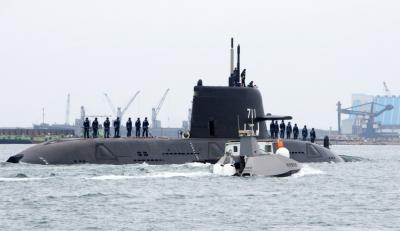
Taiwan's first indigenous defense submarine, the SS-711 Hai Kun (海鯤, or Narwhal), departed for its 13th sea trial at 7am today, marking its seventh submerged test, with delivery to the navy scheduled for July. The outing also marked its first sea deployment since President William Lai (賴清德) boarded the submarine for an inspection on March 19, drawing a crowd of military enthusiasts who gathered to show support. The submarine this morning departed port accompanied by CSBC Corp’s Endeavor Manta (奮進魔鬼魚號) uncrewed surface vessel and a navy M109 assault boat. Amid public interest in key milestones such as torpedo-launching operations and overnight submerged trials,
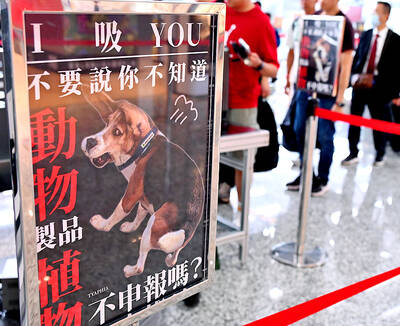
Quarantine awareness posters at Taiwan Taoyuan International Airport have gone viral for their use of wordplay. Issued by the airport branch of the Animal and Plant Health Inspection Agency, the posters feature sniffer dogs making a range of facial expressions, paired with advisory messages built around homophones. “We update the messages for holidays and campaign needs, periodically refreshing materials to attract people’s attention,” quarantine officials said. “The aim is to use the dogs’ appeal to draw focus to quarantine regulations.” A Japanese traveler visiting Taiwan has posted a photo on X of a poster showing a quarantine dog with a

SECURITY RISK: A university student sent a general alarm signal to THSRC’s control center on April 5, causing four operating trains to temporarily halt services The Ministry of Transportation and Communications yesterday pledged to submit a report on ways to harden the communication security of railway systems after a university student hacked into Taiwan High Speed Rail Corp’s (THSRC) radio communications system and disrupted operations of four high-speed rail trains last month. Investigation by the police and prosecutors found that the university student and radio enthusiast, surnamed Lin (林), first used a software-defined radio (SDR) filter to analyze THSRC signals, downloaded the data to a computer, cracked the parameters and then programmed the codes into his radio devices. Lin then sent a general alarm signal to


 RSS
RSS