


Taiwan's "freeters" are a happy species of working-class representing a new employment ecology, but are they happy about their future? Not necessarily.
"Freeter," a term coined by the Japanese by combining the English word "free" and the German word Arbeiter, is defined as "people with college diplomas who engage in menial employment." They seek a free lifestyle and consider leading a carefree life to be more important than their careers.
According to a recent survey in Japan, the number of freeters aged between 15 and 34 there now accounts for about one-fifth of the population in this age group, or roughly 4 million.
In Taiwan, more young men and women are less likely to become freeters through choice, as there are simply fewer jobs for them upon graduation.
"I could not find a work last summer after graduation and could not find any this year either, as the number of my competitors in the job market increased, " said Huang Chang-hui, a teacher at a community after-class center.
Helping grade schoolers with their homework, earning NT$4,800 a month, Huang said she lives with her parents and uses her income as an allowance.
Huang said she is not a happy freeter.
Abon, who runs the Red Potato Studio in Hualien, worked as a freelancer after graduation, writing Haklo-dialect novels and strip cartoons and designing T-shirts.
Although he was happy with his work and free lifestyle, Abon did not fare very well financially. He quit the freelancer career a year and a half later and turned to a regular job as a messenger/driver for a cargo company.
Abon said, however, that he will resume his freeter status when he has saved enough money to live on for one year.
"My key goal is that I realize my ideals when I'm still young," Abon said.
Japanese socio-economists have warned that freeters are a hidden worry in Japanese society as they will have difficulty finding a decent job when they pass 30 and become a burden on Japanese society when they become old and have no savings or relatives to depend on.

INCREASED CAPACITY: The flights on Mondays, Wednesdays, Fridays and Sundays would leave Singapore in the morning and Taipei in the afternoon Singapore Airlines is adding four supplementary flights to Taipei per week until May to meet increased tourist and business travel demand, the carrier said on Friday. The addition would raise the number of weekly flights it operates to Taipei to 18, Singapore Airlines Taiwan general manager Timothy Ouyang (歐陽漢源) said. The airline has recorded a steady rise in tourist and business travel to and from Taipei, and aims to provide more flexible travel arrangements for passengers, said Ouyang, who assumed the post in July last year. From now until Saturday next week, four additional flights would depart from Singapore on Monday, Wednesday, Friday
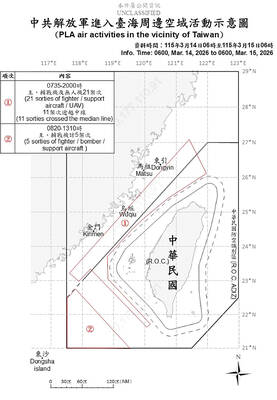
The Ministry of National Defense yesterday reported the return of large-scale Chinese air force activities after their unexplained absence for more than two weeks, which had prompted speculation regarding Beijing’s motives. China usually sends fighter jets, drones and other military aircraft around the nation on a daily basis. Interruptions to such routine are generally caused by bad weather. The Ministry of National Defense said it had detected 26 Chinese military aircraft in the Taiwan Strait over the previous 24 hours. It last reported that many aircraft on Feb. 25, when it spotted 30 aircraft, saying Beijing was carrying out another “joint combat

Taiwan successfully defended its women’s 540 kilogram title and won its first-ever men’s 640 kg title at the 2026 World Indoor Tug of War Championships in Taipei yesterday. In the women’s event, Taiwan’s eight-person squad reached the final following a round-robin preliminary round and semifinals featuring teams from Ukraine, Japan, Thailand, Vietnam, the Basque Country and South Korea. In the finals, they swept the Basque team 2-0, giving the team composed mainly of National Taiwan Normal University students and graduates its second championship in a row, and its fourth in five years. Team captain
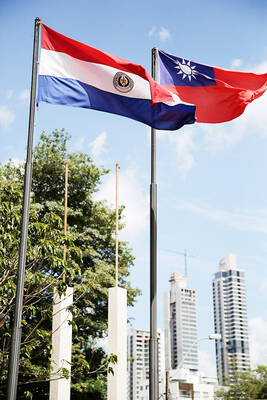
When Paraguayan opposition lawmaker Leidy Galeano returned from an all-expenses-paid tour of six Chinese cities late last year, she was convinced Paraguay risked missing out on major economic gains by sticking with longtime ally Taipei over Beijing — a message that participants on the trip heard repeatedly from Chinese officials. “Everything I saw there, I wanted for my country,” said Galeano, a member of the newly-formed Yo Creo party whose senior figures have spoken favorably about China. This trip and others like it — which people familiar with the visits said were at the invitation of the Chinese consulate in Sao Paulo


 RSS
RSS