


Taiwan reiterated its regret that the World Health Organization (WHO) misunderstood the country's handling of the SARS epidemic, urging it to remove Taiwan from its travel warning advisory list sooner rather than later.
"We have done better a job than some other countries. However, we have been asked to meet a much stricter standard," Department of Health (DOH) Director-General Chen Chien-jen (陳建仁) said at a news conference yesterday.
"We are not weak. Taiwan has been `quarantined' from the WHO for 20 years and [our health-care system] has grown to become a model," he said.
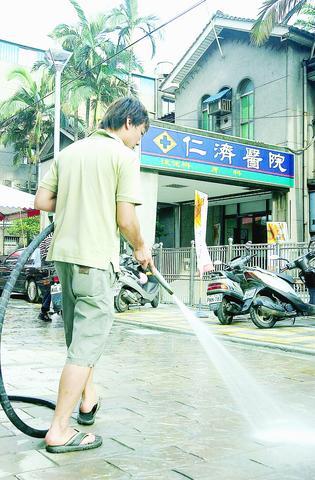
PHOTO: SEAN CHAO, TAIPEI TIMES
Chen said Taiwan has furnished the WHO with more information about the country's SARS situation in the hope that the world health watchdog lift its warning against non-essential travel to the country.
The WHO rejected Taiwan's previous application for removal from its travel advisory list. It asked the country to check whether the six suspected SARS cases reported in the US, South Korea, the Philippines, Malaysia, Germany and Brazil between March and early June were acquired in Taiwan.
"We have toiled to collect sufficient data to prove that Taiwan has not exported any SARS cases," Chen said, adding that all six probable cases the WHO was investigating as coming from Taiwan tested negative for SARS.
Chen said Taiwan will not be daunted by the setback and will even redouble efforts to meet the WHO's relatively stringent requirements for removal from its travel advisory list, even though the nation has been kept from participation in the world health body.
Moreover, Chen said, Taiwan must remain on the alert against the possibility of SARS-positive individuals entering the country and starting a new line of transmission.
Saying that an 82-year-old veteran showed SARS-like symptoms after returning from a visit to the central Chinese province of Hunan earlier this week, Chen stressed that it is important to keep certain quarantine measures for incoming passengers.
He used the example to imply that the WHO may wish to consider looking into whether the disease has spread to other regions of China.
Meanwhile, Chen also said that Taiwan's four representatives, who have been invited by the WHO to attend an international seminar on SARS, will participate in the activity as representatives of a state.
"Su Yi-jen (蘇益仁), director-general of the Center for Disease Control (CDC) under the DOH was addressed with his formal, official title in the WHO invitation to the seminar to be held in Kuala Lumpur, Malaysia from June 17 to 18," Chen said.
Chen said the WHO has also invited three Taiwan scholars -- Chen Pei-che (陳培哲), director of the Hepatitis Research Center of National Taiwan University Hospital (NTUH), Chang Shang-chun (張上淳), director of the Infectious Disease Department at NTUH, and Ho Mei-shang (何美鄉), an associate research fellow of the Institute of Biomedical Sciences of Academia Sinica -- to attend the seminar.
According to DOH officials, the WHO will make special arrangements to let Su and other Taiwan participants discuss SARS issues with delegates from other countries.
The Taiwan delegates will leave for Kuala Lumpur on Sunday and are scheduled to return next Thursday.
As to the latest development of the government's efforts to control the spread of SARS, another medical professional yesterday succumbed to the illness.
Tsai Chiao-miao (
Later she was transferred to Chang Gung Memorial Hospital at Linkou (
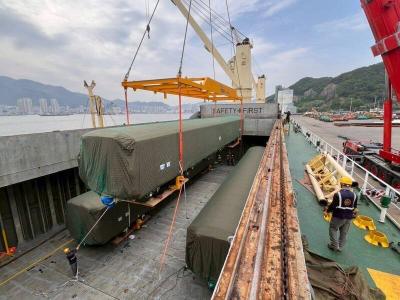
The first of 10 new high-capacity trains purchased from South Korea’s Hyundai Rotem arrived at the Port of Taipei yesterday to meet the demands of an expanding metro network, Taipei Rapid Transit Corp (TRTC) said yesterday. The train completed a three-day, 1,200km voyage from the Port of Masan in South Korea, the company said. Costing NT$590 million (US$18.79 million) each, the new six-carriage trains feature a redesigned interior based on "human-centric" transportation concepts, TRTC said. The design utilizes continuous longitudinal seating to widen the aisles and optimize passenger flow, while also upgrading passenger information displays and driving control systems for a more comfortable
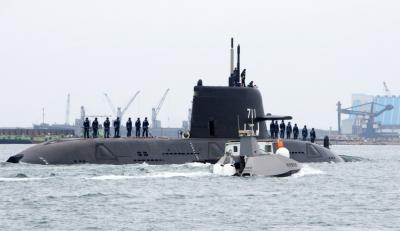
Taiwan's first indigenous defense submarine, the SS-711 Hai Kun (海鯤, or Narwhal), departed for its 13th sea trial at 7am today, marking its seventh submerged test, with delivery to the navy scheduled for July. The outing also marked its first sea deployment since President William Lai (賴清德) boarded the submarine for an inspection on March 19, drawing a crowd of military enthusiasts who gathered to show support. The submarine this morning departed port accompanied by CSBC Corp’s Endeavor Manta (奮進魔鬼魚號) uncrewed surface vessel and a navy M109 assault boat. Amid public interest in key milestones such as torpedo-launching operations and overnight submerged trials,
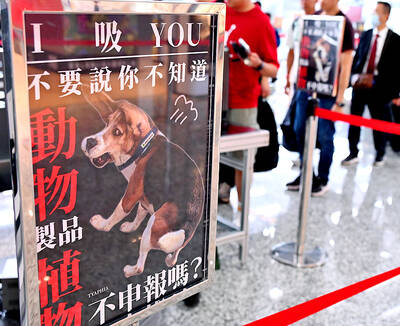
Quarantine awareness posters at Taiwan Taoyuan International Airport have gone viral for their use of wordplay. Issued by the airport branch of the Animal and Plant Health Inspection Agency, the posters feature sniffer dogs making a range of facial expressions, paired with advisory messages built around homophones. “We update the messages for holidays and campaign needs, periodically refreshing materials to attract people’s attention,” quarantine officials said. “The aim is to use the dogs’ appeal to draw focus to quarantine regulations.” A Japanese traveler visiting Taiwan has posted a photo on X of a poster showing a quarantine dog with a

Taiwan’s coffee community has launched a “one-person-one-e-mail” campaign, calling for people to send a protest-e-mail to the World Coffee Championships (WCC) urging it to redesignate Taiwanese competitors as from “Taiwan,” rather than “Chinese Taipei.” The call followed sudden action last week after the WCC changed all references to Taiwanese competitors from “Taiwan” to “Chinese Taipei,” including recent World Latte Art champion Bala (林紹興), who won the World Latte Art Championship in San Diego earlier this month. When Bala received the trophy, he was referred to as representing Taiwan, as well as in the announcement on the WCC’s Web site, until it


 RSS
RSS