


Former superintendent of Taipei's Veterans General Hospital Chang Mau-song (張茂松), who enjoys a close relationship with former president Lee Teng-hui (李登輝), recently hit the headlines after he became the target of corruption allegations.
Chang, a famous cardiologist with a good reputation throughout the country, was born on Jan. 12, 1942. After graduating from the National Defense Medical Center in 1967, he joined the Veterans General Hospital in 1972.
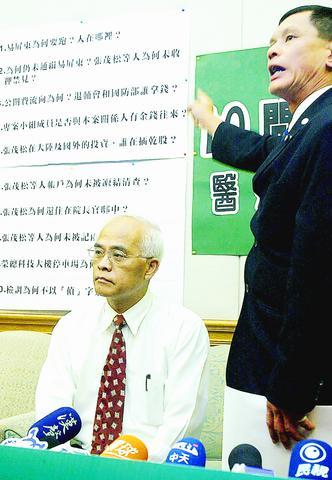
PHOTO: SEAN CHAO, TAIPEI TIMES
Eight years later, Chang became the director of the hospital's Department of Heart Functions and an assistant professor at National Yang-Ming University's Medical School.
In 1982, he was promoted to chief cardiologist of the department of cardiology at the hospital's Taichung branch. In the meantime, he married Chou Jo-hua (周若華), the daughter of Chou Chi-hsun (周濟勳) who was then superintendent of the Veterans General Hospital.
Two years later, he was again promoted and transferred back to Taipei as the hospital's chief cardiologist. In 1989, he became a professor at Yang-Ming University's Medical School. In 1994, he was promoted to director of the medical school.
In 1995, Chang was again promoted and he became the deputy superintendent of the Taipei Veterans General Hospital this time.
In 1997, he became the dean of Yang-Ming University's Medical School and only a year after that, Chang took over the superintendent's office at the Veterans General Hospital and the vice president's office at the National Yang-Ming University.
When Chang became superintendent, he also became one of former president Lee Teng-hui's most-trusted medical doctors and often provided consultant services to Lee.
After Lee retired in 2000, he and his wife Tseng Wen-hui (曾文惠) still visited Chang regularly at the hospital for regular health check-ups.
Chang well-served the former first family and Lee once said, "Chang did take good care of me and my wife."
Recently, however Chang has found himself the target of some fierce criticism.
On April 23, DPP legislators Lee Chen-nan (李鎮楠) and Charles Chiang (江昭儀) first made their accusation against Chang at a press conference.
According to the lawmakers, Chang was the only person at the hospital to have access to a secret NT$300 million fund called the "Jung-kwang Fund."
Lee and Chiang said that as a superintendent of the hospital, Chang was responsible for explaining what was happening with the fund, something the lawmakers claimed he had failed to do. In addition, Lee and Chiang said, Chang had a duty to determine whether the fund was illegal.
The DPP lawmakers also accused Chang of accepting bribes from medical equipment and drug manufacturers, while also claiming Chang hired a friend to handle the money for him.
According to Lee and Chiang, the hospital's chief accountant Yi Ping-tung (易屏東) -- recently promoted to the position of chief secretary and personal aide to Chang -- was the person taking care of the bribe money for Chang.
Chang resigned his post as the superintendent of the hospital on the same day as the press conference. His position was taken over by Deputy Superintendent L Liang-shong (
The Shihlin District Prosecu-tors' Office also decided on the same day to begin an investigation into the corruption accusations under Prosecutor Chou Miao-jan's (卓繆然) command.
In addition to the NT$300-million fund, Chang is also under suspicion of laundering another NT$3.6 billion and depositing the money into bank accounts in the US.
The Shihlin District Court immediately approved Chou's request to ban Chang and Yi from traveling outside the country on April 23. However, by that time Yi had already fled to China.
Prosecutors have not yet filed a request to detain Chang, much to the annoyance of Lee and Chiang.
Lee and Chiang held another press conference at the Legislative Yuan yesterday morning and said that the Cabinet's Vocational Assistance Commission for Retired Servicemen, the Ministry of National Defense and prosecutors owed the public a clear explanation over the investigation.
"Obviously, Yi fled on purpose. Why haven't prosecutors issued a warrant for his arrest?" Lee said.
Lee said that both the commission and defense ministry are close to the hospital and it is impossible that none of the officials at these two government offices know nothing about Chang's alleged embezzlement.
In addition, the retired serviceman commission is the superior government office of the hospital. "Why did it approve Chang's resignation without any hesitation? After all, Chang is a famous cardiologist with a good reputation. It is not logical, is it?" Lee said.

NATIONAL SECURITY: Authorities are working to confirm the identities of the military personnel involved and investigating possible illegal conduct and regulatory violations Authorities are probing possible national security implications after Kinmen police and immigration officers on Sunday found a Chinese woman allegedly posing as a tourist while engaging in prostitution involving more than 10 military personnel. The woman, surnamed Chen (陳), has since been deported, authorities said, adding that investigators are still working to confirm the identities of those implicated, as the records only listed code names and aliases. The case stemmed from a report received by the Kinmen District Prosecutors’ Office on Friday last week from the Jinhu Precinct of the Kinmen County Police Bureau. On Sunday, police, along with the National Immigration

GLOBALGIVING: ‘ Caving to external pressure is not acceptable for an organization that has cultivated justice reform and human rights for 30 years,’ one NGO said A slew of non-government organizations (NGOs) have withdrawn from the GlobalGiving fundraising platform after it announced it would use “Chinese Taipei” instead of “Taiwan” from next month. The Taiwan Good Rice Association wrote on Facebook on Friday that it was informed on April 28 via a teleconference call of the change, which was made because the platform wanted to operate in China. Taiwan Good Rice is to terminate all cooperative relationships with GlobalGiving in response to the platform’s “unilateral and non-negotiable” decision to remove references to Taiwan, the NGO said. “Taiwan is in the official name of Taiwan Good Rice Association and the

HEAVY WEATHER: Typhoon Jangmi is due to crash straight into the Ryukyus as airlines look to shift flights to larger aircraft or cancel flights to Okinawa entirely Taiwan’s international air carriers announced flight adjustments over the weekend as Typhoon Jangmi is forecast to hit the Ryukyu Islands today and tomorrow. The Central Weather Administration (CWA) upgraded Jangmi from a tropical storm to a typhoon at 8am yesterday, with the eye located 580km south of Naha city. It was moving north at 19kph. Today, China Airlines’ CI-120, CI-121, CI-122 and CI-123 flights between Taoyuan and Naha, Okinawa, have been canceled as well as CI-132 and CI-133 between Kaohsiung and Naha. EVA Air’s BR-112, BR-113, BR-186 and BR-185 flights between Taoyuan and Naha are also canceled. Low-cost carrier Tigerair Taiwan canceled IT-230,
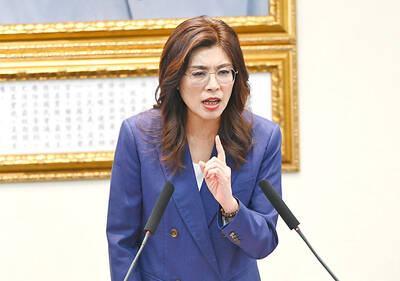
Chinese Nationalist Party (KMT) Chairwoman Cheng Li-wun (鄭麗文) yesterday briefed her party’s Central Standing Committee regarding her scheduled visit to the US between Monday next week and June 16, saying that her purpose would be to persuade the US that the Republic of China (ROC) Constitution was a “one China” constitution that would foster stable and peaceful cross-strait relations. The ROC Constitution is the most important defense for all Taiwanese citizens, as it upholds our democracy and has contributed to our robust economy, which aligns with international and US interests, she said. “We would not be troublemakers and drag the US under,”


 RSS
RSS