


■ Environment
Cyanide spill sickens scores
More than 100 people in Taichung County have been hospitalized after being poisoned by liquefied cyanide from an overturned truck, police said yesterday. Environmental officials feared the cyanide, which flowed into a nearby sewer, could create an ecological disaster when it streams into the sea through Taichung Harbor. Police said the accident took place Thursday afternoon after the truck got a flat tire and crashed. "The rear tire of the truck came off in front of the intersection of Lihai Road in Wuchi and overturned when the driver stepped on the brake," a police officer said. He said the tank holding 35 tonnes of liquefied cyanide came off from the truck and spilled all over the road. Doctors said nearby residents began to feel sick Thursday night and by yesterday morning more than 100 people had been hospitalized after breathing in air containing poisonous particles.
■ Crime
Bleaching bandit guilty
A Cameroonian, Mbwemo Franco, was found guilty of fraud and sentenced to eight months in prison by the Taipei District Court, local media reported yesterday. Police said that Franco told a hotel owner, surnamed Cheng, that he was capable of bleaching black paper into US dollar bills. The Cameroonian then cheated Cheng of his money, claiming that he needed US$13,000 (about NT$452,500) to purchase special bleach in order to turn the paper into money for him. Cheng later changed his mind and called the police instead. Franco was arrested on the spot when he collected the money from the hotel owner. The Cameroonian will be deported from Taiwan after his sentence is completed.
■ Education
Fewer students going to US
The number of students pursuing education in the US hit a 10-year low last year at 13,767, a 7 percent decrease from the the 2001 level, according to statistics compiled by the Ministry of Education. Ministry statistics show that the number of students acquiring US study visas was 14,878 in 2001, also a decline from the 2000 level of 15,547. The noticeable falls might have something to do with the Sept. 11 terrorist attacks on the US, while the war in Iraq might have caused the situation to deteriorate further, ministry officials said. After the outbreak of the war, the Ministry asked Taipei Economic and Cultural Offices across the US to inform Taiwan's students there, or those who are planning to go there, of the heightened security alert. The situation might also be the result of a shift in interest among students to Australia, Britain, Canada and New Zealand.
■ Health
Tonnes of biowaste lost
KMT Legislator Hsu Chung-hsiung (徐中雄) urged the government yesterday to step up measures to track medical waste, particularly in light of the severe acute respiratory disease (SARS) outbreak. Hsu made the remarks in a press conference held at the Legislative Yuan. Hsu said that the Department of Health has estimated that about 14,834 tonness of contagious medical waste was produced last year, but the Environmental Protection Administration could only account for 9,221 tonnes of it and therefore lost track of 40 percent of the total. However, Hsu said that academic circles and the private sector have estimated that the missing medical waste could reach as high as 9072 tonnes.

The Ministry of Finance this afternoon announced the winning numbers for the March-April uniform invoice lottery. The winning number for the NT$10 million (US$318,060) special prize is 19531471, and the winning number for the NT$2 million grand prize is 85941329. Three numbers were drawn for the NT$200,000 first prize: 07225810, 20231230 and 83518781. Those with receipts matching the last seven digits of any of the first-prize numbers will win the NT$40,000 second prize, while those matching the last six digits will win the NT$10,000 third prize. Those whose receipts match the last five digits of the first-prize numbers can claim the NT$4,000 fourth prize,

SIX SUBSIDIES: The monthly allowance for older farmers is to increase to NT$10,000, and NT$5,000 is to be given to homemakers under the national pension system, Lai said The government is to implement major welfare policies for disadvantaged groups, including raising the monthly allowance for older farmers to NT$10,000 and providing homemakers with NT$5,000 per month, President William Lai (賴清德) said yesterday. Lai made the remarks during a visit to Wangling Temple in Chiayi County, saying that the planned increases were being introduced amid economic growth and an increase in tax revenue. Touting a policy, in which the government plans to provide a monthly allowance of NT$5,000 for every child under the age of 18 in a bid to address Taiwan’s low birthrate, Lai said that if received for the
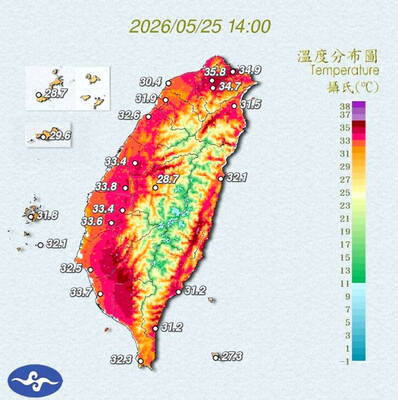
STAY COOL: The HPA recommended that people stay hydrated, use air-conditioning or fans while indoors, wear loose-fitting clothes and walk in the shade while outdoors Employers must implement measures such as installing cooling equipment, and providing drinking water and rest breaks for outdoor workers starting from Monday next week, the Taipei Department of Labor said on Sunday. Employers who fail to comply could face fines of NT$30,000 to NT$300,000 under the Occupational Safety and Health Act (職業安全衛生法), the department said. Businesses in Taipei employing fewer than 100 workers, as well as registered self-employed workers with labor insurance coverage, could receive on-site assessments and guidance from occupational safety consultants to help them apply for central government subsidies to implement or improve heat-protection measures, it said. Under the Ministry of

NATIONAL SECURITY: Authorities are working to confirm the identities of the military personnel involved and investigating possible illegal conduct and regulatory violations Authorities are probing possible national security implications after Kinmen police and immigration officers on Sunday found a Chinese woman allegedly posing as a tourist while engaging in prostitution involving more than 10 military personnel. The woman, surnamed Chen (陳), has since been deported, authorities said, adding that investigators are still working to confirm the identities of those implicated, as the records only listed code names and aliases. The case stemmed from a report received by the Kinmen District Prosecutors’ Office on Friday last week from the Jinhu Precinct of the Kinmen County Police Bureau. On Sunday, police, along with the National Immigration


 RSS
RSS