


Newly appointed Cabinet spokesman Lin Chia-lung (
Describing Lin as a "handsome and photogenic" young man, Premier Yu Shyi-kun said that Lin is qualified for the job because of his impressive educational and political background.
Lin, 38, holds a doctorate in politics from Yale University. He also obtained masters degrees in politics and philosophy from Yale.
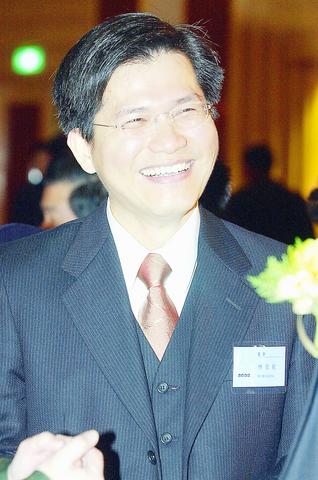
TAIPEI TIMES FILE PHOTO
He has been teaching politics at National Chung Cheng University since he returned to Taiwan from the US in 1998. He was appointed senior adviser to the National Security Council in May 2000 when the DPP came into to power.
Director-General of the Government Information Office Arthur Iap (葉國興), who was assigned by the premier to screen potential candidates for the position, praised Lin as someone who is composed and possesses great interpersonal skills.
"He's one of the few candidates who met the four criteria set down by the premier," he said.
The four criteria are: impressive educational background, extensive experience in the civil sector, familiarity with the media and a calm demeanor.
In addition to his good looks and impressive educational background, Lin is known for his negotiating skills and eloquence.
As a leader of the student movement during his university years, Lin was under surveillance and banned from taking leave during his two-year compulsory military service between 1988 and 1990.
He was able to persuade his supervisor to let him take a few days off to participate in a student demonstration taking place at the Chiang Kai-shek Memorial Hall in 1989.
He also played a significant role in persuading Academia Sinica President Lee Yuan-tseh (
As a Nobel laureate in science, Lee was capable of tipping the scales in the presidential election. Although Lee eventually turned down Chen's offer to assume the post of premier, Lee did help garner support from undecided voters.
DPP Legislator Lee Wen-chung (
"A perfect example is the establishment of the Taiwan Thinktank," Lee said. "I remember when he was at school, he was a member of the school's China Study Association. In addition to keeping close contact with association members while he was in school, he got them together after graduation and after they had returned to Taiwan. That's how the Taiwan Thinktank came about."
Established in December 2001, the Taiwan Thinktank is regarded as an influential resource for Chen's administration. Lin also chairs the think tank's Asia Pacific Forum, which holds irregular closed-door meetings to solicit opinions from academics and politicians.
Lee went to the same university as Lin and chaired the China Study Association. He was expelled by the school three times because of his pro-independence views. He was eventually kicked out in 1986 when Lin began his studies at the same school.
Chung Cha-pin (
"He's a smart, low-key and careful person who doesn't easily make his stance known until the very last minute," he said.
Chung went to the same university and joined the same school association with Lin when Lin was the association chair. Chung was also Lin's assistant when Lin was senior adviser to the National Security Council.
According to Chung, Lin knew exactly what he wanted to do when he was a university student -- that is, go to graduate school and become an academic.
His dream came true when he was admitted to the graduate school of National Taiwan University in 1986 to pursue studies in political science. He went on to pursue another master's degree in philosophy at Yale University in 1992 and in political science at Yale in 1993.
He returned to Taiwan in 1998 after obtaining his doctorate in political science from Yale.
According to Chung, Lin's sophistication and extensive political connections have a lot to do with his becoming chairman of the school's China Study Association and a student of Hu Fu (
"In the 1980s, the association was considered a pro-unification group because it received funding from the KMT and association members could get access to the ruling party's high-ranking officials and sensitive government information," Chung said.
As the chairman of the highly political association, Chung said, Lin was walking a fine line between keeping the party funding coming in and embracing left-wing thinking.
"He had to be very careful and skillful in terms of mingling with the school and pro-independence student groups," Chung said.
Despite the potential headaches, school authorities were fond of Lin because he was a brilliant young man and did well at school.
"The association is a rebellious group," Chung said.
Thanks to Hu's extensive academic and political connections, Lin got to know many outstanding academics including Mainland Affairs Council Vice Chairman Chen Ming-tong (
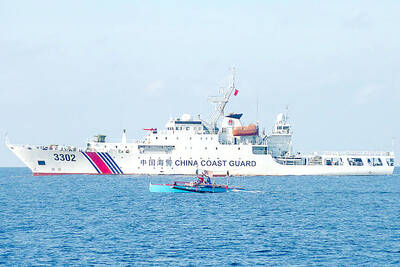
EXPANSIONIST: China deploys an average of 40 to 50 warships and coast guard vessels daily in the South China Sea, despite pledges not to militarize the region, an official said China is attempting to expand its influence across the First Island Chain and increase pressure on Japan by sending coast guard vessels into waters off of Taiwan under the pretext of maritime negotiations with Japan and the Philippines, a national security official said yesterday. China’s recent actions in the waters east of Taiwan and Japan and the Philippines’ exclusive economic zones (EEZ) are attempts to establish dominance in First Island Chain waters, said the official who declined to be named, adding that this is “expansion disguised as law enforcement.” Framing China’s actions solely as a cross-strait issue is a serious misjudgment that
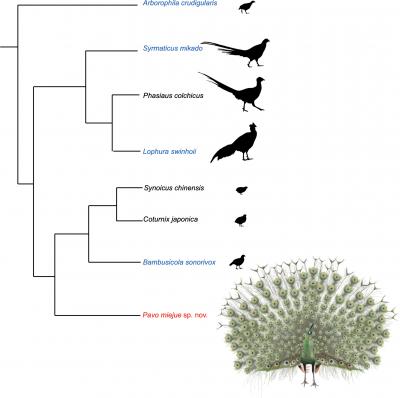
Through analyzing fossil evidence, a research team at National Taiwan University (NTU) discovered the largest endemic bird to have lived in Taiwan, naming it Pavo miejue, or extinct peafowl (滅絕孔雀). The Mikado pheasant, which is printed on the back of the NT$1,000 bank note, was previously believed to be the biggest endemic bird to Taiwan. The research team’s findings suggest that Pavo miejue lived during the Pleistocene epoch tens of thousands of years ago. It is the first endemic extinct bird species discovered and formally named in Taiwan. The study was coauthored by NTU Institute of Ecology and Evolutionary Biology professor Tsai Cheng-hsiu (蔡政修),
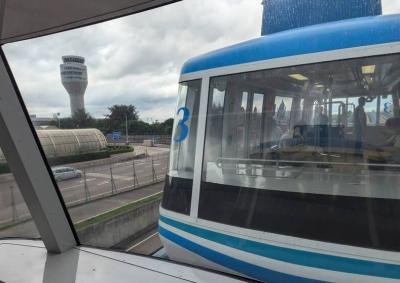
Taiwan Taoyuan International Airport is to suspend its automated Skytrain service connecting Terminal 1 and Terminal 2 starting on July 1 to facilitate connection works for the upcoming Terminal 3, the airport operator said today. Passengers and staff who need to travel between the two terminals after the suspension can instead use the Taoyuan MRT or the airport's 24-hour shuttle bus service, Taoyuan International Airport Corp said. The Taoyuan MRT Airport Line directly links the two terminals, while the shuttle buses are to operate around the clock, the company added. The Skytrain provides free transportation between the airport’s two terminals for travelers and
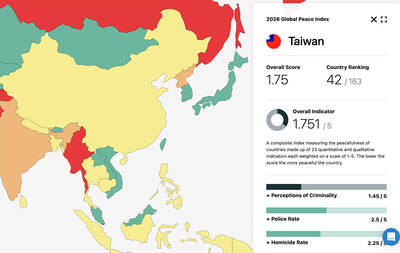
Taiwan ranked 42nd in terms of peacefulness among 163 countries, down five places from last year, according to this year’s Global Peace Index. With an overall score of 1.751, Taiwan dropped from 37th last year, the report published by the global Institute for Economics and Peace showed. The overall score measures a country’s level of peacefulness using 23 quantitative and qualitative indicators across three domains — ongoing domestic and international conflict, societal safety and security, and militarization. While Taiwan ranked 42nd worldwide, it was listed in ninth place among the 19 Asian-Pacific countries in the report, after New Zealand, Singapore, Japan, Malaysia,


 RSS
RSS