


Taipei City's Bureau of Cultural Affairs yesterday launched a series of memorial activities for the annual commemoration of the 228 Incident, including a 228 Film Festival featuring movies depicting the relationships between local Taiwanese people and Chinese mainlanders.
This year's film festival, titled "From Confrontation to Integration" will display six movies made between 1950 and 2000 that track the development of Taiwan society in and around the time of the 228 Incident.
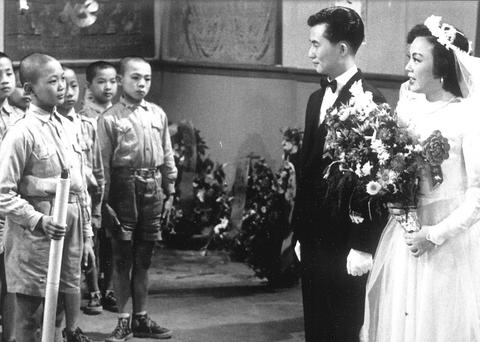
PHOTO COURTESY OF THEBUREAU OF CULTURAL AFFAIRS
The 228 Incident refers to a brutal military crackdown in 1947 on civilians protesting the corrupt administration of Chen Yi (陳儀), a Chiang Kai-shek (蔣介石) appointed governor sent to assist in the rebuilding of Taiwan after World War II.
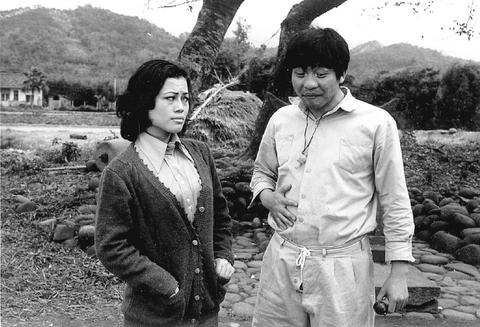
PHOTO COURTESY OF THE BUREAU OF CULTURAL AFFAIRS
Taipei City Deputy Mayor Pai Hsiu-hsiung (白秀雄), also the acting chief of the cultural affairs bureau, yesterday said, "It is important that we remember the pain of the tragedies, but it is more important that we learn to move forward."
Writer Bo Yang (柏楊), a mainlander who fled with the Nationalist troops in 1949 to Taiwan and later became a political dissident during the White Terror era of the KMT administration, yesterday said as someone from the Chinese mainland, he felt extremely sorry for the Taiwanese victims persecuted in the 228 Incident.
"When the 228 Incident broke out, I was still in Shenyang City [in northeastern China]," Bo said. "I remember a local magazine report that said the Americans were being kind to the Japanese because they only dropped two atomic bombs on Japan. The Taiwanese, on the other hand, were more misfortunate; they were given a KMT government."
However, Bo added, "After more than half a century it is time to forget the hate and embrace harmony."
"Marriages between Taiwanese and mainlanders are common in society now. If love can help people bridge their differences, why can't hatred be forgiven," Bo said.
Veteran filmmakers Lee Hsing (李行), Lin Fu-di (林福地), Tseng Chung-ying (曾仲影), Hsin Chi (辛奇) and veteran photographer Lin Tsan-ting (林贊庭) also took part in the press conference and discussed the images of the conflicts and ethnic integration illuminated in their early works that showed Taiwanese society living under the yoke of authoritarian rule.
Lee Hsin, who came to Taiwan with the KMT government in 1949, said, "During the past 50 years, I have dedicated my film-making career to matters concerning Taiwan, and many of them are about the interaction between the local Taiwanese and mainlanders."
"The lives of Taiwanese and mainlanders are so intertwined that we must not aggravate the division between them, but should seek harmony and tolerance in order to strive for the prosperity of Taiwan," Lee said.
Lin Fu-di, who was born in Taiwan during the Japanese colonization and was in hiding at the time of the 228 Incident, said, "The 228 Incident happened because the Taiwanese people could not accept the reality that the so-called mother country was corrupt and impoverished."
"It was a historical tragedy. Both Taiwanese and mainlanders were killed during the unrest," Lin said.
"We must move forward instead of lamenting the past," Lin said.
The six films to be exhibited in the 228 Film Festival include Making Peace Between Families, Descendants of the Yellow Emperor, March of Happiness, Love Song in the Tea Field, Our Neighbors and Sweet Home.
The films, all featuring environments and situations in which conflict occurred constantly between local Taiwanese and mainlanders, depict the process of how those conflicts were smoothed out and agreements reached.
The films will run at the Taipei 228 Memorial Museum starting every Friday and Saturday at 7pm from Feb. 28 to March 15. On Feb. 27, there will a memorial concert held at the museum in the evening. First lady Wu Shu-chen (

NATIONAL SECURITY: Authorities are working to confirm the identities of the military personnel involved and investigating possible illegal conduct and regulatory violations Authorities are probing possible national security implications after Kinmen police and immigration officers on Sunday found a Chinese woman allegedly posing as a tourist while engaging in prostitution involving more than 10 military personnel. The woman, surnamed Chen (陳), has since been deported, authorities said, adding that investigators are still working to confirm the identities of those implicated, as the records only listed code names and aliases. The case stemmed from a report received by the Kinmen District Prosecutors’ Office on Friday last week from the Jinhu Precinct of the Kinmen County Police Bureau. On Sunday, police, along with the National Immigration

GLOBALGIVING: ‘ Caving to external pressure is not acceptable for an organization that has cultivated justice reform and human rights for 30 years,’ one NGO said A slew of non-government organizations (NGOs) have withdrawn from the GlobalGiving fundraising platform after it announced it would use “Chinese Taipei” instead of “Taiwan” from next month. The Taiwan Good Rice Association wrote on Facebook on Friday that it was informed on April 28 via a teleconference call of the change, which was made because the platform wanted to operate in China. Taiwan Good Rice is to terminate all cooperative relationships with GlobalGiving in response to the platform’s “unilateral and non-negotiable” decision to remove references to Taiwan, the NGO said. “Taiwan is in the official name of Taiwan Good Rice Association and the

HEAVY WEATHER: Typhoon Jangmi is due to crash straight into the Ryukyus as airlines look to shift flights to larger aircraft or cancel flights to Okinawa entirely Taiwan’s international air carriers announced flight adjustments over the weekend as Typhoon Jangmi is forecast to hit the Ryukyu Islands today and tomorrow. The Central Weather Administration (CWA) upgraded Jangmi from a tropical storm to a typhoon at 8am yesterday, with the eye located 580km south of Naha city. It was moving north at 19kph. Today, China Airlines’ CI-120, CI-121, CI-122 and CI-123 flights between Taoyuan and Naha, Okinawa, have been canceled as well as CI-132 and CI-133 between Kaohsiung and Naha. EVA Air’s BR-112, BR-113, BR-186 and BR-185 flights between Taoyuan and Naha are also canceled. Low-cost carrier Tigerair Taiwan canceled IT-230,
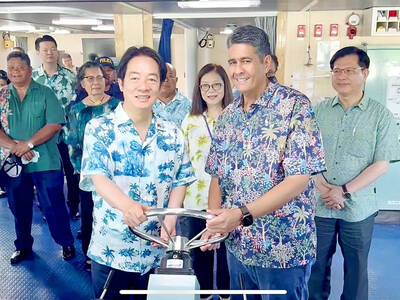
MULTIPRONGED APPROACH: China has sought to pressure Palau across a number of fronts, but the island nation has staunchly resisted overtures to ditch Taiwan Palau has been firm in backing Taiwan despite Chinese pressure that uses tourism economics, cyberattacks and criminal infiltration as tools to threaten the Pacific ally into renouncing its recognition of Taiwan as a sovereign state. The Presidential Office yesterday announced that Vice President Hsiao Bi-khim (蕭美琴) would visit Palau from Saturday to Wednesday next week at the invitation of Palauan President Surangel Whipps Jr. Whipps in April said in an interview that China had outspokenly asked Palau to “denounce Taiwan.” “And we have said: ‘We have no enemies, but nobody tells us who our friends are,’” he said. Whipps has told reporters multiple times


 RSS
RSS