


The navy's plan to build a mini-AEGIS ship -- which has been shelved for eight years -- is likely to be resumed if local shipbuilders prove they can handle the task, defense sources have said.
The mini-AEGIS building plan, known in the navy as the Advanced Combat System (ACS) project, would not, however, be the same plan as that initially drafted in the late 1980s, if it were to be revived.
The state-run China Shipbuilding Corp, which was the navy's only choice for the building of the mini-AEGIS before the project was put on hold, now has to start from scratch and prove to the navy that it can build such a ship.
The ACS project was stopped in 1994 when Admiral Nelson Ku (顧崇廉) was the commander-in-chief of the navy. Ku has retired from the navy and is now a lawmaker with the PFP.
Ku is generally believed to have played a key role in the shelving of the ACS project, which led him to become the target for criticism every time the ACS issue was brought up.
But former defense minister Wu Shih-wen (世文), who followed in Ku's footsteps to take charge of the navy, hinted in an interview published in the latest issue of the Defence International magazine that his role in the matter might have been no less significant. Wu was the deputy chief of the general staff while Ku was the navy chief.
Regardless of who was responsible for holding up the ACS project, many naval officials share the same view that the navy missed a good chance to own an indigenously-built advanced fighting ship before 2000.
According to the initial plan, the mini-AEGIS would have been built in 50 months. If construction had started in 1994, it could have become operational before 2000.
The ACS project was originally drafted by a group of highly-educated naval officials led by the late Captain Yin Ching-feng (尹清風).
Yin, who was then head of the research and development department at navy general headquarters, was in charge of the case from the beginning.
He completed the draft of the project before he was transferred to lead the weaponry procurement office of the navy general headquarters.
Yin was murdered in late 1993, but the navy was ready by then to start construction of the mini-AEGIS on the basis of the Chenkung-class frigate that China Shipbuilding had built for it.
The plan at the time was to lengthen the hull of the Chenkung-class frigate by 50m so that the ship would have enough room for more weapon systems and larger equipment.
The hardware recommended for installation in the mini-AEGIS included: A smaller version of the SPY-1 phased array radar, a five-inch gun, a vertical launch system for the Standard SM-II missile or the locally-developed TC-II missile, a Harpoon anti-ship missile and a towed sonar.
The list might have to be changed if the ACS is revived since the design is over 10 years old.
* The mini-AEGIS building plan is known as the Advanced Combat System project.
* China Shipbuilding Corp was chosen to build the ship.
* The ACS project was halted in 1994.
Source: Taipei Times
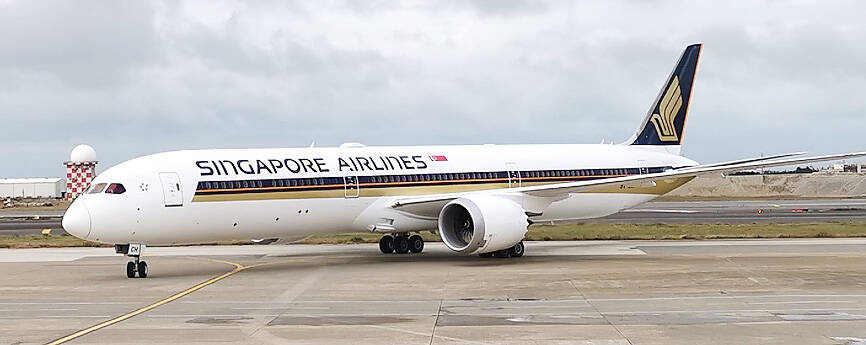
INCREASED CAPACITY: The flights on Mondays, Wednesdays, Fridays and Sundays would leave Singapore in the morning and Taipei in the afternoon Singapore Airlines is adding four supplementary flights to Taipei per week until May to meet increased tourist and business travel demand, the carrier said on Friday. The addition would raise the number of weekly flights it operates to Taipei to 18, Singapore Airlines Taiwan general manager Timothy Ouyang (歐陽漢源) said. The airline has recorded a steady rise in tourist and business travel to and from Taipei, and aims to provide more flexible travel arrangements for passengers, said Ouyang, who assumed the post in July last year. From now until Saturday next week, four additional flights would depart from Singapore on Monday, Wednesday, Friday

Taiwan’s three major international carriers are increasing booking fees, with EVA Airways having already increased the charge to US$28 per flight segment from US$25, while China Airlines (CAL) and Starlux Airlines are set to follow suit. Booking fees are charged by airlines through a global distribution system (GDS) and passed on to passengers. Carriers that apply the fees include CAL, EVA, Starlux and Tigerair Taiwan. A GDS is a computerized network operated by a company that connects airlines with travel agents and ticketing platforms, allowing reservations to be made and processed in real time. Major players include Amadeus, Sabre and Travelport. EVA Air began
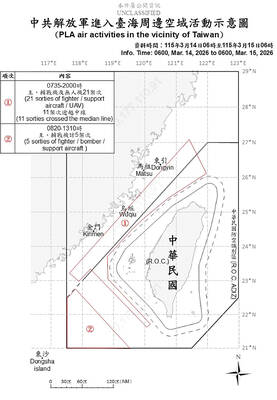
The Ministry of National Defense yesterday reported the return of large-scale Chinese air force activities after their unexplained absence for more than two weeks, which had prompted speculation regarding Beijing’s motives. China usually sends fighter jets, drones and other military aircraft around the nation on a daily basis. Interruptions to such routine are generally caused by bad weather. The Ministry of National Defense said it had detected 26 Chinese military aircraft in the Taiwan Strait over the previous 24 hours. It last reported that many aircraft on Feb. 25, when it spotted 30 aircraft, saying Beijing was carrying out another “joint combat

When Paraguayan opposition lawmaker Leidy Galeano returned from an all-expenses-paid tour of six Chinese cities late last year, she was convinced Paraguay risked missing out on major economic gains by sticking with longtime ally Taipei over Beijing — a message that participants on the trip heard repeatedly from Chinese officials. “Everything I saw there, I wanted for my country,” said Galeano, a member of the newly-formed Yo Creo party whose senior figures have spoken favorably about China. This trip and others like it — which people familiar with the visits said were at the invitation of the Chinese consulate in Sao Paulo


 RSS
RSS