


Vice President Annette Lu (呂秀蓮) yesterday criticized Premier Yu Shyi-kun for what she said was his lack of ability and courage in failing to take the responsibility for the grassroots financial reform mess.
Lu said Yu's mishandling of the affair has resulted in President Chen Shui-bian (陳水扁) becoming the scapegoat for the policy failure.
"The man with power just hid behind and left the responsibility for the blame on the man who does not have the power," Lu said.
She made the remarks while receiving a delegation of certified accountants from Taiwan and the US at the Presidential Office yesterday morning.
Yu submitted his resignation to Chen last Friday, vowing to shoulder the responsibility for the grassroots financial reforms.
Chen visited Yu's residence Saturday night to persuade the premier to stay on the job to accomplish those reforms.
Although Chen expressed gratitude to Yu after the premier retracted his resignation on Sunday, Lu condemned Yu for what she said was his incompetence which had led to the president becoming the target of public criticism.
Lu said that the huge demonstration by farmers and fishermen in Taipei last Saturday had actually lost its focus and was a result of malicious political mobilization.
"Most of those farmers and fishermen do not oppose the government's plan to reorganize the credit departments of the farmers' and fishermen's associations, but they just took on the streets to urge the government to protect their rights in face of Taiwan's entry into the World Trade Organization," Lu said.
"But a handful of members, who control the credit departments and created the non-performing loan problems, manipulated those innocent people into boycotting the government's financial reforms," she said.
Lu said that the Executive Yuan had failed to properly evaluate the situation and ease grassroots-level anger.
Therefore, she said, Chen had no choice but to jump to the forefront to solve the crisis.
"Farmers and fishermen insisted on joining the protest because they are worried about their livelihoods," Lu said.
"If the Executive Yuan had properly communicated with the heads of local governments in dealing with these issues, the situation would not have gone so far."
"The media always blames the president for his policymaking. However, people should understand who is actually in charge of the Cabinet, including the Council of Agriculture," she said.
"The president finally stood on the front line because he could not allow the situation to worsen," she said.
Commenting on the search for new chiefs for the Council of Agriculture and Ministry of Finance, Lu urged the public to recommend the best candidates to Yu. She also urged Yu to recruit real talent instead of acquaintances.
"We can't accept the nomination of a Hakka as the head of the council just because the outgoing chairman is a Hakka," she said.
Lu said the next council chief should not only have expertise in agricultural economics but also have experience in international marketing .
Reacting to Lu's criticism, Yu told reporters he would "accept criticism from anyone" and would respect Lu's suggestions about the new Cabinet members.
"No one should blame the wrong person," the premier said. "The Executive Yuan should assume full responsibility."
"I also expect the media to give me more time to look for suitable candidates," he said.
Yu made the comments after a meeting of the DPP's Central Standing Committee. Yu told reporters that he and Chen had agreed that professional capabilities should be the prime factor in choosing Cabinet candidates.
(with additional reporting by staff reporter Lin Mei-chun)
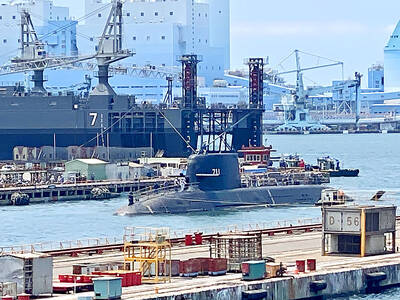
AGING: While Japan has 22 submarines, Taiwan only operates four, two of which were commissioned by the US in 1945 and 1946, and transferred to Taiwan in 1973 Taiwan would need at least 12 submarines to reach modern fleet capabilities, CSBC Corp, Taiwan chairman Chen Cheng-hung (陳政宏) said in an interview broadcast on Friday, citing a US assessment. CSBC is testing the nation’s first indigenous defense submarine, the Hai Kun (海鯤, Narwhal), which is scheduled to be delivered to the navy next month or in July. The Hai Kun has completed torpedo-firing tests and is scheduled to undergo overnight sea trials, Chen said on an SET TV military affairs program. Taiwan would require at least 12 submarines to establish a modern submarine force after assessing the nation’s operational environment and defense

Yangmingshan National Park authorities yesterday urged visitors to respect public spaces and obey the law after a couple was caught on a camera livestream having sex at the park’s Qingtiangang (擎天崗) earlier in the day. The Shilin Police Precinct in Taipei said it has identified a suspect and his vehicle registration number, and would summon him for questioning. The case would be handled in accordance with public indecency charges, it added. The couple entered the park at about 11pm on Thursday and began fooling around by 1am yesterday, the police said, adding that the two were unaware of the park’s all-day live
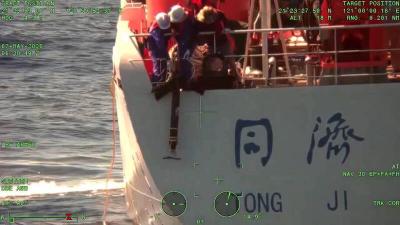
The coast guard today said that it had disrupted "illegal" operations by a Chinese research ship in waters close to the nation and driven it away, part of what Taipei sees a provocative pattern of China's stepped up maritime activities. The coast guard said that it on Thursday last week detected the Chinese ship Tongji (同濟號), which was commissioned only last year, 29 nautical miles (54km) southeast of the southern tip of Taiwan, although just outside restricted waters. The ship was observed lowering ropes into the water, suspected to be the deployment of scientific instruments for "illegal" survey operations, and the coast

A former soldier and an active-duty army officer were yesterday indicted for allegedly selling classified military training materials to a Chinese intelligence operative for a total of NT$79,440. The Taipei District Prosecutors’ Office indicted Chen Tai-yin (陳泰尹) and Lee Chun-ta (李俊達) for contravening the National Security Act (國家安全法) and the Anti-Corruption Act (貪污治罪條例). Chen left the military in September 2013 after serving alongside then-staff sergeant Lee, now an army lieutenant, at the 21st Artillery Command of the army’s Sixth Corps from 2011 to 2013, according to the indictment. Chen met a Chinese intelligence operative identified as “Wang” (王) through a friend in November


 RSS
RSS