


The summer lull in the partisan fighting over various policy issues will soon come to an end as lawmakers started signing up for the new session yesterday.
The TSU, the tiny ally of the DPP, demanded that Minister of Finance Lee Yung-san (
Meanwhile, the KMT called on the Cabinet to voluntarily take back next year's budget, which it said is full of deceiving figures meant to hide the nation's financial troubles.
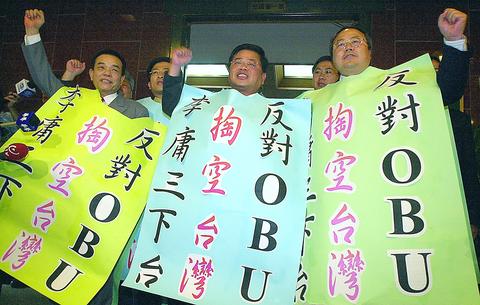
PHOTO: LIAO RAY-SHIAN, TAIPEI TIMES
Jumping on the bandwagon, the PFP vowed to give the administration a rough ride when the budgetary review begins later this month.
During a collective registration, legislators from the TSU said they oppose offshore banking unit (OBU) operations proposed by the finance ministry to help local investors conduct business in China.
"Oppose OBU! Down with Lee Yung-san," they chanted.
Earlier, the Ministry of Finance indicated it is mulling introducing the OBU mechanism in line with a consensus reached by last year's Economic Development Advisory Conference.
But TSU legislative leader Su Ying-kwei (
"Such a practice, if allowed, would encourage investors to migrate to China and leave their debts in Taiwan," Su said.
Fellow TSU Legislator Liao Pen-yan (
Chen Chien-ming (
Because an executive order would suffice to carry out the OBU plan, the fledgling party threatened to sap the ministry's power through legal revisions, if necessary.
In addition, the 12-member caucus said it would continue pushing for a referendum law that allows the people to have the final say on major policy disputes, political and economic.
The KMT, on the other hand, accused the DPP administration of manipulating the figures when preparing next year's budget and urged the Cabinet to withdraw the plan on its own accord.
According to KMT Legislator Wang Chun-yu (
KMT Legislator Cheng Feng-shih (
"The government must quit playing Santa Claus at the [expense of the] nation's financial health," he said.
Recently, the Cabinet said it would extend the senior-citizen stipend to retired workers with money earmarked for the national pension program.
The KMT, though supportive of expanding the NT$3,000-per-month allowance to more groups, frowns on the proposal to borrow money from the national pension fund.
The PFP said it would play the bad cop during the budgetary review in light of the low efficiency with which the government executed last year's budget. PFP legislative leader Shen Chih-hwei (沈智慧) cited official statistics that show various government agencies failed to carry out their spending programs for last year.
She noted that during the fiscal period, the reserve capital for the Ministry of Transportation and Communications was NT$38.5 billion.
The Ministry of Economic Affairs and the Council of Agriculture trailed in second and third with NT$9.6 billion and NT$5.5 billion, respectively, the lawmaker said.

UPGRADE: The Kang Ding-class frigate is replacing its Chaparall missiles with Tien Chien II and Hua Yang VLS, which would provide it with long-range, 360° air defense Taiwan plans to produce 1,200 to 1,376 Hai Chien II missiles (海劍二, Sea Sword II) — also known as TC-2N — to serve as the standard air defense system of the navy’s surface combatant fleet, a source said yesterday. Last week, the Hai Chien II, the naval version of the Tien Kung II missile (天劍二, Sky Sword II), completed a live-fire test in waters off the National Chungshan Institute of Science and Technology’s Jiupeng facility (九鵬) in Pingtung County’s Manjhou Township (滿州). The MIM72 Chaparral and other dated air defense missiles that currently arm Taiwanese ships have inadequate range to combat Chinese

REASONS FOR TRAVEL: An assistant professor said that proposed amendments to penalize drivers if they used drugs overseas would not deter people from traveling People who operate a motor vehicle under the influence of marijuana would have their driver’s license revoked, even if they used the substance while overseas, the Ministry of Transportation and Communications said yesterday, citing proposed amendments to the Road Traffic Management and Penalty Act (道路交通管理處罰條例). The amendments would also authorize the government to revoke the licenses of people determined to have used Category 1 or Category 2 narcotics, even if they were not operating a vehicle while under the influence of drugs, as well as ban them from taking the license test for three years, the ministry said. People aged 18 or

HEAVY WEATHER: Typhoon Jangmi is due to crash straight into the Ryukyus as airlines look to shift flights to larger aircraft or cancel flights to Okinawa entirely Taiwan’s international air carriers announced flight adjustments over the weekend as Typhoon Jangmi is forecast to hit the Ryukyu Islands today and tomorrow. The Central Weather Administration (CWA) upgraded Jangmi from a tropical storm to a typhoon at 8am yesterday, with the eye located 580km south of Naha city. It was moving north at 19kph. Today, China Airlines’ CI-120, CI-121, CI-122 and CI-123 flights between Taoyuan and Naha, Okinawa, have been canceled as well as CI-132 and CI-133 between Kaohsiung and Naha. EVA Air’s BR-112, BR-113, BR-186 and BR-185 flights between Taoyuan and Naha are also canceled. Low-cost carrier Tigerair Taiwan canceled IT-230,
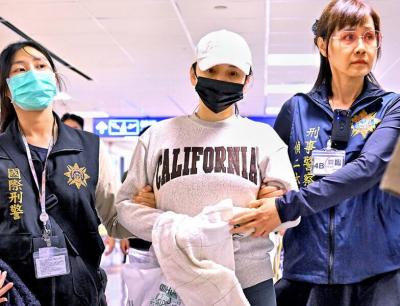
Johanne Liou (劉喬安), a Taiwanese woman who shot to unwanted fame during the Sunflower movement protests in 2014, returned to Taiwan last night after being deported from the US. She is to stand trial in Taiwan for charges involving embezzlement, fraud and drug crimes. The Criminal Investigation Bureau (CIB) said it took her into custody at Taiwan Taoyuan International Airport and would first question her before transferring her to the New Taipei District Prosecutors’ Office. She was arrested upon disembarking a flight from San Francisco that landed shortly before 7pm. Liou absconded to the US in 2019 after jumping bail


 RSS
RSS