


In the fall of 2000, one day before the first anniversary of the Sept. 21, 1999 earthquake, more than 20 elderly ladies climbed a mountain to more than 2,000m above sea level to visit the Jen-ai Junior High School (仁愛國中) in Nantou County, which had been seriously damaged by the quake and by typhoons. The 11-hour trip was fraught with danger and there were worries about rockfalls. The old ladies told the students: "You must maintain hope for the future no matter what."
They were all alumnae from the Taipei Third Girls' Senior High School during the Japanese era. The school is known today as the Taipei Municipal Chung Shan Girls' Senior High School. Eighty-seven-year-old Koo Yen Pi-hsia (辜顏碧霞), who had just been discharged from the hospital and whose legs were still swollen, insisted on going up the mountain to see the children. She made the return journey, however, in a wheelchair. After returning to Taipei, she passed away peacefully early on Dec. 3, holding the hands of her son Jeffrey Koo (辜濂松) and eldest grandson Koo Chung-liang (辜仲諒).
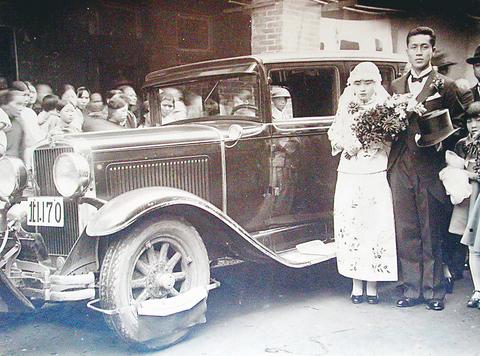
PHOTO: CHEN HSIANG-LIN
When asked about his mother, whom everyone respectfully called "Angel Grandma," the eyes of Jeffrey Koo, chairman of Chinatrust Commercial Bank (中國信託商業銀行), turn red.
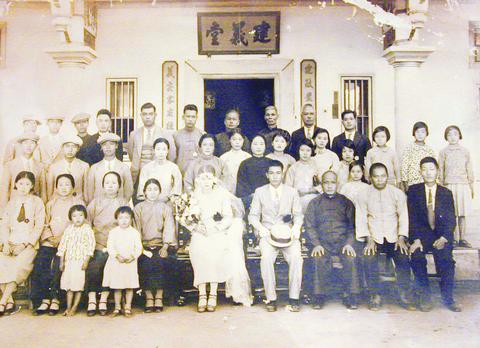
PHOTO COURTESY: JEFFREY KOO
"One day people from the State Secrets Protection Bureau suddenly came and took my mother away," he said. "We were driven out of our house. I was only holding an alarm clock and my sister Li-ching (麗卿) did not bring anything except the clothes she was wearing."
That happened in 1950, when Koo Yen Pi-hsia was 37 and Jeffrey Koo was only a 17-year-old student at the Chien Kuo Senior High School (
Widowed at 23
Koo Yen Pi-hsia was from Sanhsia (三峽) in Taipei. Her father, Yen Chao-pin (顏朝斌), was once a teacher and also served as the leader of the Chengfu (成福) district in Sanhsia. She was born in 1914 and married into the prominent Koo family of Lukang in 1932. Her husband was Koo Yueh-fu (辜岳甫), a son born to the first wife of Koo Hsien-jung (辜顯榮). Over the next three years, she gave birth to eldest son Jeffrey and two daughters, Koo Li-ching and Koo Li-fen (辜麗芬). In 1936, Koo Yueh-fu died. His wife was only 23 at the time.
In 1937 Koo Hsien-jung also died and the Koo family split its family property. Though Koo Yen Pi-hsia was a widow of the Koo family, the extended family let her decide whether to remarry. In fact, they even thought a young beautiful woman like her should remarry and, at a family meeting, decided to have some members of the family adopt her son and two daughters. But she did not want this.
Jeffrey Koo said, "At that time, she knelt down before my father's altar and promised never to remarry, so she won back the right to take care of her children."
After moving to a new place, Koo Yen Pi-hsia became the first female president of the Kaosha Iron Foundry Company (
The "Literary Salon"
Because Koo Yueh-fu was frequently in touch with arts and cultural circles before his death, Koo Yen Pi-hsia also devoted herself to the arts and promoted a "Literary Salon." Lu Ho-juo (
Lu was known as a talented person. Apart from being a reporter and magazine editor, he wrote literary works that were famous in Japan. He also wrote theater scripts and participated in performances, and was Taipei's top tenor singer. Later generations remember his spectacular concert at the Chung Shan Hall, where women screamed for him throughout the show.
A superwoman in the business world, Koo Yen Pi-hsia was also a good writer. But she was stern in demeanor and normally carried a serious face. Jeffrey Koo said, "My mother normally looked quite fierce. It was because she understood her position as a young widow, so she paid special attention to what she said and did. She would not even meet with a man alone. She didn't want to give others any opportunity for gossip."
A disastrous loan
But the destinies of Koo Yen Pi-hsia and Lu Ho-juo were entangled in one incident that made them lead players in a tragedy of the times.
In August 1949, the Kuangming News (
Lin Chih-chieh (
Another occurrence during the White Terror era was the Great Socialist Youth Alliance incident (社會主義青年大同盟事件), in which Li Tzu-sung (黎子松), a teacher from Hsinchu Senior High School, and some of his students -- including female students Fu Ju-chih (傅如芝), Huang Chu-ying (黃竹櫻) and Tseng Mei-jung (曾美容) -- were arrested. They were at one point held in the same cell as Koo. In 2000, before becoming president of Academia Historica, Chang Yen-hsien (張炎憲) interviewed Tseng about the experience. She said, "Koo Yen Pi-hsia was the most pitiful. She was put in the same cell with me. No one dared adopt her children for fear of being implicated. Later her parents adopted them. I was born in the same year as her son. Every night she went to sleep holding me in her arms. I cried until my clothes were wet. So were hers."
Centipede meals
Lin Chih-chieh, who was also at one point held in the same cell as Koo and Huang Chu-ying, said prison life was hard. At every meal they ate cucumbers, pumpkins and celery. Sometimes there would be a centipede in the food. To relieve the pain of such a life, they turned to literature and music. They had no books, however, so they discussed whatever they could remember about one famous literary work each week.
Lin said the first book they discussed was La Dame aux Camelias, which was suggested by her. The second book was Les Miserables, which was suggested by Koo because she sympathized with the girl who sold matches in the story -- one could see that she was very compassionate and kind to other people. Though married into a prominent family, she still cared very much about disadvantaged groups.
In those five years, Jeffrey Koo and his sister Koo Li-ching had to depend on each other. Every Wednesday afternoon -- the time for prison visits -- they would go to the prison on time come rain or shine, and wait to see their mother.
Diaries burnt
After her release from prison in 1955, Koo Yen Pi-hsia started writing a diary about the memories of those tragic days. Because she did not want these tragedies to affect her children, she later burned them.
She seldom mentioned her prison days. When she did, she would only say, "At that time, Jeffrey was only a little more than 10 years old. He had some hard times." In her later years, she was enthusiastic about charity work and devoted herself to Buddhism. She was not only the "Angel Grandma" of the Koo family, but was also an "Angel of Silver Bells" who brought warmth and smiles to everyone around her.
Not until 1999, a year before her death, did she file an application for compensation in accordance with the Regulations Governing Compensation for Improper Trial Cases of Sedition and Spies during the Martial Law Period (戒嚴時期當判亂暨匪諜審判案件補償條例), in the hope that she would have her name cleared.
Koo Yen Pi-hsia's literary achievements have also won considerable praise. In 1942, she wrote the novella Flow (
The literary value of that novella was once again recognized by the re-publication of the Chinese version in 1999. For her, the novella's reappearance after being shelved for more than 50 years was in fact a farewell to her days in this prominent family, as well as a farewell to the vicissitudes of life.
The Kaosha iron factory, which was registered under her name, also had a role in Lu Ho-juo's legendary life.
The print shop
In May 1949, Lu Ho-juo began selling his family assets and set up the Ta-an Print Shop (大安印刷所) in Taipei. The first book he printed was a music text book for primary schools edited by the musician Chang Tsai-hsiang (張彩湘). Chang was later also jailed for his associations with Lu.
In the eyes of the KMT government, the Ta-an Print Shop was part of the communist organization in Taiwan. In the "Case Against the Rebellion by the Communist Bandits' Taiwan Provincial Work Committee" (匪台灣省工作委員會叛亂案) in the Security Bureau's (安全局) "Compilation of Past Handling of Communist Bandit Activities" (歷年辦理匪案彙編), it is said that "communist bandits" had set up the Ta-an Print Shop in Taipei, and that they printed reactionary documents.
A few years ago, Fang A-yun (方阿運), who was arrested for working in the print shop, showed the judge's verdict in his case to the author Lan Po-chou (藍博洲). This official document also states that the Ta-an Print Shop printed "rebel documents for the Zhu-Mao (Zhu De, 朱德 and Mao Zedong, 毛澤東) gang of communist bandits," including "documents regarding the founding of the People's Republic of China" and "the national anthem of the People's Republic of China."
According to Fang, the first day he went to the print shop, "a Master Chen from the Kaosha Iron Foundry was busy installing the machinery."
It is a strange coincidence that when the Luku (
The Ta-an Print Shop is the key to the later, unknown whereabouts of Lu and the mystery surrounding his death.
Keelung High School Incident
The Kuangming News (光明報), where Lu was editor-in-chief, was first published in January 1949 by the headmaster of the Keelung High School, Chung Hao-tung (鐘浩東). It was accused by the KMT government of disseminating "propaganda for the communist bandits" and was closed in August of the same year. Chung, his wife, Chiang Pi-yu (蔣璧玉), and some teachers in Keelung Junior High School and many students from Taiwan University and Cheng Kung Senior High School were arrested. This became known as the "Keelung High School Incident" in the White Terror archives.
Chung, the oldest brother of the famous author Chung Li-ho (
In May 1949, Lu set up the Ta-an Print Shop while also editing the Kuangming News. After the Kuangming News was closed down, he was afraid that the print shop was also in danger, and in October he arranged to have his wife and children sent back to his wife's family in Fengyuan, near Taichung. One source says that he escaped to Pingtung and then later returned to Taipei to close down the print shop.
One night in February 1950, Lu went to the home of one of the print shop's owners, named Hsiao (蕭), without knowing that Hsiao's friend had already been arrested. Lu was arrested and held for several hours by plain-clothes agents from the State Secrets Protection Bureau (保密局), while one of the agents returned to the bureau to check his name. Lu got away because his ID papers were issued in his original name, Lu Shi-tui (
The print shop was then closed down. Panchiao's Lin family, which ran a publishing company, had earlier commissioned Lu to print some books for them. Lu transferred the order and the deposit to another printer, who delayed and never fulfilled the contract. The Lin family then published a warning in a newspaper saying that "Lu Ho-juo (original name Lu Shi-tui), is in charge of the Ta-an Print Shop ..."
Love for Taiwan leads to misfortune
Only then did the secret police realize that the Lu Shi-tui they had checked up on that February night was in fact Lu Ho-juo. One by one, they arrested Lu's wife, uncle, eldest son and his close female friend Su Yu-lan (蘇玉蘭), who were imprisoned.
Having lived through both the Kuangming News and the Ta-an Print Shop incidents, Lu must have been planning to leave the island. One piece of evidence that he intended to leave is that he borrowed money from Koo Yen Pi-hsia. The authorities, however, still accused him of having contacts with the communist "Taiwan Provincial Work Committee," and said that he hid in the Luku armed base run by the committee. This was around February or March, 1950.
It is said that Lu, while hiding in the Luku area, was bitten by a poisonous snake and died in the mountains in the fall of 1950, but there is no way of verifying either of these two pieces of information. In November the following year, the Security Command issued a so-called "list of hiding communist bandits who have still not turned themselves in" (尚未自首潛匪名單). Lu was still on the list, with the only notes being "xx years, Taichung County, Taipei singer."
Lu Cheng-hui (
In the tragic fate of Taiwan's people in the years following the 228 Incident in February 1947, people like Koo Yen Pi-hsia, Chung Hao-tung, his wife and Lu Ho-juo could not escape the heartless suppression of the White Terror era. In 1952, the terror was further extended to the Luku Mountains.
Research by Ho Jui-ling (何瑞玲), Chen Hsiang-lin (陳祥麟), Huang Pang-ping (黃邦平), Hsu Shao-hsuan (許紹軒), Liu Li-jen (劉力仁), Hung Min-lung (洪敏隆) and Liang Hsiu-hsien (梁秀賢), staff reporters of the Liberty Times.

FUKUOKA SITUATION: Japanese media reported that the pathogen is expected to be identified by the summer, while the CDC downplayed the idea that it was hMPV A “mysterious cold-like illness” reported in Japan’s Fukuoka Prefecture does not seem to be a new disease, but Japanese authorities have been asked about the situation, the Centers for Disease Control (CDC) said yesterday. The Fukuoka Prefectural Medical Association on Wednesday told a news conference that a “mystery cold” that has become a hot topic on social media is “highly likely to be caused by some kind of viral infection,” Japan’s KBC News reported. “Many people are experiencing symptoms starting with a sore throat, followed by a runny nose, phlegm and a severe cough,” KBC News reported, citing association officials. Health authorities are

Nvidia Corp CEO Jensen Huang (黃仁勳) arrived in Taiwan yesterday ahead of upcoming AI and technology events, saying he plans to meet with clients and Taiwan Semiconductor Manufacturing Co Chairman C.C. Wei (魏哲家) during his visit. After landing at Taipei Songshan Airport, Huang posed for photos with fans and handed out Yakult drinks to reporters and supporters waiting at the scene, saying he has “a lot to do” during the trip. Asked about reports that Nvidia’s planned headquarters site in Taipei’s Beitou Shilin Technology Park could break ground on May 27, Huang said that if the company holds an event, he would

Carrefour Taiwan is to begin using a new name from the start of July, but it cannot divulge the name until then, the chairman of the supermarket chain's parent company said today. President Chain Store Co chairman Lo Chih-hsien (羅智先) was asked by reporters after a shareholders' meeting to confirm whether the company has settled on a new name for the supermarket brand. In March, the government-registered name of two Carrefour Taiwan branches was quietly changed to "Le Chia Kang" (樂家康) in Chinese, raising speculation that has been selected as the name. Lo said that because of local regulations and contractual obligations, the
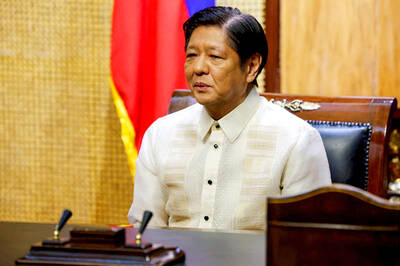
The Philippines would likely be involved in any conflict over Taiwan due to its proximity to the democracy claimed by China, President Ferdinand Marcos Jr said, reiterating a stance that risks angering Beijing. “In the Philippines, we do not have a choice because Taiwan is so close to the Philippines and we have almost 200,000 Filipino nationals living and working in Taiwan,” Marcos said in an interview with Japanese media in Manila on Monday. The Philippine leader’s comments come ahead of a state visit to Japan next week, where he is to meet with Japanese Prime Minister Sanae Takaichi to discuss security


 RSS
RSS