


Former DPP chairman Lin I-hsiung (
The site, where the Yi-Kwang Presbyterian Church now stands, is where his six-year-old twin daughters and 60-year-old mother were murdered on Feb. 28, 1980.
Lin yesterday returned to the site on Hsin-yi Road with friends and church leaders who had gathered with him to commemorate the day.
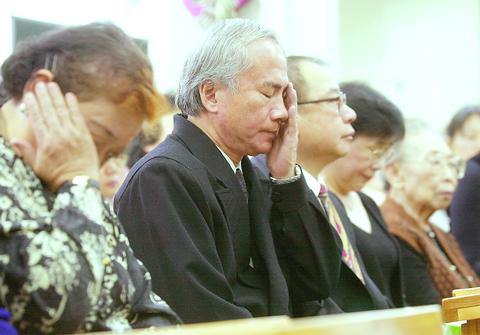
PHOTO: CHIANG YING-YING, TAIPEI TIMES
"It has been 22 years. I want to express my gratitude for those who have showed concern for us. Without the support from [these friends] we probably could not have continued on this path," Lin said.
Many of those attending the commemoration ceremony cried during Lin's speech.
To return his friends' love, Lin said, he had constantly encouraged his wife and his surviving daughter to lead meaningful and useful lives.
"I have tried very hard to carry on," he said. "To be one's own master and to control one's own destiny are the eternal desires of human beings, and democracy is the most significant system to help us realize this desire."
Under the sponsorship of the Chilin Foundation (
The museum exhibits documents, photos, newspapers, pamphlets, posters and T-shirts related to democracy movements.
Lin said the museum's aim is to generate determination among Taiwanese to consolidate the development of democracy.
Taiwan's history of democratic development has shown that the promotion of democracy is constantly challenged by relentless obstacles, according to Lin, and each conflict and effort to intimidate puts the existence of democracy in peril.
"Only by adhering firmly to democratic beliefs and resolving internal discord through democratic measures can crises be defused," he said.
Lin knows the cost of championing democracy all too well.
His daughters Liang-chun (亮均) and Ting-chun (亭均) and his mother Lin Yu Ah-mei (林游阿妹) were killed by a man, dressed in black, who broke into Lin's home while both Lin and his wife were away.
Lin was in jail -- he had been arrested on Dec. 13, 1979, for participating in a human-rights rally in Kaohsiung three days earlier. His wife, Fang Su-min (方素敏), was attending the public hearing into what was by then already called the Kaohsiung Incident (美麗島事件).
Lin's eldest daughter, Huan-chun (
The murderer has never been apprehended. However, Lin and many Taiwanese believe that the killings were politically motivated.
The murders -- on the anniversary of the 228 Incident (二二八事件), in which Taiwanese rebelling against KMT rule in 1947 were massacred -- rocked the nation.
The twins and their grandmother were not buried until Lin was released from jail in 1985.
After the murders, Fang and Huan-chun moved to the US to start a new life. Fang returned to Taiwan and ran in the 1983 Legislative Yuan elections in memory of the twins and Lin's mother.
"I don't know if [the murderer] is still alive now," Fang once said.
"But I don't hate him, because love is our best weapon."
Lin is revered by many Tai-wanese for transforming his personal sorrow into strength to struggle for the country's democracy.
The DPP came into power under his leadership, ending the KMT's five-decade-long rule after Chen Shui-bian (
Lin now spends much of his time running the Tzulin Cultural and Education Foundation, a pro-Taiwan political and environmental pressure group.
Huan-chun still lives in the US. She married an American in 1998 and her second child was born four days ago.

NATIONAL SECURITY: Authorities are working to confirm the identities of the military personnel involved and investigating possible illegal conduct and regulatory violations Authorities are probing possible national security implications after Kinmen police and immigration officers on Sunday found a Chinese woman allegedly posing as a tourist while engaging in prostitution involving more than 10 military personnel. The woman, surnamed Chen (陳), has since been deported, authorities said, adding that investigators are still working to confirm the identities of those implicated, as the records only listed code names and aliases. The case stemmed from a report received by the Kinmen District Prosecutors’ Office on Friday last week from the Jinhu Precinct of the Kinmen County Police Bureau. On Sunday, police, along with the National Immigration

GLOBALGIVING: ‘ Caving to external pressure is not acceptable for an organization that has cultivated justice reform and human rights for 30 years,’ one NGO said A slew of non-government organizations (NGOs) have withdrawn from the GlobalGiving fundraising platform after it announced it would use “Chinese Taipei” instead of “Taiwan” from next month. The Taiwan Good Rice Association wrote on Facebook on Friday that it was informed on April 28 via a teleconference call of the change, which was made because the platform wanted to operate in China. Taiwan Good Rice is to terminate all cooperative relationships with GlobalGiving in response to the platform’s “unilateral and non-negotiable” decision to remove references to Taiwan, the NGO said. “Taiwan is in the official name of Taiwan Good Rice Association and the

HEAVY WEATHER: Typhoon Jangmi is due to crash straight into the Ryukyus as airlines look to shift flights to larger aircraft or cancel flights to Okinawa entirely Taiwan’s international air carriers announced flight adjustments over the weekend as Typhoon Jangmi is forecast to hit the Ryukyu Islands today and tomorrow. The Central Weather Administration (CWA) upgraded Jangmi from a tropical storm to a typhoon at 8am yesterday, with the eye located 580km south of Naha city. It was moving north at 19kph. Today, China Airlines’ CI-120, CI-121, CI-122 and CI-123 flights between Taoyuan and Naha, Okinawa, have been canceled as well as CI-132 and CI-133 between Kaohsiung and Naha. EVA Air’s BR-112, BR-113, BR-186 and BR-185 flights between Taoyuan and Naha are also canceled. Low-cost carrier Tigerair Taiwan canceled IT-230,

Chinese Nationalist Party (KMT) Chairwoman Cheng Li-wun (鄭麗文) yesterday briefed her party’s Central Standing Committee regarding her scheduled visit to the US between Monday next week and June 16, saying that her purpose would be to persuade the US that the Republic of China (ROC) Constitution was a “one China” constitution that would foster stable and peaceful cross-strait relations. The ROC Constitution is the most important defense for all Taiwanese citizens, as it upholds our democracy and has contributed to our robust economy, which aligns with international and US interests, she said. “We would not be troublemakers and drag the US under,”


 RSS
RSS