

For me the Taipei Times began with drinking a beer while sitting on the floor of an apartment in Neihu around Christmas, 1997. I was paying a visit to a friend, Anthony Lawrance, who was at that time running one of the other English-language newspapers and who was deeply fed up with his job. He was himself an Anglo-South African liberal, with the political outlook that implied. His boss was a Mainlander who wanted to vigorously protect the privileges of the KMT ancien regime. They were bound to loathe each other and he was certain to be unhappy.
The story of Taiwan was its transformation from something almost utterly contemptible, the Chiang family dictatorship which made it not only an international pariah but a laughingstock, to something quite admirable, a functioning liberal democracy and a surprisingly open society. The world needed to know more about Taiwan. The problem was that there was no credible source of information. News magazines might mention Taiwan once in blue moon, I could get a story about it into The Economist perhaps four times a year, but for Taiwan's situation to be better understood, both by foreign non-Chinese speaking residents here in Taiwan and those interested in the nation's affairs abroad, there needed to be a credible English-language daily newspaper.
"You would think someone would have the get up and go to do it" Anthony said. "How difficult could it be?"
"Have you ever met Antonio Chiang?" I asked.
I had known Antonio for two or three years, mostly for his quotability on Taiwan affairs. I knew that he had long harbored the dream of being able to start a decent English-language newspaper in Taiwan. I also knew that what stopped him was that he didn't know how to. Perhaps he could find the backing. But how to turn that money into a broadsheet available every morning was a process about which, despite his experience with Chinese papers, he did not feel knowledgeable enough to undertake. But maybe together we were.
So, right there, we started back-of-the-envelope calculations about how much it would cost. Anthony knew enough about the paper he worked for to have some idea of major budget items as well as advertising revenues. We both knew enough to be able to thrash out things like staffing levels, pay rates and so forth, and from this initial idea we began to put together a business proposal. Anthony met Antonio, who was interested, and said tell me more, and so it began.
I remember an article in a regional news magazine about the launching of the Taipei Times that said, with something of a sneer, that it had been put together in a pub. Actually this was not so very far from the truth. Anthony and I would meet perhaps once a week around midnight at 45 with a laptop and, over a few pints of Carlsberg, review and revise and add stuff to and delete items from a burgeoning spreadsheet that soon began to convince us that, first, we knew what we were talking about and, second, that it was not so impossibly expensive. Both of these were important. We had to be able to persuade Antonio we knew what we were doing, that we weren't fantasists about the project, so he could persuade his money man -- at the time we had no idea whom this might be -- that this wasn't pie in the sky.
In July 1998, I was in England at my parents' 50th wedding anniversary when Anthony called me.
"We're on," he said. "The Liberty Times are going to do it."
So it was back to the pub, this time to brainstorm about whom we might ask to join us. We knew just about every foreigner with any journalism or writing background. Who could we entice, and who was worth enticing, to help in a project that only got more complex the deeper we got into it?
Soon, as well as the pub meetings, there were coffee shop meetings, at which Antonio, Anthony and I first met the Liberty Times' appointees to form a steering group to manage the launch of the paper.
We first walked into the newspaper's "office" at the beginning of November that year. I add the quotation marks since at the time it contained just four desks and a phone. From such modest beginnings we had the paper up and running in seven and a half months, by which time we had a staff of about 100 and by far the most modern office, in terms of equipment, of any paper in Taipei, English or Chinese. We should have had a great sense of achievement. Actually we were so bedeviled by interminable problems with the utterly dysfunctional computer software used to edit and design the paper that the actual launch seemed more like an unnecessary distraction in a Sysiphean task. We were at least blessed with an excellent design from Alicia Beebe. Not only did it look vastly better than anything else in the region, it was almost indestructible in that anyone possessed of a few simple guidelines and a modicum of visual sense could, without a huge amount of prior design experience, turn out decent-looking pages; it still saves us on a daily basis.
Others in this supplement will talk of the paper's successes over the past five years, and they have been significant. But there have been problems, too. One of them is staff. For local reporters, there is a limited career ladder at an English publication, and with their English skills and a good-looking clippings file, there are too many opportunities available for it to be easy to retain talented staff. For the copy desk, the problem is that the result of having to maintain a rough parity between what Taiwanese and foreign employees earn -- any company that doesn't do this, such as the now defunct Eastern Express in Hong Kong, will soon find itself with huge problems -- is that experienced editors can earn in Hong Kong twice what they can earn here. So we are forced to rely a great deal on talented youngsters looking for a rung on the ladder. This mixture of youth and staff turnover weakens that collective historical memory that is the backbone of a newspaper of record. People cannot put the necessary background into stories simply because they don't know it. Often they don't even know what they might usefully look for in the archives. This makes producing material of the depth and quality that we originally envisaged a far harder task than we anticipated, especially when senior staff have so much time consumed in routine but constant training of newcomers.
Another limit that neither Anthony nor I anticipated that evening in Neihu is the journalistic culture of Taiwan. People often complain of a lack of balance in stories but much of this is a function of the news culture here. In the US or the UK it is common to think that anyone attacked has a right of reply and that their view should be solicited before a story can be thought of as complete. It is also common for reporters to develop their own stories based on tips and personal contacts. News in Taiwan gravitates to a great extent around the press conference. Reporters go to press conferences, write down what they hear, ask very few if any questions -- which are seldom if ever hostile -- then come back and write their stories. If the press conference has been called by group A to criticize group B, then only A's version will be reported. If B is to have a say, they call their news conference the next day and an equally one-sided story is produced from the opposite angle. We have, of course, tried to encourage our reporters to break this mold, but they are limited by the collective culture of the news business, decided as it is by the vastly more numerous reporters for Chinese-language media. We have found that aggressive questioning by our beat reporters is more likely to get them banned from news conferences than change the way the business works.
Part of the problem is that Taiwan might have press freedom, but the idea of a fourth estate is chronically weak. Traditionally the media in Chinese societies have been seen as organs through which to disseminate propaganda, an attitude that prevailed in Taiwan until the late 1980s. Even here at the Times, reporters look askance at me when I remind them that authority is their enemy. The legendary British press baron Lord Northcliffe said that: "News is what somebody somewhere wants to suppress; all the rest is advertising." Taiwan's news culture is still dominated by "advertising" and rail against it as we might at the Times, we can no more be free of it than anyone else.
In short, while the Taipei Times has had its successes, of which we can be justifiably proud -- and this is reflected in the fact that almost since our first day of publication we have consistently sold 30 percent more papers per day than our two competitors combined -- the answer to Anthony's question "how hard could it be?" is "a lot harder than we, or perhaps anyone else, thought." In our vanity we believed, all those years ago, that a paper with enough people who knew what international-standard newspapers were and enough fire in their bellies could simply ignore the limitations of journalism as practiced in Taiwan. We found out the hard way that that could not be, that we could not override Taiwan's news culture nor could we remake it, though we have significantly raised the bar. Having learned to survive over the past five years, perhaps only now can we start work to achieve the visionary goals we set ourselves back in the autumn of 1998. Running a new daily is rather like being a parent for the first time, the infant needs to be constantly fed, constantly cleaned up after and you lose a lot of sleep. Every task has to be carried out for the first time and you find out only by trial and error how things should best be done. But after five years, the infant can pretty much take care of itself. The parent faces a different set of problems revolving around education, explanation and understanding. So do we.
Laurence Eyton is an associate editor in chief of the Taipei Times.
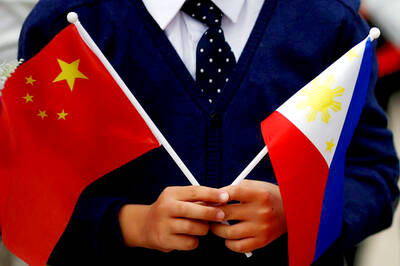
The Philippine Coast Guard yesterday said it has deployed its largest vessel and an aircraft to challenge a Chinese research ship operating off northern Batanes near Taiwan, adding that a Chinese coast guard vessel had also moved in. The Philippine operation “disrupted the vessel’s unauthorized marine scientific research and compelled it to leave its loitering position,” said Jay Tarriela, Philippine Coast Guard spokesperson on South China Sea issues. The Philippine Coast Guard said the BRP Teresa Magbanua and an aircraft were deployed to counter the Chinese vessel, which it said had remained about 37 nautical miles northwest of Itbayat Island since Monday. The
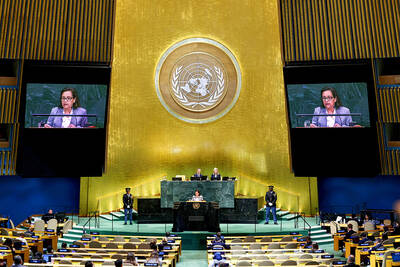
PLEA: How the UN addresses Taiwan’s security issue would be a test of its strength and relevance, Marshall Islands President Hilda Heine told the UN General Assembly Only Taiwan’s elected government can represent the people of Taiwan, Marshall Islands President Hilda Heine said on Friday at the UN General Assembly, calling for the nation’s inclusion in the UN. Taiwan and its 23 million people are a reality, and only its democratically elected government can represent it, Heine said when addressing the 81st session of the UN General Assembly General Debate. Appropriate ways must be found for Taiwan’s substantive participation in UN meetings if the UN is to be truly inclusive and effective in years to come, she said. UN member states would experience pressure to accept a
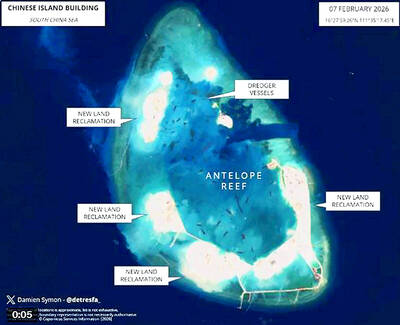
RUNWAY: Analysts said the first aircraft landing is expected by the middle of next year, while Chinese state media said it would serve civilian needs Chinese construction of a runway on Antelope Reef (Lingyang Reef, 羚羊礁) in the Paracel Islands (Xisha Islands, 西沙群島), is well under way with analysts estimating it could be completed by the middle of next year, strengthening Beijing’s military control over the disputed South China Sea. Satellite images reviewed by Reuters show grading work, piles of gravel and concrete, and compaction cranes in operation to build a full-scale runway that military attaches and security analysts say could be one of China’s most important offshore bases in the region. The images, taken on Friday last week by commercial satellite imagery provider Vantor, also show
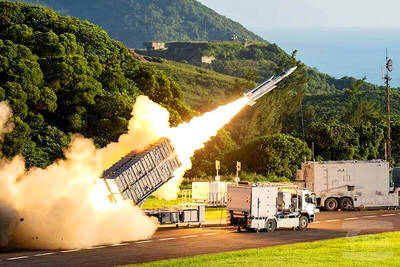
RESILIENCE: Keeping the defense industry’s assembly lines open would prove essential should the nation be involved in a prolonged conflict, a source said The Ministry of National Defense has prepared a NT$22 billion (US$692.3 million) program to acquire about 200 improved Hsiung Feng anti-ship missiles from next year to 2035, a source said. Commenting on condition of anonymity, a high-ranking defense official said the ministry’s plan for enhanced-capability Hsiung Feng II and Hsiung Feng III missiles would be funded as part of the regular defense budget. The 200 missiles would be added on top of the 1,400 missiles being funded via the Sea-Air Combat Power Improvement Plan, they said. The program is not about padding missile numbers, but expanding the capability to defeat


 RSS
RSS