


Britain’s Jonnie Peacock on Thursday sprinted to glory in the Paralympics’ showpiece final, stripping “Blade Runner” Oscar Pistorius of another title with a lightning-quick 100m.
The 19-year-old, who holds the world record of 10.85 seconds in the straight sprint, again proved he is the fastest amputee runner in the world by taking gold at the Olympic Stadium in east London in a new Paralympic record of 10.9 seconds.
Pistorius, 25, was just out of the medals in fourth, clocking 11.17 seconds behind compatriot, friend and roommate Arnu Fourie, who took bronze in 11.08 seconds and US sprinter Richard Browne, who won silver in 11.03 seconds.
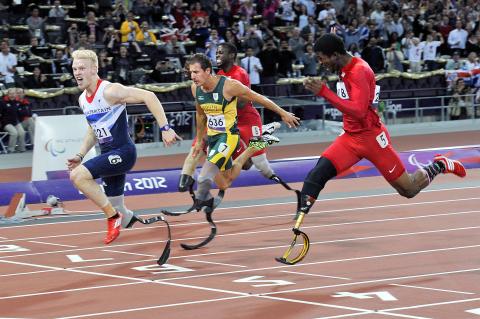
Photo: AFP
A stunned Peacock described his win as “amazing,” while the South African star was magnanimous in defeat and said the Briton’s performance was just the start of a stellar career.
“I can’t imagine how happy he must be to do this in front of his home crowd,” Pistorius told Britain’s Channel 4 television. “Well done, it’s a great time for him. He’s still young and he’s got a great future ahead of him.”
Organizers had billed the T44 race for single and double below-the-knee amputees as the race of the Games, predicting that all eight finalists could go under 11 seconds for the first time.
Photo: AFP
Peacock, a single-leg amputee trained by Dan Pfaff, who coached Canada’s Donovan Bailey to Olympic 100m glory in 1996, signaled his intent in Thursday’s heats by equaling the Paralympic record of 11.08 seconds.
Pistorius, the T44 100m, 200m and 400m champion in Beijing, had warned that he was not favorite for the straight sprint, as he was a one-lap specialist.
The Games’ most high-profile athlete, who became the first double-amputee to run in the Olympics last month, had been keen to let his running do the talking after becoming embroiled in a row over artificial-blade length.
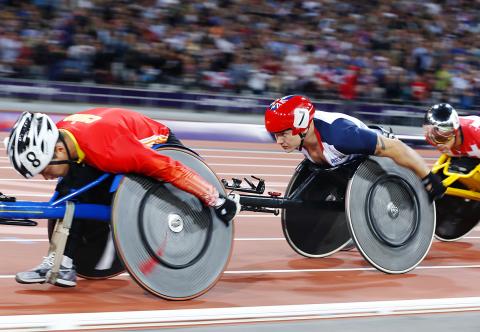
Photo: Reuters
After sensationally losing his T44 200m title to Brazil’s Alan Oliveira on Sunday, Pistorius said he was at a disadvantage in terms of stride length as his rivals were “a lot taller.”
The row about whether his rivals had illegally flouted rules governing the maximum allowed height of prostheses has rumbled on all week, although the International Paralympic Committee (IPC) has said there were no violations.
Pistorius gained a measure of revenge over Oliveira on Thursday, as he anchored South Africa to a world record-breaking victory in the T42-46 4x100m relay for single and double below-the-knee amputees and upper-limb amputees.
British wheelchair racer David Weir provided the warm-up for the sprint kings by retaining his T54 800m title after successfully defending his 1,500m crown and winning gold in the 5,000m.
Weir’s teammate Hannah Cockroft doubled up after winning the T34 100m to take the 200m, while France’s Assia El Hannouni won the T12 200m title for blind and visually impaired runners for the third consecutive Games.
Earlier in the day, Britain’s Sarah Storey clinched her fourth gold of the Games and the 11th in her career by winning the women’s individual C4/5 road race over 64km at the Brands Hatch motor racing circuit in southeast England.
The 34-year-old cyclist has now won 11 golds in her Games career — a joint record for a British woman Paralympian.
Australian swimmer Jacqueline Freney took a national record-breaking seventh gold of the Games in the S7 400m freestyle, after teammate Matthew Cowdrey bagged his 12th career gold and South Africa’s Natalie du Toit got her 13th.
Russia-born US swimmer Jessica Long won the S8 100m freestyle for the third Games in a row, beating her own world record, for her fifth gold in the British capital.
In five-a-side soccer, Brazil were on course to retain their unbeaten Paralympic record since the sport was introduced in 2004. They made the final again, where they are scheduled to play France.
In goalball, one of only two Paralympic sports with no Olympic equivalent, Japan won through to face favorites China after both Asian sides beat Scandinavian opposition to win their semi-finals.
In wheelchair basketball, Australia held off a dramatic late rally by the US and dashed their dreams of a third straight Paralympic wheelchair basketball title, as they progressed to yesterday’s women’s final.

For some, Cristiano Ronaldo remains the essential spearhead for Portugal’s FIFA World Cup bid, while others believe his presence would prevent Roberto Martinez’s strong side from flourishing. The debate around the five-time Ballon d’Or winner rages on, as it did at UEFA Euro 2024 and four years ago in Qatar — yet Ronaldo endures, ready to play in a record sixth World Cup. The 41-year-old remains a global superstar despite swapping the European elite for Saudi Arabia’s Al-Nassr, and is the leading men’s international goalscorer with 143 strikes. With 25 of those coming in 30 games under Martinez, the coach

Taiwanese tennis star Hsieh Su-wei on Wednesday advanced to the second round of the mixed doubles at the French Open, after she and German partner Mark Wallner defeated Slovenian Andreja Klepac and Briton Lloyd Glasspool in straight sets, despite temperatures exceeding 32°C in Paris, while Taiwan’s top men’s doubles player Ray Ho also reached the second round. Hsieh, who made it to the semi-finals in the mixed doubles at Roland Garros in 2024, and Wallner defeated Klepac and Glasspool 6-3, 7-5 in just more than an hour, converting three of five break points, while holding their opponents to just one conversion

FAST AND LOOSE: Despite command struggles, Ohtani has pitched his way out of trouble after falling behind in counts, which manager Roberts credited to his velocity Shohei Ohtani on Wednesday night tossed six innings of no-hit ball, gave himself an early lead with a home run and still was not satisfied with his performance. The Los Angeles Dodgers’ two-way superstar dropped some expletives that were picked up by the on-field mic as he struggled with his command in a 4-1 win over the Colorado Rockies. He struck out seven, walked four and gave up an earned run in the fourth inning while visibly fuming on the mound. Ohtani (5-2) earned his third consecutive victory. “Just command was off, and I just felt like I was battling the lack of

Taiwanese sprinter Chen Yi-cen on Friday won the silver medal in the women’s 400m final at the Asian U20 Athletics Championships in Hong Kong, with a time of 53.16 seconds. Chen, 15, was the youngest among the eight finalists, and her performance also met the qualifying standard of 53.50 seconds for the Nagoya Asian Games in Japan in September and October. Chen first made her mark at the National Games in Tainan in 2023, at the age of 13, winning the women’s 400m final in 55.55 seconds to become the youngest gold medalist in the history of the event. Meanwhile,


 RSS
RSS