


Japan and the US made it through the semi-finals of the women’s Olympic soccer tournament on Monday, setting up a rematch of the World Cup final won by Japan just a year ago.
Japan beat France 2-1 in London and the US defeated Canada 4-3 in extra-time in a thrilling match at Old Trafford in Manchester, England.
The US will be going for revenge and their third straight gold medal. Japan will be playing in their first Olympic final to try to show that their World Cup win was not a fluke.
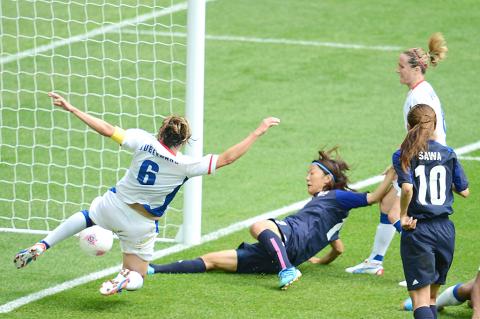
Photo: AFP
Japan opened a two-goal lead against France and then held on for the victory, surviving a missed penalty kick by France in the final minutes.
The US came from behind three times to send the match against Canada into extra-time, then got a stoppage-time winner from Alex Morgan to advance. She headed the ball into the net after a cross by Heather O’Reilly as time was about to expire, putting the US in the final for the fifth straight time.
“This team refuses to lose and always finds a way to win,” US coach Pia Sundhage said. “There is something special about this team.”
Christine Sinclair scored for Canada in the 22nd, 67th and 73rd minutes, but the US rallied with goals by Megan Rapinoe in the 54th and 70th minutes, and by Abby Wambach from a penalty-kick in the 80th.
“If I’m sitting in the stands watching this game and not rooting for any team, it’s fantastic, it’s entertaining,” Sundhage said.
The US have played in the final in every Games since women’s soccer was introduced in Atlanta, Georgia, in 1996.
Canada were trying to secure their first top-three finish at an Olympics or World Cup. They were also trying to end a 26-match winless streak against the US. They had been eliminated by the US in extra-time in the quarter-finals in Beijing four years ago.
Canada coach John Herdman loudly complained about the refereeing of Christiana Pedersen of Norway, especially when the penalty was awarded to the US. He did not think it was a hand ball and was in awe that Pedersen awarded an indirect free-kick against goalkeeper Erin McLeod for holding the ball inside the area for more than six seconds. The indirect kick led to the hand ball.
“Two bizarre decisions. I’ve never seen a decision like that given. An indirect free-kick without a real warning or a yellow card, just a bit random, and then the handball when something just gets blasted at you,” Herdman said.
Japan reached their first Olympic final with the win over France at Wembley. Their best result so far had been a fourth-place finish in 2008 in Beijing, when they lost to the US in the semi-finals.
“Since 2008, we have had an objective to win a medal at the Olympics,” Japan coach Norio Sasaki said. “The attitude of the players to win this game was strong. The mental part makes the difference at this stage.”
It was the first time Japan had entered a tournament as one of the main title favorites following their World Cup triumph in Germany last year. They had eliminated Brazil, silver medalists in the last two Olympics, to make it to the semi-finals in London.
Japan looked set for a comfortable win over France after goals by striker Yuki Ogimi in the 32nd minute and Mizuho Sakaguchi in the 49th. France pulled one back through substitute Eugenie le Sommer in the 75th minute and they had a chance to equalize from the penalty spot just a minute later, but midfielder Elise Bussaglia rolled her spot-kick wide of the right post.
“I feel horrible. It is a shameful feeling,” Bussaglia said. “I opened up my body too much and the ball went wide. We miss the final now, so it is a big disappointment and it’s shameful.”
Wendie Renard and Louisa Necib each had chances in the final minutes, but they could not get the ball into the net, ending France’s hopes of advancing to their first final in a top women’s competition.
France were playing in their first Olympics, but they also reached the semi-finals of last year’s World Cup, when they lost to the US. They eventually lost the third-place match to Sweden, so they can still do one better in London and leave with the bronze.
“Today was even more disappointing than the World Cup,” France coach Bruno Bini said. “In the last 20 minutes we played very well and were even better than Japan. They barely reached our side of the pitch.”
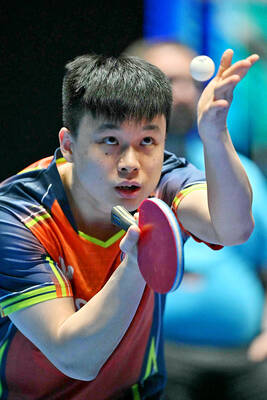
Taiwan’s men’s table tennis team won bronze on Saturday at this year’s International Table Tennis Federation World Team Table Tennis Championships in London, matching the country’s best-ever finish at the regular tournament. Consisting of Lin Yun-ju, Taiwan’s top-ranked player at world No. 7, Feng Yi-hsin, Kuo Guan-hong, Hong Jing-kai and Hsu Hsien-chia, the team won bronze after losing 0-3 to Japan in the semifinals. In the opening match, 24-year-old Lin played the first game against world No. 3 Tomokazu Harimoto 11-5, but ultimately lost the next three closely contested games 9-11, 10-12 and 10-12. Feng then faced world No. 8 Sora Matsushima in

Taiwanese fire dancer Yang Li-wei advanced to the final of Britain’s Got Talent this weekend after receiving a Golden Buzzer during her live semi-final performance. Yang, a member of Taiwan’s Coming True Fire Group, awed judges and audiences with a high-intensity fire performance featuring flaming umbrellas, fire swallowing and spinning metal structures balanced with her legs. Judge Simon Cowell praised Yang as a star, while guest judge KSI reacted with amazement before pressing the Golden Buzzer, sending her to the finals. The dance group wrote on social media that the Golden Buzzer was “the highest honor” on the talent show, adding: “Twenty-three years

Memphis Grizzlies forward Brandon Clarke, 29, has died, the NBA team said in a statement on Tuesday, while the family of Jason Collins, the first openly gay man to play in a major US pro sports league, announced the former Grizzlies and Brooklyn Nets player had died after a battle with brain cancer. “We are heartbroken by the tragic loss of Brandon Clarke,” the Grizzlies said in a statement posted on social media. “Brandon was an outstanding teammate and an even better person whose impact on the organization and the greater Memphis community will not be forgotten.” The statement did not provide

As Super Rugby fast approaches its playoff season it finds itself racing toward a reckoning with many issues that threaten the southern hemisphere tournament. A group of stakeholders met in the New Zealand city of Christchurch late last month to address problems that are making the future of the 31-year-old competition increasingly tenuous. The discussion was made more urgent by the decision by the owners of Moana Pasifika to fold the Auckland-based club for financial reasons. That followed the closure of the Melbourne Rebels at the end of the 2024 season, likewise because of financial difficulties. Problems addressed included player retention as more


 RSS
RSS