


Japan’s Kohei Uchimura crowned four years of dominance in male gymnastics by romping to the Olympic individual all-around title on Wednesday.
Marcel Nguyen ended Germany’s 76-year wait for a men’s medal in the event by finishing second, with Danell Leyva of the US claiming bronze.
Since finishing second to China’s Yang Wei in Beijing in 2008, Uchimura has won an unprecedented three consecutive individual world titles and he can now be considered one of the finest gymnasts in history.
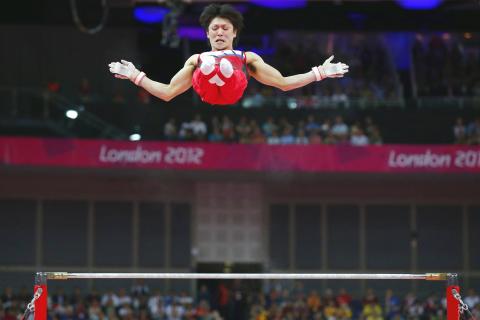
Photo: AFP
“I have been aiming for this and now I have achieved it, but it still feels like a dream,” he said. “It felt a bit like revenge after the qualification and the team final. I wasn’t watching any of the other competitors. I didn’t even think about how they were doing.”
Uchimura had been disappointed in qualifying, falling twice and producing only the ninth-best score of the day, while failing to inspire Japan to gold in the team event, but he grew in strength as the individual final progressed.
After calmly negotiating the pommel horse and the rings, he produced a vault scored at 16.266 and impressed on both the parallel bars and the high bar, before clinching his maiden Olympic title on the floor.
The 23-year-old finished with a score of 92.690 points to Nguyen’s 91.031, with reigning world parallel bars champion Leyva on 90.698.
Uchimura had come off the pommel horse in qualifying and he produced a messy dismount on the apparatus in the team final that almost cost Japan silver, but his opening pommel routine earned him a solid score of 15.066.
Britain’s Kristian Thomas also started impressively, scoring 15.566 for his floor routine to finish the first rotation in second place behind South Korea’s Kim Soo-myun.
Uchimura earned a score of 15.333 on the rings, while US national champion John Orozco’s challenge evaporated after he miscued his pommel dismount and was rewarded with a mark of 12.566.
Orozco’s teammate Leyva also hesitated at the end of his pommel routine, yielding a costly low score of 13.500.
Uchimura was first up on the vault and produced a Yurchenko with a 2.5 twist and an inch-perfect landing to earn a score of 16.266 that would not be bettered on that apparatus.
He led by 0.432 points from Japanese teammate Kazuhito Tanaka at the halfway stage, although Tanaka trimmed his lead to 0.182 points with a 15.575 display on the high bar in the fourth rotation.
Tanaka could only score 14.166 on the floor, though, and then he came off the pommel horse in the final rotation, allowing Uchimura to waltz to the title, despite a stumble in his second tumbling pass on the floor.
Thomas’ medal hopes were hit by a fall on the vault, while Germany’s Fabian Hambuchen was also unable to live up to his billing as one of the pre-event favorites.
With Hambuchen misfiring and Philipp Boy having failed to make the final, Germany’s third-ranked gymnast Nguyen took it upon himself to lead his country’s quest for individual glory.
After a crowd-pleasing routine on the high bar, he avoided any mishaps on the floor to become Germany’s first Olympic medal-winner in the event since Alfred Schwarzmann and Konrad Frey in 1936.
“It sounds nice,” said Nguyen, when told about the statistic. “It’s amazing. A dream came true today. I’m just happy to have this medal around my neck.”
Leyva had appeared out of contention, but a dazzling 15.700 routine on the high bar delighted the crowd and was enough to give him the bronze.
“It was redemption for the whole team,” said Leyva, who had been unable to prevent the US from slumping to a fifth-place finish in the team final. “I wanted to show what we were really worth. I’m really happy with the way I finished.”
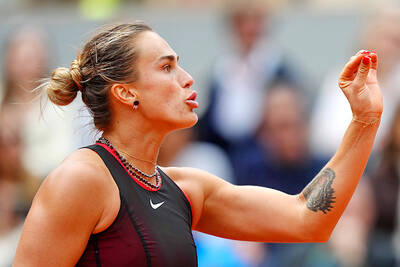
After letting another big lead slip with an error-strewn performance at the French Open on Wednesday, top-ranked Aryna Sabalenka felt like getting as far away from the courts as possible. “Just want to quit tennis right now,” Sabalenka said after wasting a lead of a set and two breaks in a 3-6, 7-5, 6-0 loss to Diana Shnaider in the women’s singles quarter-finals. “We’ll see in few days. Hopefully I’ll get back on track mentally.” Sabalenka’s wait for a first French Open title continues despite the four-time major winner leading 4-1 in the second set and being two points from victory while
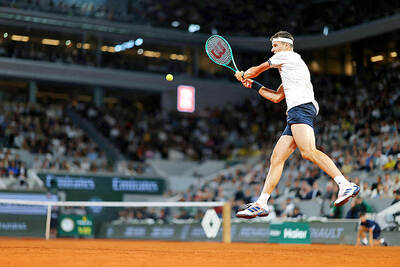
BIG NAMES GONE: Zverev is the clear favorite for a maiden Grand Slam title, reaching semi-finals for the fifth time in six years and finishing second on three occasions Alexander Zverev on Tuesday breezed past Rafael Jodar to stay on course for an elusive Grand Slam title at the French Open, while Jakub Mensik halted Joao Fonseca’s scintillating run in the quarter-finals. Zverev, the highest-ranked player left in the men’s draw, put an end to Spanish teenager Jodar’s impressive Roland Garros debut, easing into the semi-finals with a 7-6, (7/3), 6-1, 6-3 win. The 29-year-old Zverev is the clear favorite for a maiden Grand Slam title. He has finished runner-up on three occasions, including at the 2024 French Open. “I want to win the matches that are ahead of
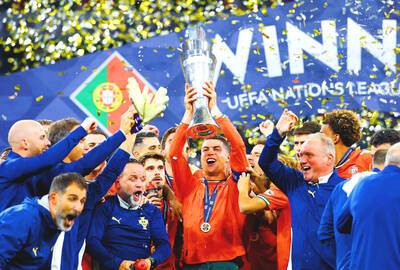
For some, Cristiano Ronaldo remains the essential spearhead for Portugal’s FIFA World Cup bid, while others believe his presence would prevent Roberto Martinez’s strong side from flourishing. The debate around the five-time Ballon d’Or winner rages on, as it did at UEFA Euro 2024 and four years ago in Qatar — yet Ronaldo endures, ready to play in a record sixth World Cup. The 41-year-old remains a global superstar despite swapping the European elite for Saudi Arabia’s Al-Nassr, and is the leading men’s international goalscorer with 143 strikes. With 25 of those coming in 30 games under Martinez, the coach
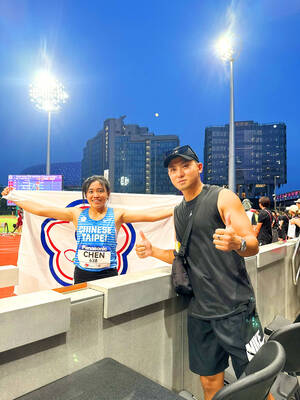
Taiwanese sprinter Chen Yi-cen on Friday won the silver medal in the women’s 400m final at the Asian U20 Athletics Championships in Hong Kong, with a time of 53.16 seconds. Chen, 15, was the youngest among the eight finalists, and her performance also met the qualifying standard of 53.50 seconds for the Nagoya Asian Games in Japan in September and October. Chen first made her mark at the National Games in Tainan in 2023, at the age of 13, winning the women’s 400m final in 55.55 seconds to become the youngest gold medalist in the history of the event. Meanwhile,


 RSS
RSS