


Egyptian sailor Ahmed Habash has his own way of dealing with the difficulties faced by the hundreds of Muslim athletes who will fast at the London Olympics. He plans to keep his watch on Egyptian time.
The holy month of Ramadan, one of the most important periods on the Islamic calendar, began on Friday when Muslims around the world fast from dawn until dusk.
That presents an acute problem for athletes and while Habash, like other Egyptian Olympians, has been given license by the High Egyptian Islamic Council not to fast during competition days, he will obey the rules during training at the south-coast town of Weymouth, albeit on Egyptian time.
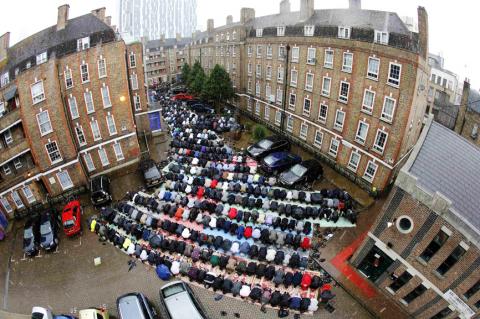
Photo: Reuters
“I can’t eat during the day and I can only eat after sunset, but I choose to fast according to Egyptian time, which makes it easier,” said Ahmed, who will compete in the men’s RS-X sailing fleet.
Sunset in Cairo will actually correspond to 7pm in Weymouth, meaning Habash will not have to wait quite as long to refuel after a hard day on the water.
“During the actual races I am not going to fast, but it does mean when I return home I’ll have to re-fast, but only for the five days that I miss,” he said.
Algeria’s team spokesman Mohammed Azzoug said there were no hard-and-fast rules for team members.
“It’s a very personal thing,” he said. “We just give them the basic information and let them make their decisions.”
Somalian 1,500m runner Mohamed Mohamed Hassan is not so relaxed.
“It’s a blessing month,” he said at a welcome ceremony at the Olympic Village in east London, an area with a huge Asian population and near one of the capital’s oldest mosques.
“I have been waiting for this month for the past 11 months, it’s a month we are very happy to welcome,” he said. “As an athlete it can get difficult, but I’m ready to fast and to train and to get through this difficult month.”
Teammate Zamzam Mohamed Farah added: “It’s a religious matter. I’m just as fast and I don’t think it will affect me.”
London 2012 organizers say they have catered for the needs of the 3,500 athletes faced with fasting from the early hours of the morning until gone 9pm local time every day.
A 24-hour catering service in the athletes village means they will be able to eat late at night, while they offer “fast-breaking” packs which include water, energy bars and fruit.
There are also multi-faith areas where athletes can perform their daily prayers.
It is a sensitive issue, particularly in an area that boasts 250,000 Muslims. Thousands, some in flowing white robes, gathered at the numerous mosques that can be found around the Olympic Park on Friday to mark the start of Ramadan.
Thousands of Muslim Olympians and family members are expected to visit the mosques over the coming weeks for prayers and other Ramadan activities.
“This year we are expecting a higher number of people to come through our doors,” Salman Farsi, an East London Mosque spokesman, said on Friday.
“Today is the first day. The whole place is buzzing,” he added.
However, opinion is divided among local worshippers about whether athletes should be excused.
“It should be an individual judgement call. I don’t think the Olympics is a sufficient enough reason to decide not to fast,” said Yahya Alkasmiyah, a charity worker whose family is originally from Bangladesh. “There are people who are doing all sorts of challenging things outside the Olympics as well. It may actually enhance and boost [athletes’] morale and give them an additional boost.”
Algeria’s Azzoug said there were no signs pointing to Mecca in athletes’ bedrooms in the village, but it was not a problem.
“Now they have iPhones you can easily find out which direction it is,” he said.

NO HARD FEELINGS: Taiwan’s Lin Hsiang-ti and Indonesia’s Dhinda Amartya Pratiwi embraced after fighting to a tense and rare 30-29 final game in their Uber Cup match The Taiwanese men’s team on Wednesday fought back from the brink of elimination to defeat Denmark in Group C and advance to the quarter-finals of the Thomas Cup, while the women’s team were to face South Korea after press time last night in the Uber Cup quarter-finals in Horsens, Denmark. In the first match, Taiwan’s top shuttler Chou Tien-chen faced a familiar opponent in world No. 3 Anders Antonsen. It was their 16th head-to-head matchup, with the Dane taking his fourth victory in a row against former world No. 2 Chou, winning 21-14, 13-21, 21-15 in 1 hour, 22 minutes. The

Jannik Sinner continued his quest to become the first man in history to win five Masters 1000 tournaments in a row with a 6-2, 6-3 victory over Danish qualifier Elmer Moller at the Madrid Open on Sunday. The world leader extended his winning streak to 19 matches, a run that began early March in Indian Wells, and he has captured 24 consecutive victories at the Masters 1000 level, dating back to the Paris Masters last October. Searching for a maiden title at this level on clay, Sinner advanced to the round of 16 at the Caja Magica with a 77-minute performance against
Tennis players are facing an unexpected opponent at the Madrid Open. A stomach virus or food poisoning has affected Iga Swiatek, Coco Gauff, Marin Cilic and others, raising concerns. World No. 1 Aryna Sabalenka avoided an upset by Naomi Osaka on the court on Monday and said she is trying to avoid illness by sticking to a diet of chicken breasts, rice and salad. The rumor among the players was bad shrimp tacos were to blame. Sabalenka knocked on wood for luck and said, “So far, so good. I heard that I have to avoid those tacos,” she laughed, adding “I stick to the
Kite-surfing fabrics, car tires and shortened shoelaces helped Kenyan Sabastian Sawe and Adidas crack the two-hour marathon barrier. When Sawe on Sunday shattered one of athletics’ most elusive barriers in storming to victory at the London Marathon in 1 hour, 59 minutes, 30 seconds, it did not come from just physiology and grit, but from design choices drawn from far beyond the course. Sawe debuted Adidas’ lightest-ever racing shoe, the Adizero Adios Pro Evo 3. “It starts with the mentality of the athlete, the coach, and the team behind the product, which is: What can we do better? What is the 1 percent


 RSS
RSS