


Brazil’s 1970 World Cup-winning team is fondly remembered as one of the best to have graced the competition but current coach Dunga says it may not have been as good as it looks in television replays.
Dunga, whose team is often criticized for a perceived lack of style, said the team featuring Pele and Rivelino may have been flattered by television because the public only see the best bits.
“In 1970, we didn’t have a television in my home,” Dunga said. “When they show highlights from 1970, all you see are the good parts.”
“Nobody repeats 1966 because Brazil didn’t do well. From 1958, they just show the good parts, and from 1962, they also just show the good parts,” he said.
“If we take the current Brazilian team and just show the best bits, fans will think it’s a spectacular team,” Dunga said. “But today, they show as many negative moments as good ones.”
Brazilian critics often hark back to the old days, complaining that the modern team lacks the artistic touch of the sides who won the World Cup in 1958, 1962 and 1970.
Even today, Brazilian television frequently repeats the famous goal Pele scored in the 1958 final against Sweden, his near miss from the center circle in the 1970 and the flowing move which ended with Carlos Alberto Torres slamming the ball into the net at the end of the 1970 final against Italy.
“Another thing is that the 1970 team had four months to prepare,” said Dunga, adding it was human nature to think things were better in the past.
“My grandfather always told my father it was better in his day and my father told me the same,” he said.
“I tell my son it was better in my day and I’m sure he’ll say the same to his son,” Dunga said.
“It’s difficult. Back in 1958, football was just about technique. Then they added physical preparation, then they brought in tactics, then they added the pressure and the emotional side,” Dunga said. “If you have a close look at the teams from the past, they committed the same mistakes as the teams of today.”
Dunga added that some people were just never satisfied.
“The pressure gets greater and greater,” he said.
“We always have to win but even when we win, they are not happy because we didn’t put on a show. If we put on a show, they are not happy because we didn’t score six or seven goals,” Dunga said. “If we score six or seven goals, then they say that the opposition was no good.”
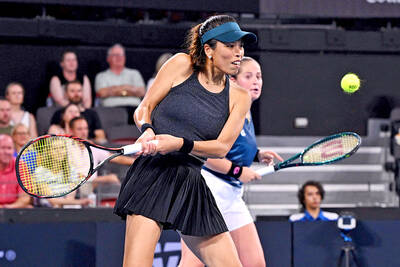
Taiwanese tennis star Hsieh Su-wei on Wednesday advanced to the second round of the mixed doubles at the French Open, after she and German partner Mark Wallner defeated Slovenian Andreja Klepac and Briton Lloyd Glasspool in straight sets, despite temperatures exceeding 32°C in Paris, while Taiwan’s top men’s doubles player Ray Ho also reached the second round. Hsieh, who made it to the semi-finals in the mixed doubles at Roland Garros in 2024, and Wallner defeated Klepac and Glasspool 6-3, 7-5 in just more than an hour, converting three of five break points, while holding their opponents to just one conversion
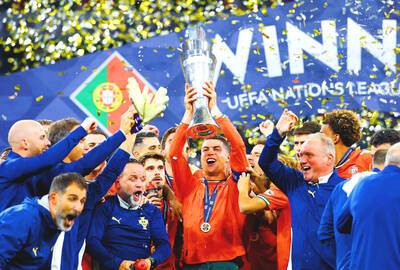
For some, Cristiano Ronaldo remains the essential spearhead for Portugal’s FIFA World Cup bid, while others believe his presence would prevent Roberto Martinez’s strong side from flourishing. The debate around the five-time Ballon d’Or winner rages on, as it did at UEFA Euro 2024 and four years ago in Qatar — yet Ronaldo endures, ready to play in a record sixth World Cup. The 41-year-old remains a global superstar despite swapping the European elite for Saudi Arabia’s Al-Nassr, and is the leading men’s international goalscorer with 143 strikes. With 25 of those coming in 30 games under Martinez, the coach
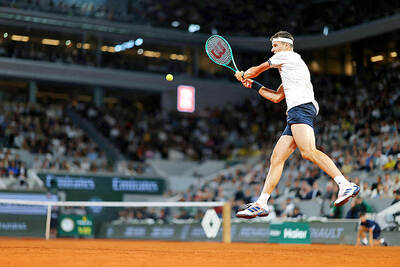
BIG NAMES GONE: Zverev is the clear favorite for a maiden Grand Slam title, reaching semi-finals for the fifth time in six years and finishing second on three occasions Alexander Zverev on Tuesday breezed past Rafael Jodar to stay on course for an elusive Grand Slam title at the French Open, while Jakub Mensik halted Joao Fonseca’s scintillating run in the quarter-finals. Zverev, the highest-ranked player left in the men’s draw, put an end to Spanish teenager Jodar’s impressive Roland Garros debut, easing into the semi-finals with a 7-6, (7/3), 6-1, 6-3 win. The 29-year-old Zverev is the clear favorite for a maiden Grand Slam title. He has finished runner-up on three occasions, including at the 2024 French Open. “I want to win the matches that are ahead of
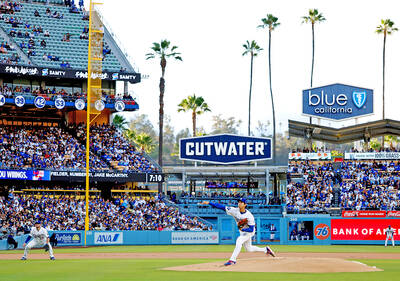
FAST AND LOOSE: Despite command struggles, Ohtani has pitched his way out of trouble after falling behind in counts, which manager Roberts credited to his velocity Shohei Ohtani on Wednesday night tossed six innings of no-hit ball, gave himself an early lead with a home run and still was not satisfied with his performance. The Los Angeles Dodgers’ two-way superstar dropped some expletives that were picked up by the on-field mic as he struggled with his command in a 4-1 win over the Colorado Rockies. He struck out seven, walked four and gave up an earned run in the fourth inning while visibly fuming on the mound. Ohtani (5-2) earned his third consecutive victory. “Just command was off, and I just felt like I was battling the lack of


 RSS
RSS