


Brazil is probably the only major soccer-playing country where reporters can join in goal celebrations and interview players as they fight on the pitch.
Dozens of television and radio reporters stand on the touchlines at games in Brazil, interviewing players seconds before kick-off, at halftime and when they storm off the pitch after being shown a red card.
If a fight breaks out, they run onto the pitch and try and get a few quick quotes. When a player scores, he will often go straight to the cameras and microphones so his celebration can be broadcast to millions of listeners.
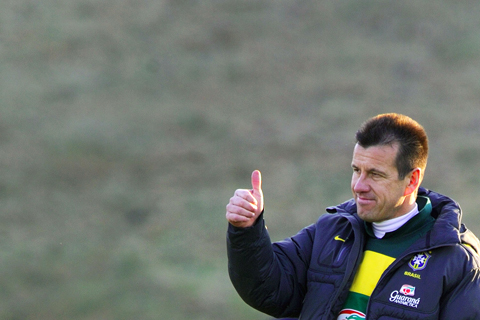
PHOTO: AFP
Last year, Ronaldo, playing his first domestic game in Brazil for 15 years, left the field with a black eye after he was hit on the head by a microphone and a television camera in a media scrum on the field at the end of the match.
After so long in Europe, he was shocked at finding reporters on the field.
“I can’t answer questions when I’m warming up,” he said.
For the hundreds of Brazilian reporters who are sent to the World Cup, the set-up, with no pitch access, can be a shock.
They have, however, traditionally enjoyed access to players that colleagues from other countries can only dream of.
Even at the height of a World Cup, Brazil would organize a daily “mixed zone” in which the players would walk alongside a barrier on their way back to the team bus, answering questions from the several hundred people in the media pack on the other side of the fence.
Although something of a sweaty scrum, it generally worked well. This World Cup, however, has been completely different.
Coach Dunga has replaced the sacred mixed zone with a daily conference in which two selected players trot out the usual cliches to a room of 400 reporters.
He has even done the unthinkable and restricted access to training sessions — often broadcast live in Brazil.
The new policy has been especially tough on radio reporters, who have hours of air time to fill. Radio is still hugely important in Brazil, where many people still do not have Internet access.
“We have to talk on seven programs every day and the hourly news bulletins,” Radio Itatiaia reporter Wellington Campos said. “In the past, it was always very open, not just for the Brazilians but also for foreigners, you could choose the player you wanted to speak to. That’s over.”
This has led to tensions between the media and the team, especially as Dunga has included the powerful Globo television network — Brazil’s rights holders — in his clampdown.
Four years ago, players would take part in round tables and give exclusive interviews to Globo but, under Dunga, they are treated the same as everyone else.
Tensions boiled over after Sunday’s win over Ivory Coast, with an exchange between Dunga and a Globo journalist during the post-match press conference.
Brazilian media said Dunga was heard to swear under his breath.
Globo later criticized the coach’s behavior and has since refused to use his name.
With the battle set to continue, Brazil’s 2002 World Cup winning coach Luiz Felipe Scolari suggested a truce.
“We have to put up with each other,” he said. “The best thing is to work together, and when the World Cup finishes, each side can tell the other to go to hell.”
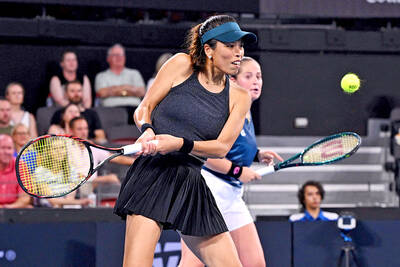
Taiwanese tennis star Hsieh Su-wei on Wednesday advanced to the second round of the mixed doubles at the French Open, after she and German partner Mark Wallner defeated Slovenian Andreja Klepac and Briton Lloyd Glasspool in straight sets, despite temperatures exceeding 32°C in Paris, while Taiwan’s top men’s doubles player Ray Ho also reached the second round. Hsieh, who made it to the semi-finals in the mixed doubles at Roland Garros in 2024, and Wallner defeated Klepac and Glasspool 6-3, 7-5 in just more than an hour, converting three of five break points, while holding their opponents to just one conversion
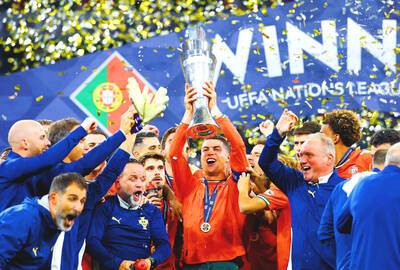
For some, Cristiano Ronaldo remains the essential spearhead for Portugal’s FIFA World Cup bid, while others believe his presence would prevent Roberto Martinez’s strong side from flourishing. The debate around the five-time Ballon d’Or winner rages on, as it did at UEFA Euro 2024 and four years ago in Qatar — yet Ronaldo endures, ready to play in a record sixth World Cup. The 41-year-old remains a global superstar despite swapping the European elite for Saudi Arabia’s Al-Nassr, and is the leading men’s international goalscorer with 143 strikes. With 25 of those coming in 30 games under Martinez, the coach
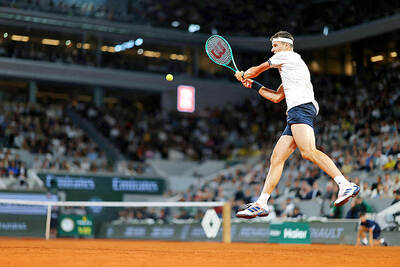
BIG NAMES GONE: Zverev is the clear favorite for a maiden Grand Slam title, reaching semi-finals for the fifth time in six years and finishing second on three occasions Alexander Zverev on Tuesday breezed past Rafael Jodar to stay on course for an elusive Grand Slam title at the French Open, while Jakub Mensik halted Joao Fonseca’s scintillating run in the quarter-finals. Zverev, the highest-ranked player left in the men’s draw, put an end to Spanish teenager Jodar’s impressive Roland Garros debut, easing into the semi-finals with a 7-6, (7/3), 6-1, 6-3 win. The 29-year-old Zverev is the clear favorite for a maiden Grand Slam title. He has finished runner-up on three occasions, including at the 2024 French Open. “I want to win the matches that are ahead of
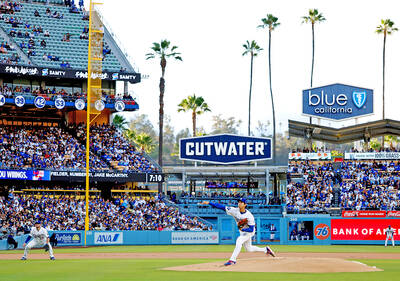
FAST AND LOOSE: Despite command struggles, Ohtani has pitched his way out of trouble after falling behind in counts, which manager Roberts credited to his velocity Shohei Ohtani on Wednesday night tossed six innings of no-hit ball, gave himself an early lead with a home run and still was not satisfied with his performance. The Los Angeles Dodgers’ two-way superstar dropped some expletives that were picked up by the on-field mic as he struggled with his command in a 4-1 win over the Colorado Rockies. He struck out seven, walked four and gave up an earned run in the fourth inning while visibly fuming on the mound. Ohtani (5-2) earned his third consecutive victory. “Just command was off, and I just felt like I was battling the lack of


 RSS
RSS