


Ethnic Koreans in Japan cried over North Korea’s early exit from the World Cup on Monday, but said they were grateful for the rare chance to unite and see the team in their first finals in 44 years.
North Korea, who lost to Brazil last week in their opening game in South Africa, were crushed 7-0 by a merciless Portugal, meaning they cannot reach the knockout round.
Some 500 pro-Pyongyang Koreans supported their team at a school in Tokyo, donning symbolic red T-shirts and waving North Korean flags.
They cheered especially loudly when the screen showed J-League striker Jong Tae-se — “the people’s Rooney” — as well as two other Japan-born North Korea players, midfielders Ahn Yong-hak and Ryang Yong-gi.
“Cho-sen [Korea] are playing in such a huge game after 44 years and my son is playing in the team,” Ahn’s mother Jong Mal-rye, 62, said before the game. “Nothing is more delighting than this.”
“Win, win, Cho-sen,” fans shouted in unity at the school’s steaming hot gymnasium, where they set up food booths selling Korean pickles, but as the goals piled up, anticipation turned to misery.
“I regret it, but I have to say the fact that we, Koreans, got together like this means a lot,” Mun Sun-ryong, 26, said after witnessing the rout. “This is our real power. Not many ethnic groups in Japan can do the same.”
Japan, which occupied the Korean peninsula until the end of World War II, is home to nearly 1 million ethnic Koreans, many of them children of former forced laborers.
Up to 100,000 of them are believed to be loyal to Pyongyang.
“I realized how great Koreans are just because so many got together here for this,” said Lee Nami, an 18-year-old university student. “I regret the result of today’s game, but the Koreans can unite like this when the chance comes.”
Ethnic Koreans in Japan, divided into the pro-North and pro-South, often have complex backgrounds.
Striker Jong, who broke down in tears during his side’s national anthem before the Brazil game, holds South Korean nationality, but he managed to obtain a North Korean passport after attending patriotic pro-Pyongyang schools in Japan at the urging of his ethnic Korean mother, who is loyal to the North.
It was the communist nation’s first World Cup since 1966 in England, when they upset the mighty Italy to reach the quarter-finals.
Ri Jon-su, 25, who was selling red T-shirts bearing the slogan “1966 Again,” said before the game: “I want the team to play as aggressively as it did in 1966.”
It was not to be.
■EUSEBIO HAILS VICTORY
AFP, CAPE TOWN, SOUTH AFRICA
Elated Portugal legend Eusebio has hailed his country’s 7-0 World Cup drubbing of North Korea as one of the team’s greatest ever victories.
Considered one of the best players of all time, Eusebio is in South Africa with the team and witnessed their goal rampage in Cape Town on Monday.
“Fantastic, just fantastic,” said the 68-year-old, who scored four goals for Portugal when they memorably came from 3-0 down to beat North Korea 5-3 in the 1966 World Cup quarter-finals. “That was one of the greatest wins I’ve ever seen from the national side. To score seven goals against a team that had given Brazil a lot of work shows the quality that Portugal have,” he told the FIFA Web site. “Everyone’s over the moon.”
In reference to that classic encounter in 1966, Eusebio said it was difficult to make comparisons.
“You suffer a lot more when you watch games than when you play in them,” he said. “Even when we went three goals down in that 1966 match, I didn’t feel as nervous as I did today, at least until we got the second goal, and then the third and the fourth, which came right after each other.”
North Korea held Portugal for almost 30 minutes until Raul Meireles got the breakthrough, but it was the three quick second-half goals from Simao, Hugo Almeida and Tiago that changed the course of the match.
Portugal face Brazil in Durban on Friday and coach Carlos Queiroz said their reputation would be at stake.
“We are closer to the round-of-16, but we don’t want Brazil to score any goals because this will put our reputation, our prestige, into question,” he said.

For some, Cristiano Ronaldo remains the essential spearhead for Portugal’s FIFA World Cup bid, while others believe his presence would prevent Roberto Martinez’s strong side from flourishing. The debate around the five-time Ballon d’Or winner rages on, as it did at UEFA Euro 2024 and four years ago in Qatar — yet Ronaldo endures, ready to play in a record sixth World Cup. The 41-year-old remains a global superstar despite swapping the European elite for Saudi Arabia’s Al-Nassr, and is the leading men’s international goalscorer with 143 strikes. With 25 of those coming in 30 games under Martinez, the coach

Taiwanese tennis star Hsieh Su-wei on Wednesday advanced to the second round of the mixed doubles at the French Open, after she and German partner Mark Wallner defeated Slovenian Andreja Klepac and Briton Lloyd Glasspool in straight sets, despite temperatures exceeding 32°C in Paris, while Taiwan’s top men’s doubles player Ray Ho also reached the second round. Hsieh, who made it to the semi-finals in the mixed doubles at Roland Garros in 2024, and Wallner defeated Klepac and Glasspool 6-3, 7-5 in just more than an hour, converting three of five break points, while holding their opponents to just one conversion

FAST AND LOOSE: Despite command struggles, Ohtani has pitched his way out of trouble after falling behind in counts, which manager Roberts credited to his velocity Shohei Ohtani on Wednesday night tossed six innings of no-hit ball, gave himself an early lead with a home run and still was not satisfied with his performance. The Los Angeles Dodgers’ two-way superstar dropped some expletives that were picked up by the on-field mic as he struggled with his command in a 4-1 win over the Colorado Rockies. He struck out seven, walked four and gave up an earned run in the fourth inning while visibly fuming on the mound. Ohtani (5-2) earned his third consecutive victory. “Just command was off, and I just felt like I was battling the lack of
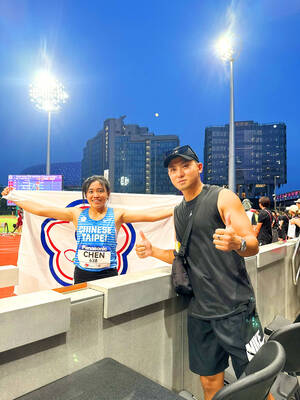
Taiwanese sprinter Chen Yi-cen on Friday won the silver medal in the women’s 400m final at the Asian U20 Athletics Championships in Hong Kong, with a time of 53.16 seconds. Chen, 15, was the youngest among the eight finalists, and her performance also met the qualifying standard of 53.50 seconds for the Nagoya Asian Games in Japan in September and October. Chen first made her mark at the National Games in Tainan in 2023, at the age of 13, winning the women’s 400m final in 55.55 seconds to become the youngest gold medalist in the history of the event. Meanwhile,


 RSS
RSS