


“You can’t lose anything here — except fat.”
Such is the greeting for visitors written on the steps to the women’s section of one of Jeddah’s most modern fitness studios. Most of the girls and women who are working out on fitness equipment or walking on treadmills to the sound of disco music do have a good deal of heft on their hips.
But most of them don’t seem to be working up too much of a sweat — their pace is a moderate one as they tread the stepper, or chat away at the juice bar.
“Oh, I’m so tired from the work-out,” says one of the thinner women as she alternatively works on her upper arm muscles and talks on her mobile with a girlfriend.
Many women here are engaged in physical fitness sport for the first time in their lives — for in the state-run girls’ schools in Saudi Arabia, there is no physical education because traditionalists and Islamic scholars have spoken out against it. They fear a decline in morality if girls are permitted to kick and chase after a ball or if women are allowed to enter a sports stadium.
“Football and basketball are sports in which you have to move a lot and jump, and this could damage a girl’s hymen,” Sheikh Abdullah al-Manea, a member of the high council of religious scholars recently warned.
Another sheikh was more blunt: “Women’s sport is sinful.”
As a result, female athletes are not welcome in the sports clubs in the Saudi kingdom. As yet, there is not even an authority in charge of issuing licenses for women’s fitness studios. In recent months several studios for women were closed because they lacked a permit. Operators of men’s fitness studios don’t have any such problem.
The few women’s fitness clubs which still exist in the big cities are operated as a section of a hospital or under the term “health club.”
One such club is home to a basketball court which the women’s basketball team Jeddah United rents for its practice sessions.
“In some parts of society they have a very narrow-minded idea about what they think is religion,” says Lina al-Maeena, the founder of the basketball club. “It is the same segment of society that was against girls’ education and satellite TV. They are a minority, but they have a very loud voice.”
On this recent balmy autumn evening the young mother is wearing a black robe and a headscarf. This is the dress code dictated by law in Saudi Arabia for all women who move about in public.
Lina al-Maeena then resolutely strides through a small door to the court where the youth team is already training — and suddenly there she stands, in basketball shorts reaching to her knees, a T-shirt and a sweat band in her hair.
“I am conservative. I don’t want at all to play basketball on the street in my shorts,” Lina says vehemently, while her teammates are now also taking off their robes. “But we need more mobility. Women in Saudi Arabia should finally be able to drive cars and our club should get exactly the same support as the men’s clubs do.”
A long-legged girl now approaches Al Sharefa Maali al-Abdali, who is collecting the girls’ monthly dues. “Please be patient,” the girl says, then promises: “My mother has so far only paid for October, but I’ll bring the money for November next time.”
Al-Maeena — who is not only the founder, but also the captain of the women’s team — explains, “We have a few sponsors, but we have to pay for the court, the jerseys and everything else by ourselves.”
In the meantime, the port city of Jeddah, which is considerably more open to the world than the capital, Riyadh, and most other Saudi provinces, also now has a private women’s soccer club.
The typical Saudi lifestyle that binds women to the household also poses health risks. Many of them suffer from osteoporosis, diabetes, depression and symptoms of vitamin D insufficiency.
“Sports are the best medicine against depression and boredom,” al-Maeena said.
In her view, it would also be better for the social climate if girls and women could get more exercise in Saudi Arabia.
“It’s not for nothing that it is said, ‘The devil lives in the backyard of empty minds,’” she said.
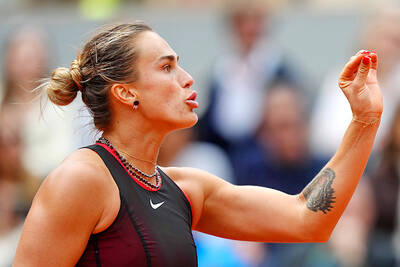
After letting another big lead slip with an error-strewn performance at the French Open on Wednesday, top-ranked Aryna Sabalenka felt like getting as far away from the courts as possible. “Just want to quit tennis right now,” Sabalenka said after wasting a lead of a set and two breaks in a 3-6, 7-5, 6-0 loss to Diana Shnaider in the women’s singles quarter-finals. “We’ll see in few days. Hopefully I’ll get back on track mentally.” Sabalenka’s wait for a first French Open title continues despite the four-time major winner leading 4-1 in the second set and being two points from victory while
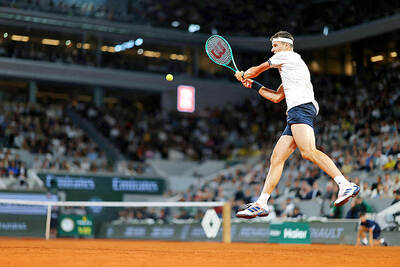
BIG NAMES GONE: Zverev is the clear favorite for a maiden Grand Slam title, reaching semi-finals for the fifth time in six years and finishing second on three occasions Alexander Zverev on Tuesday breezed past Rafael Jodar to stay on course for an elusive Grand Slam title at the French Open, while Jakub Mensik halted Joao Fonseca’s scintillating run in the quarter-finals. Zverev, the highest-ranked player left in the men’s draw, put an end to Spanish teenager Jodar’s impressive Roland Garros debut, easing into the semi-finals with a 7-6, (7/3), 6-1, 6-3 win. The 29-year-old Zverev is the clear favorite for a maiden Grand Slam title. He has finished runner-up on three occasions, including at the 2024 French Open. “I want to win the matches that are ahead of

For some, Cristiano Ronaldo remains the essential spearhead for Portugal’s FIFA World Cup bid, while others believe his presence would prevent Roberto Martinez’s strong side from flourishing. The debate around the five-time Ballon d’Or winner rages on, as it did at UEFA Euro 2024 and four years ago in Qatar — yet Ronaldo endures, ready to play in a record sixth World Cup. The 41-year-old remains a global superstar despite swapping the European elite for Saudi Arabia’s Al-Nassr, and is the leading men’s international goalscorer with 143 strikes. With 25 of those coming in 30 games under Martinez, the coach
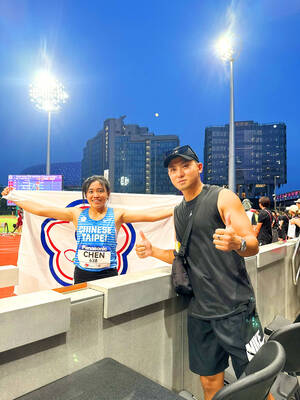
Taiwanese sprinter Chen Yi-cen on Friday won the silver medal in the women’s 400m final at the Asian U20 Athletics Championships in Hong Kong, with a time of 53.16 seconds. Chen, 15, was the youngest among the eight finalists, and her performance also met the qualifying standard of 53.50 seconds for the Nagoya Asian Games in Japan in September and October. Chen first made her mark at the National Games in Tainan in 2023, at the age of 13, winning the women’s 400m final in 55.55 seconds to become the youngest gold medalist in the history of the event. Meanwhile,


 RSS
RSS