


The US Securities and Exchange Commission (SEC) has appealed the dismissal of an insider trading lawsuit filed against billionaire Mark Cuban, owner of the Dallas Mavericks NBA team.
The SEC filed notice on Wednesday with the US District Court in Dallas, which dismissed the case on July 17, informing the court of plans to challenge the ruling in a New Orleans appeal court.
US District Judge Sidney Fitzwater granted Cuban’s motion to dismiss the case, but gave the SEC time to file an amended complaint.
The SEC decided instead to appeal to a higher court.
The 51-year-old Texas business tycoon was alleged to have sold 600,000 shares of stock from Internet search engine company Mamma.com Inc in 2004 after receiving confidential information about a private offering.
The SEC alleged in its civil suit that Cuban avoided a loss of US$750,000 by selling his stake in the company.
Fitzwater wrote in his ruling that the SEC didn’t accuse Cuban of promising not to trade based on the confidential information he received. Therefore the commission couldn’t hold him liable for illegal insider trading.
Cuban made his money through Internet and technology companies and in 2000 purchased the Mavericks, becoming an outspoken critic of some aspects of the league and billing himself as his team’s top fan.
In related news, NBA commissioner David Stern said on Thursday that the NBA envisions having franchise teams in European cities, although there was no timetable for the move.
Stern was speaking in Taipei ahead of the first ever NBA exhibition game in the country, in which the Indiana Pacers topped the Denver Nuggets 126-104.
“There’s some good possibility over the course of many years, that if there’s appropriate arena development in Europe, there could be actual NBA franchises in Europe,” he said. “That’s the way we see the development of basketball in the world.”
Earlier this week, Stern said the league was planning a regular-season game in London sometime before the 2012 Olympics.
The only regular NBA games ever staged outside North America were in Japan in the early 1990s.
The NBA also sees affiliated leagues in other continents.
“The model in Asia, probably in Latin America, possibly in Africa will lead us — if there’s adequate arena development — to having NBA affiliated leagues, with partners in local basketball federations,” Stern said.

TITLE CAMPAIGN: The victory sent the Monkeys to the Taiwan Series for the third time in the past four seasons as they seek their first championship since 2019 The stage is set for the Taiwan Series after the Rakuten Monkeys on Monday beat the Uni-President Lions 4-3 in Game 5 of the CPBL Challenger Series in Kaohsiung. The Monkeys, who entered the top of the ninth scoreless, tied the game with a three-run blast by Lin Chih-ping and scored the winning run in the 10th on an RBI single by Lin Li, a three-time batting champion in the CPBL. Both players entered the game as pinch hitters. “The coach told me to stay prepared as a pinch hitter in the later part of the game. My teammates had

The Ministry of Sports on Wednesday night called for the Chinese Taipei Football Association (CTFA) to address issues in Taiwanese soccer after national manager Huang Che-ming on Tuesday resigned following Taiwan’s elimination in AFC Asian Cup qualifiers. Taiwan on Tuesday were thrashed 6-1 by Thailand in their Group D tie at Taipei Municipal Stadium. Taiwan finished with no points, after losing all four of their matches, eliminating them from qualifying for the 2027 AFC Asian Cup. Huang made his surprise resignation at a post-match news conference, following three losses since he took over the team from English coach Gary White in August. Huang

HIT AND RUN: Toronto manager John Schneider got his wish that his team ‘find some slug in the air out here,’ as the Blue Jays combined to total 611m of homers Tired in Toronto, the Blue Jays slugged in Seattle. Vladimir Guerrero Jr and George Springer on Wednesday woke up the Jays, as Toronto hit five home runs to rebound from an early deficit, routing the Mariners 13-4 and closing to 2-1 in the American League Championship Series (ALCS). Toronto had 18 hits — all within the first three pitches of each at-bat. “If they give us a first pitch, the pitch that we’re looking for, we’re going to attack and we’re going to be aggressive,” Guerrero said. Seattle starter George Kirby gave up eight of the hits. “I wasn’t really executing when they got
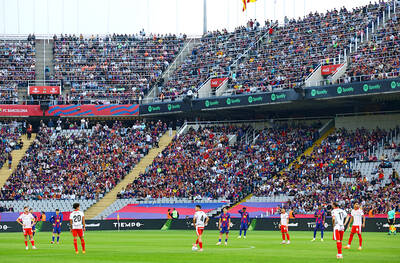
For a second straight day, protests by La Liga players against staging a regular-season game in Miami, Florida, in December were censored or not fully broadcast for television audiences. The television feed of Barcelona’s home game against Girona switched right before kickoff to an exterior view of the stadium, which only showed part of the field from a distance. That impeded home audiences from seeing the teams’ players standing still for the first 15 seconds in opposition to La Liga’s plan to hold the Barcelona-Villarreal game across the Atlantic on Dec. 20. The broadcasts of the initial moments after kickoff of the


 RSS
RSS