


A couple of weeks ago thunderstorms dispelled the gray clouds for a day and gave Beijing breathing space to hold one of its test events for the upcoming Olympics.
The timing of the storm was not fortuitous, said one employee of the Beijing Organizing Committee for the Olympic Games (BOCOG). Rockets with silver iodide shot into the heavens had triggered it.
Cloud-seeding is just one of the measures that organizers will deploy to tip the meteorological scales and prompt blue skies over Beijing for the Olympics.
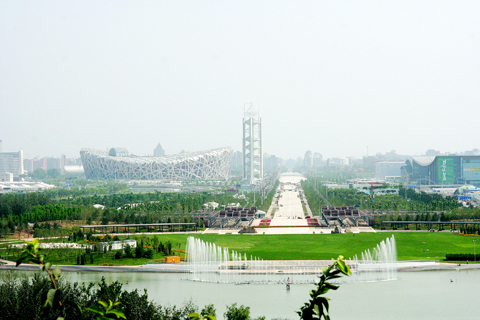
PHOTO: JOHN HANCOCK
It’s a tall order, because for the past month there have been mostly gray-sky days here. The sun has been hiding, there is occasional rain and most of the time it is like living in an atmospheric potato soup.
We are in the middle of the rainy season and while organizers managed to switch the dates for the Games from July (the wettest month) to August (the second-wettest) in order to improve the prospects for good weather, there are still concerns.
China Meteorological Administration (CMA) experts are forecasting a 41 percent chance of drizzle for the opening ceremony on Aug. 8. But while cloud-seeding may prevent the clouds from raining on this parade, the biggest problem is pollution.
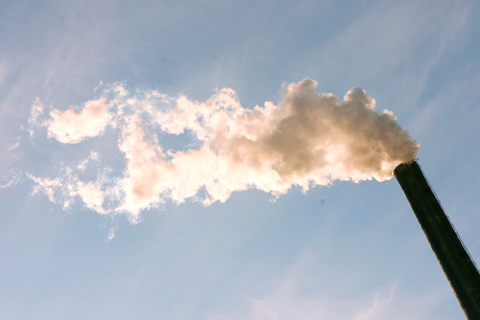
PHOTO: JOHN HANCOCK
The city has experienced breakneck development over the past 30 years and this has increased since being awarded the right to hold the Games in 2001.
The number and scale of new buildings erected over the past seven years are impressive. Increased wealth means more people in cars; the number of automobiles has swollen to 3.3 million. More power stations and factories have been constructed to fuel this prosperity.
This is undeniably good for the economy but bad for air quality and there is no silver bullet solution.
Organizers promised the International Olympic Committee (IOC) that air quality for the Games would be within WHO standards, and much has been done in this regard.
Many of the most polluting factories have been moved out of the city, hundreds of thousands of homeowners have switched from oil to gas heating, and emission standards for vehicles have been raised.
In support of what they are calling a “Green Olympics,” organizers point to the impressive 6.7m² Olympic Forest Park that has just opened. They also mention planting hundreds of millions of trees to provide 50 percent “green coverage” in the city.
In the past 10 years, they claim, pollutants such as sulfur dioxide have been reduced by 61 percent, carbon monoxide by 39 percent and inhalable particulates by 17.8 percent.
City officials say US$17.5 billion has been spent on pollution reduction measures over the same period, but others point to the gray skies and argue it has clearly not been enough.
IOC president Jacques Rogge has generally been supportive of the organizers but even he was moved to say last year that pollution was still an issue and suggested endurance events would be rescheduled if conditions were bad.
In response, Games organizers are insisting it will be all right on the night(s) because further measures controlling pollution will be introduced.
From this Sunday large-scale construction and spray painting in the city will stop, gas stations will be closed if they haven’t instituted oil vapor recovery upgrades and quarrying will be halted.
In addition, 70 percent of government motor vehicles will be taken off the road and cars will be banned on alternate days according to whether their license plates end in odd or even numbers.
All this shows determination among organizers to keep their word, but the gray mist stubbornly remains. So now it has become a battle over how to define it. Natural fog? Or unnatural smog?
The meteorological administration is citing the number of blue-sky days that it tallied last year, up from 100 in 1998 to 246 last year, as evidence for an improvement in air quality. They were hoping for 258 blue-sky days this year.
But these figures have been challenged. The BBC has been doing its own monitoring for the past few weeks and suggests that Beijing is turning gray into blue. The evidence of my own eyes over the past year tends to support this theory.
A lot of effort is being invested into shifting the pollution, but it seems now that a miracle — like cloud-seeding — is needed to radically improve the situation. The organizers must be praying for fair winds.
“John Hancock” is the Taipei Times’ correspondent for the Beijing Olympics.

Taiwan’s top women’s badminton doubles duo, Hsieh Pei-shan (謝沛珊) and Hung En-tzu (洪恩慈), achieved a straight-sets victory over Japan’s Kaho Osawa and Mayui Tanabe at the Badminton World Federation (BWF) Super 300 Macau Open on Sunday. The Taiwanese pair won the final 21-18, 21-12, marking the duo’s second title this year after their win at the BWF Super 300 Taipei Open in May. The match on Sunday was their first encounter with the Japanese duo, ranked No. 63 in the world. Hsieh and Hung, ranked No. 12, began the opening game well. Hung, who plays left-handed, performed strongly at both the net and the
Canadian teenager Victoria Mboko upset top-seeded Coco Gauff 6-1, 6-4 on Saturday night to reach the National Bank Open quarter-finals. “Your support was incredible,” Mboko told the crowd in French after a chorus of “Ole, Ole, Ole” chants echoed around the venue. “I’m really happy to win today ... It’s incredible. I’m so happy to beat such a great champion.” Gauff dropped to 2-3 since winning the French Open. She followed the major victory with opening losses in Berlin and Wimbledon, then overcame double-fault problems to win two three-set matches in Montreal. Gauff had five double-faults on Saturday after having 23 in

Jobe Bellingham on Tuesday admitted to having “anxieties” on following in brother Jude’s footsteps after joining Borussia Dortmund in the summer. Jobe Bellingham, 19, is two years younger than Jude Bellingham, who joined Real Madrid in 2023 after three years at Dortmund. A centerpiece of the England national team, Jude Bellingham has emerged as one of the best players in the world in recent seasons. The younger Jobe Bellingham joined Dortmund in June from Sunderland after their promotion to the English Premier League. He admitted he understood what the perception would be ahead of the move to Germany. “It’s something you do think about.

Before Tuesday’s 7-2 win at the Atlanta Braves, Milwaukee Brewers manager Pat Murphy suggested “most people couldn’t tell you five players on our team.” A look at the standings would indicate more Brewers players soon will be recognized by more fans. After all, it is difficult to overlook a team that not only continues to extend their lead in the National League Central, but also boasts the best record in the majors. “What we’re doing in here right now is special,” right-handed pitcher Freddy Peralta said after allowing only four hits and one run in five innings, while setting a career high with


 RSS
RSS