


Under a golden sun, Paolo Bettini capped a perfect day for cycling by outracing, outwitting and, finally, outsprinting everyone to win the world road race title.
If ever there was a glorious highlight to a season, that was it.
As the Italian crossed the line, though, there was little joy because he had been involved in a doping scandal. He took out an imaginary gun and fired it.
"If anyone felt it was directed at them, they may have reason to think so," Bettini said.
He might as well have been shooting for all of cycling, because if people thought the sport could not sink lower than last year, they had not heard about this year.
At the end of yet another year clouded by doping scandals, Bettini showcased the sport at its best -- a veteran, never caught using performance-enhancing drugs, who used every ounce of emotion and power to win a second straight world title.
In a sport where trust is now threadbare, fans want to continue to believe in people like the Olympic champion and because of him there is hope for a better future.
SPONSORS FLEE
Some big sponsors bolted this year, most notably the sponsors of Jan Ullrich's former team, T-Mobile, and Lance Armstrong's former team, Discovery Channel. Others keep longing for that bright future, like Rabobank.
The Dutch bank was swept from high to low in one afternoon when Michael Rasmussen first seemingly clinched the Tour de France title only to be kicked out by his team for lying about his whereabouts to allegedly avoid drug tests.
Astana will stay, too, despite the expulsion of Alexandre Vinokourov from the Tour when he tested positive for a banned blood transfusion.
"I am telling you straight out. It is not five to midnight, it is five past," exasperated Rabobank sponsor Piet Van Schijndel said. "We just cannot continue like this."
It was another year when the memories of riders scaling the pristine peaks of the Tour or clattering over the muddy cobblestones of Paris-Roubaix were blocked out by views of anti-doping stations near the finish line and the hushed corridors of courts.
Hushed, though, was not the appropriate description for the Floyd Landis doping hearing in May, which highlighted the unsavory year.
Nine days of testimony to determine whether the American should be suspended and stripped of last year's Tour title dug deep into the underbelly of cycling. But never so deep than when Landis' manager threatened to reveal that three-time Tour champion Greg LeMond was sexually abused as a child if he testified against his client. LeMond then sent out the news himself and testified.
In the end, Landis lost his expensive and explosive case when an arbitration panel decided last year's Tour de France champion used synthetic testosterone to fuel his spectacular comeback victory. But like so many doping cases, this one refuses to go away. Landis' appeal to the Court of Arbitration for Sport is likely to be heard in Lausanne, Switzerland, early next year.
One year late, Oscar Pereiro was named the champion. But Landis was far from the only cyclist linked to doping this year.
OPERATION PUERTO
In June last year, Giro d'Italia champion Ivan Basso received a maximum two-year doping ban after acknowledging involvement in the Spanish blood-doping investigation, known as Operation Puerto.
The Puerto scandal, too, rife with loose ends and mystery, is bound to linger into next year.
Alberto Contador, however, capped a storybook comeback from a brain aneurism three years earlier to win the sport's biggest prize -- 23 seconds ahead of Cadel Evans for the second-narrowest margin in the Tour de France's 104-year history.
"I am marked for life by my brain operation and it allows me to savor this moment," Contador said.
How he got to the winner's stand, though, was a different story.
First, Rasmussen was kicked off his team while wearing the yellow jersey with just a few days to go. A few days earlier, Vinokourov also had to go. To the uninitiated it seemed the young Spaniard had won by default.
Contador also came under the doping glare since he missed last year's Tour when his former team was disqualified because he and four other riders were implicated in Operation Puerto. He said his name turned up by mistake.
Doping was also lurking at the World Championships in Stuttgart, Germany.
"Every big event becomes a time bomb," Bettini said before the race.
ANTI-DOPING PLEDGE
As a gesture, the International Cycling Union (UCI) wanted every rider to sign an anti-doping pledge, but Bettini refused for personal reasons. The host city got wind of it and sued to keep him out of the race. It needed a court decision to get the defending champion to the starting line.
At the same time, Giro d'Italia champion Danilo Di Luca withdrew from the championships after the Italian Olympic Committee recommended he be banned for doping. That week, the UCI lost a court case and was forced to let Spanish rider Alejandro Valverde race even though it is convinced he is linked to Operation Puerto.
"I thought that after Landis, Operation Puerto, it could not get worse," UCI president Pat McQuaid said. "In effect, it has got worse."
Taiwanese world No. 1 women’s doubles star Hsieh Su-wei on Saturday overcame a first-set loss to win her opening match at the Madrid Open. Top seeds Hsieh and partner Elise Mertens of Belgium, with whom she last month won her fourth Indian Wells women’s doubles title, bounced back from a rocky first set to beat Asia Muhammad of the US and Aldila Sutjiadi of Indonesia 2-6, 6-4, 10-2. Hsieh and Mertens were next to face Heather Watson of the UK and Xu Yifan of China in the round of 16. Thirty-eight-year-old Hsieh last month reclaimed her world No. 1 spot after her Indian
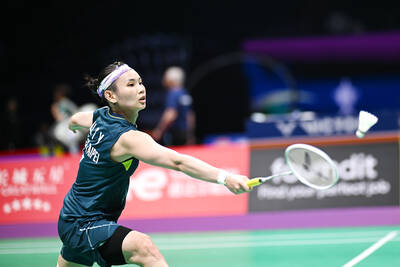
EYES ON THE PRIZE: Armed with three solid men’s singles shuttlers and doubles Olympic champions, Taiwan aim to make their first Thomas Cup semi-final, Chou Tien-chen said Taiwanese badminton star Tai Tzu-ying yesterday quickly dispatched Malaysia’s Goh Jin Wei in straight sets, while her male counterpart Chou Tien-chen beat Germany’s Kai Schaefer, as Taiwan’s women’s and men’s teams won their Group B opening rounds of the TotalEnergies BWF Thomas and Uber Cup Finals in Chengdu, China. World No. 5 Tai beat Goh 21-19, 22-20 in a speedy 33 minutes, her fourth straight victory over the world No. 24 shuttler since they first faced each other in the quarter-finals of the 2018 Malaysia Open, where Tai went on to win the women’s singles title. Malaysia followed up Tai’s opening victory
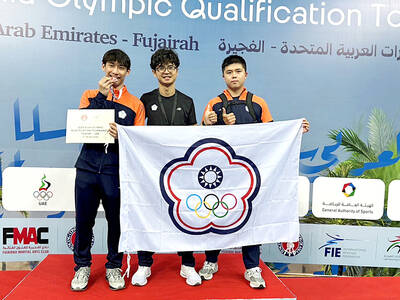
Chen Yi-tung (陳奕通) secured a historic Olympic berth on Sunday by winning the senior men’s foil event at the 2024 Asia Oceania Zonal Olympic Fencing Qualifiers in United Arab Emirates. Chen defeated Samuel Elijah of Singapore 15-4 in the final in Dubai to secure the only wild card in the event, making him the first male Olympian fencer from Taiwan in 36 years and only the sixth Taiwanese fencer to ever qualify for the quadrennial event. The last appearance by a Taiwanese male fencer at the Olympics was in 1988, when Wang San-tsai (王三財) and Cheng Ming-hsiang (鄭明祥) competed in Seoul. The

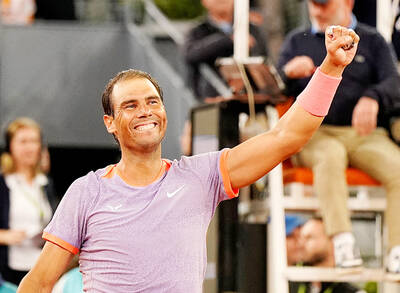
Rafael Nadal on Tuesday lost in straight sets to 31st-ranked Jiri Lehecka in the fourth round at the Madrid Open, while Taiwan’s Hsieh Su-wei advanced to the semi-finals in the women’s doubles. Nadal said that he was feeling good about his progress following his latest injury layoff. Nadal called it a “positive week” in every way and said his body held up well. “I was able to play four matches, a couple of tough matches,” Nadal said. “So very positive, winning three matches, playing four matches at the high level of tennis. I enjoyed a lot playing at home. I leave here with


 RSS
RSS