


Few big-time bankers get as excited by cycling as Piet van Schijndel. Then again, he has millions of dollars in sponsorship riding on races such as the Tour de France.
Perhaps Van Schijndel's best moment came in July during this year's Tour when Michael Rasmussen crossed the finish of the 16th stage with "Rabobank" emblazoned on his chest.
The Dane had won the Tour's toughest Pyrenees stage for Rabobank -- one of the biggest banks in the Netherlands -- and appeared to have a lock on the title.
"I saw him win the stage on the Aubisque mountain at 5pm, then at 8pm, I got this call," said Van Schijndel, an executive board member of Rabobank.
In what Van Schijndel called a "nightmare," Rabobank pulled Rasmussen out of the Tour for lying about his whereabouts to avoid doping tests. Things got worse a few days later when rumors surfaced that a team leader was also involved.
Rabobank immediately ordered an inquiry, which found that Rasmussen acted on his own without team involvement. He was fired and Rabobank emerged with its reputation intact.
"We employ 50,000 people. Everybody knows here that if you put your hands in the till and take a euro, you are gone," Van Schijndel said.
In cycling, doping allegations can instantly tarnish a sponsor's reputation -- and make it difficult to draw new multinational companies into the sport.
Because of the doping scandals, the cost of sponsoring a cycling team has leveled off in the past two years at an annual average of about 8 million euros(US$11.75 million).
Deutsche Telekom, the main sponsor of the T-Mobile team, last month ended its 16-year involvement in cycling because of a series of doping cases. Audi and Adidas also dropped their team.
When Discovery Channel stopped sponsoring of Lance Armstrong's former team this year, team leader Johan Bruyneel had a replacement firm lined up. But it pulled out at the last minute because of doping scandals.
Wim Lagae, a professor in sports marketing at Leuven University in Belgium, said cycling is not alone in facing sponsorship problems and that, as risks go, it remains an attractive niche.
"There are a lot worse deals to be had," Lagae said. But "in bad times ... there is this immediate overshoot, and you end up in crisis communication."
On the plus side, cycling sponsors gets major and immediate exposure since the brand name is the team name. Exposure is huge in key European markets almost throughout the year, and globally during the Tour de France.
Next season promises to be crucial for the future of professional cycling -- if doping stays in the news its downward spiral might become irreversible.
"It will be the time of truth," Van Schijndel said. "If it doesn't get better and we get more incidents, it will be very bleak."
Lagae, however, sees it as a time of opportunity, much as a savvy investor buys when stocks are down.
"For a smart company, this is the time to get in," he said.
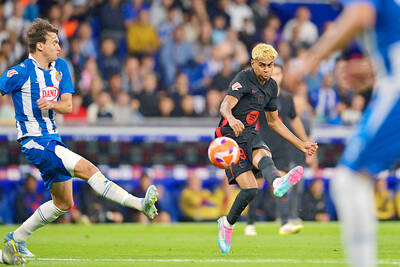
A stunning Lamine Yamal strike on Thursday helped crown Barcelona La Liga champions with a 2-0 win over local rivals RCD Espanyol, with victory ensuring Real Madrid cannot catch them at the top of the table. Yamal’s effort and Fermin Lopez’s goal took Hansi Flick’s side seven points clear of Los Blancos with two matches remaining, to clinch Barcelona’s 28th title and complete a superb domestic treble. Only the UEFA Champions League title escaped an exciting young Barca side this season, as they won the league for the second time in six years, at Espanyol’s ground again just as in 2022-2023. Back then,

SSC Napoli will have to wait one more week to seal the Serie A title after on Sunday being held to a goalless draw at Parma, while closest rivals Inter drew 2-2 in a dramatic game with SS Lazio. Antonio Conte’s team stayed one point ahead of Inter and were unfortunate not to win after twice striking the woodwork through Andre-Frank Zambo Anguissa and Matteo Politano, while Scott McTominay also had a free-kick tipped onto the crossbar. The away side thought they would be handed a chance to take the points from the penalty spot in the 96th minute when David Neres
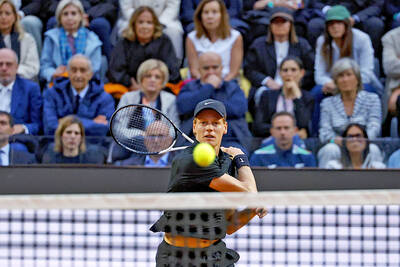
Jannik Sinner on Thursday marched into the semi-finals of the Italian Open after destroying Casper Ruud in straight sets 6-0, 6-1, while Coco Gauff won a marathon three-set battle with China’s Zheng Qinwen to advance to the women’s singles final. American Gauff is to face Italy’s Jasmine Paolini in today’s title match after pulling through 7-6 (7/3), 4-6, 7-6 (7/4) in a match that lasted over three-and-a-half hours. Ruud was supposed to be Sinner’s toughest test in Rome since he came back from his three-month doping ban, as the Norwegian came into the match in hot form on clay after winning in
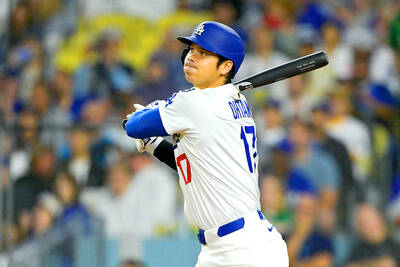
Shohei Ohtani on Thursday delivered his first two-homer game of the season and had six RBIs as the Los Angeles Dodgers poured it on with five long balls in a 19-2 victory over the visiting Athletics. Max Muncy, Andy Pages and James Outman also hit home runs for the Dodgers, who left no doubt by taking a 13-2 lead following a seven-run third inning. Muncy and Kim Hye-seong each had three hits for Los Angeles. Dodgers right-hander Matt Sauer led off a bullpen game by allowing two runs in four innings. Left-hander Justin Wrobleski (1-1) finished with four scoreless innings after he


 RSS
RSS