


If the first leg of the round-the-world Volvo Ocean Race is an indicator of the shape of seas and waves and boat malfunctions to come, the 59,264km, eight-month race may dispel the notion of sailing as the sport of blue-blazered Britons sipping cocktails at sundown.
The first night out, when the seven boats set sail from Vigo, Spain, on Nov. 12, they were met with winds that gusted past 70km and waves that peaked at more than 12m.
"It's a big contrast to go from being onshore to being thrown into a full gale in wild seas in a pitch-black night; normally you like a few days to warm into it," the British skipper Neal McDonald said from Cape Town, shortly after he completed the 10,300km of the first leg.

PHOTO: EPA
McDonald, a veteran of four round-the-world races, is at the helm of Ericsson, which arrived in Cape Town fourth.
Two boats -- Movistar, from Spain, and the Disney-backed Pirates of the Caribbean, the only American entry -- were forced to return to port for repairs after that first night and will pick up the race on the second leg, to Melbourne, Australia.
The first leg was won by Mike Sanderson, a New Zealander at the helm of ABN AMRO One, which arrived in Cape Town on Dec. 1.
Sanderson and his crew of nine set a world record for a monohull, covering 880km in 24 hours. But it was hardly all smooth sailing.
Sanderson said that in his e-mail messages, he often described their battles with the elements with the phrase, "we've been firefighting all night."
After the last time he wrote it, a nasty electrical fire broke out on board. The fire was extinguished, but he said he would be careful before using that phrase again.
Such conditions make for tough sailing in any circumstances, but with a new class of boats, known as Volvo 70s, which, McDonald said, are "more powerful, more complicated and more fragile" than the previous Volvo 60s, "it's really like learning a new set of rules."
"We had the 60s for 12 years," he said. "You have to treat these new boats with a bit more respect; you can't push them around."
The 70s feature 62 percent more sail area, said James Dadd, the Volvo's chief measurer.
Bigger sails mean faster boats but less stability, so the 70s have added a canting keel, which can be positioned on the side opposite to the sail.
"It's basically like having four tons of guys hiking out on trapezes," said Dadd, who added that the new boats had the potential to reach speeds much greater than the previous class.
That is, when the keels are functioning properly. Pirates of the Caribbean, skippered by the American Paul Cayard, who won the round-the-world race then known as the Whitbread in 1998, said he was on the water only 16 hours before he realized the boat was not going to make it to Cape Town. A breakdown in the keel structure had threatened the watertight integrity of the boat.
McDonald had a related problem on Day 18 -- what is known as a "free Willy" situation because of the keel's resemblance to a killer whale.
It happened on a pitch-black night: a huge bang sent the crew scrambling to figure out what had happened, and as they responded, "the boat simply heeled over out of control, practically capsizing!" McDonnald wrote in an e-mail message. "The keel wasn't going where we wanted it to go; it was going where it wanted to go."
The crew got the keel locked into place, but the last 1,600km to Cape Town were much slower than it would have liked.
Pirates of the Caribbean, Movistar and Ericsson are all designed by Farr Yacht Design in Annapolis, Maryland.
Taiwanese world No. 1 women’s doubles star Hsieh Su-wei on Saturday overcame a first-set loss to win her opening match at the Madrid Open. Top seeds Hsieh and partner Elise Mertens of Belgium, with whom she last month won her fourth Indian Wells women’s doubles title, bounced back from a rocky first set to beat Asia Muhammad of the US and Aldila Sutjiadi of Indonesia 2-6, 6-4, 10-2. Hsieh and Mertens were next to face Heather Watson of the UK and Xu Yifan of China in the round of 16. Thirty-eight-year-old Hsieh last month reclaimed her world No. 1 spot after her Indian

EYES ON THE PRIZE: Armed with three solid men’s singles shuttlers and doubles Olympic champions, Taiwan aim to make their first Thomas Cup semi-final, Chou Tien-chen said Taiwanese badminton star Tai Tzu-ying yesterday quickly dispatched Malaysia’s Goh Jin Wei in straight sets, while her male counterpart Chou Tien-chen beat Germany’s Kai Schaefer, as Taiwan’s women’s and men’s teams won their Group B opening rounds of the TotalEnergies BWF Thomas and Uber Cup Finals in Chengdu, China. World No. 5 Tai beat Goh 21-19, 22-20 in a speedy 33 minutes, her fourth straight victory over the world No. 24 shuttler since they first faced each other in the quarter-finals of the 2018 Malaysia Open, where Tai went on to win the women’s singles title. Malaysia followed up Tai’s opening victory

Chen Yi-tung (陳奕通) secured a historic Olympic berth on Sunday by winning the senior men’s foil event at the 2024 Asia Oceania Zonal Olympic Fencing Qualifiers in United Arab Emirates. Chen defeated Samuel Elijah of Singapore 15-4 in the final in Dubai to secure the only wild card in the event, making him the first male Olympian fencer from Taiwan in 36 years and only the sixth Taiwanese fencer to ever qualify for the quadrennial event. The last appearance by a Taiwanese male fencer at the Olympics was in 1988, when Wang San-tsai (王三財) and Cheng Ming-hsiang (鄭明祥) competed in Seoul. The

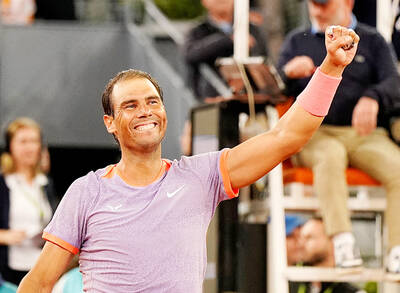
Rafael Nadal on Tuesday lost in straight sets to 31st-ranked Jiri Lehecka in the fourth round at the Madrid Open, while Taiwan’s Hsieh Su-wei advanced to the semi-finals in the women’s doubles. Nadal said that he was feeling good about his progress following his latest injury layoff. Nadal called it a “positive week” in every way and said his body held up well. “I was able to play four matches, a couple of tough matches,” Nadal said. “So very positive, winning three matches, playing four matches at the high level of tennis. I enjoyed a lot playing at home. I leave here with


 RSS
RSS