


A bill designed to compel children to support their elderly parents triggered a heated debate in the legislature yesterday, as lawmakers and social workers disagreed on whether filial piety should be made a legal issue.
The debate took place during a public hearing to discuss a draft of the maintenance of parents law (子女奉養父母法), proposed by a group of legislators across party lines.
The bill would require that children provide their elderly parents with enough support so that the older generation can have a reasonable standard of living.
Parents would be able to apply for a court order compelling support. Children in violation of such an order would face imprisonment of up to one year, community service or fines of up to NT$200,000, according to the bill's provisions.
Wu Yu-chin (吳玉琴), secretary-general of the League of Welfare Improvement for Older People, which is against the draft, argued that such a law would put parent-child relationships under a state of tension.
"Prescribing the practice of filial piety by law will only create tensions in the family. Filial piety should be encouraged, but not prescribed by law," Wu said.
Wu said the main emphasis of the bill is on financial support for the elderly, which she said is a problem that should be dealt with by the establishment of a system such as the national pensions program.
"This is a system that requires people to make payments when they are young so that they can support themselves when they get old. In this way, people will live their life with dignity and don't need to ask their children for money," Wu said.
New Party legislator Lai Shyh-bao (賴士葆), an architect of the bill, said he does not think it is a problem to solve a moral problem by law, noting Singapore already passed a similar piece of legislation in 1996.
Lai argued that such legislation has now become necessary in Taiwan with the decline of the traditional value of filial piety.
Lai said the trend can be seen in news reports about old people dying alone in their homes without anyone noticing. She said many of those people had children, some of whom were highly educated.
The bill was originally supposed to pass a preliminary review in the Judiciary Committee last week. The review was suspended after justice authorities disputed the necessity of enacting a separate law, in light of provisions they say serve a similar purpose in the criminal and civil codes.
Yesterday's public hearing was arranged because of this dispute.
According to Ministry of Justice officials, there is a special chapter in the family law section of the Civil Code clearly stipulating that children are obliged to support their parents, though it does not specify the relevant legal procedures.
Instead of enacting another law, the Ministry of Justice has proposed amending the Civil Code to reinforce its effect should lawmakers consider the existing rules insufficient.
In addition to provisions in the Civil Code, the Criminal Code also establishes punishments for abandonment.
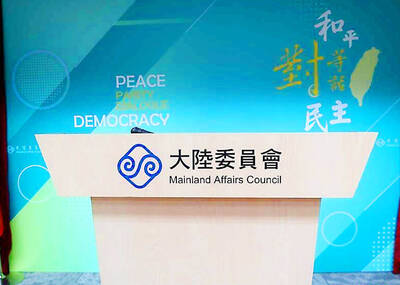
NO RECIPROCITY: Taipei has called for cross-strait group travel to resume fully, but Beijing is only allowing people from its Fujian Province to travel to Matsu, the MAC said The Mainland Affairs Council (MAC) yesterday criticized an announcement by the Chinese Ministry of Culture and Tourism that it would lift a travel ban to Taiwan only for residents of China’s Fujian Province, saying that the policy does not meet the principles of reciprocity and openness. Chinese Deputy Minister of Culture and Tourism Rao Quan (饒權) yesterday morning told a delegation of Chinese Nationalist Party (KMT) lawmakers in a meeting in Beijing that the ministry would first allow Fujian residents to visit Lienchiang County (Matsu), adding that they would be able to travel to Taiwan proper directly once express ferry

STUMPED: KMT and TPP lawmakers approved a resolution to suspend the rate hike, which the government said was unavoidable in view of rising global energy costs The Ministry of Economic Affairs yesterday said it has a mandate to raise electricity prices as planned after the legislature passed a non-binding resolution along partisan lines to freeze rates. Chinese Nationalist Party (KMT) lawmakers proposed the resolution to suspend the price hike, which passed by a 59-50 vote. The Taiwan People’s Party (TPP) voted with the KMT. Legislative Speaker Han Kuo-yu (韓國瑜) of the KMT said the resolution is a mandate for the “immediate suspension of electricity price hikes” and for the Executive Yuan to review its energy policy and propose supplementary measures. A government-organized electricity price evaluation board in March
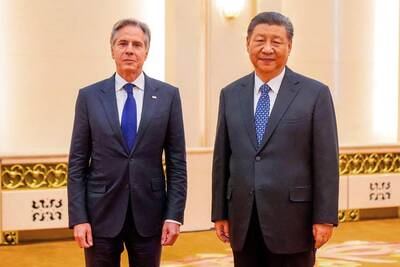
MANAGING DIFFERENCES: In a meeting days after the US president signed a massive foreign aid bill, Antony Blinken raised concerns with the Chinese president about Taiwan US Secretary of State Antony Blinken yesterday met with Chinese President Xi Jinping (習近平) and senior Chinese officials, stressing the importance of “responsibly managing” the differences between the US and China as the two sides butt heads over a number of contentious bilateral, regional and global issues, including Taiwan and the South China Sea. Talks between the two sides have increased over the past few months, even as differences have grown. Blinken said he raised concerns with Xi about Taiwan and the South China Sea, along with China’s support for Russia and its invasion of Ukraine, as well as other issues

FAST RELEASE: The council lauded the developer for completing model testing in only four days and releasing a commercial version for use by academia and industry The National Science and Technology Council (NSTC) yesterday released the latest artificial intelligence (AI) language model in traditional Chinese embedded with Taiwanese cultural values. The council launched the Trustworthy AI Dialogue Engine (TAIDE) program in April last year to develop and train traditional Chinese-language models based on LLaMA, the open-source AI language model released by Meta. The program aims to tackle the information bias that is often present in international large-scale language models and take Taiwanese culture and values into consideration, it said. Llama 3-TAIDE-LX-8B-Chat-Alpha1, released yesterday, is the latest large language model in traditional Chinese. It was trained based on Meta’s Llama-3-8B


 RSS
RSS