


Taipei Times: Why has the Ministry of Justice resisted the proposed revisions to the Code of Criminal Procedure?
Tsai Pi-yu (
If we approach the matter from an ideological perspective, we can't have a truly meaningful discussion. But from the beginning, the Judicial Yuan has portrayed itself as a reform-minded proponent of the adversarial system and the Ministry of Justice as a rigid defender of the status quo. I agree to the proposal that limits the role judges play in investigating evidence so they can be more objective arbiters in trials and for the prosecutor to shoulder the burden of proof. But I doubt that the two proposed revisions to the criminal procedure rules could do much to attain that goal.
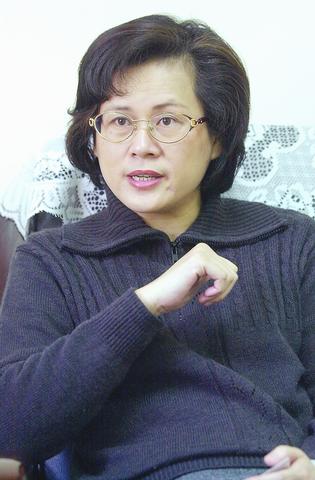
PHOTO: CHIANG YING-YING, TAIPEI TIMESN
Take the planned revision to Article 163 as an example. It states that the judge "may," rather than "should," as the present rule stipulates, investigate evidence upon his discretion, but in situations where it is needed, his investigation is mandatory to maintain fairness and justice. This means the judge can still go ahead and act as a prosecutor if he sees fit. Zealous judges will continue involving themselves deeply in the investigation while their hands-off colleagues restrict themselves to the bench. Such reform would do little to separate the duties between the judge and the prosecutor or reverse the public's distrust of judges.
That's why we have said judges should completely relinquish their right to investigate if they want to remain neutral in court. Knowing the Judicial Yuan would refuse to do so, we have asked it to mark out the boundaries of judges' investigations. Again, the Judicial Yuan refuses to cooperate, saying it prefers to have the matter settled by custom. That's no answer at all, as it usually takes a long time for a custom to develop.
TT: How do you respond to charges that some zealous prosecutors tend to abuse their power, as evidenced by the rather high number of acquittals?
Tsai: Certainly there is ample room for domestic prosecutors to improve their performance. But I reject the contention that the number of not-guilty verdicts is indicative of power abuse by prosecutors.
In Japan, the not-guilty rate is less than 1 percent, meaning that once indicted, the defendant can expect to be convicted. While I admire the effectiveness of Japanese prosecutors, I question the necessity of the ensuing trials. In the US, about 20 percent of the defendants are absolved by the court each year. In Germany, the figure is 15 percent. Based on the statistics, can we say their prosecutors are worse than ours? [Taiwan's acquittal rate is roughly 12 percent]. I would not make such a hasty conclusion.
In any event, the planned revision to Article 161 is said to address the problem. The proposal states that the prosecutor should take responsibility for proving the defendant guilty and explain how he arrived at that conclusion. It would give the judge the power to dismiss cases where the prosecutor fails to produce sufficient evidence. But it is my belief that if the judge finds the defendant innocent, he should acquit him rather than dismiss the case. The latter approach may not really help the defendant clear his name, but it would deny him the right to seek compensation for being unfairly investigated.
TT: Often suspicious of reckless reform, why has the ministry later sought to push through more revisions to the Code of Criminal Procedure?
Tsai: Though differing on the method of reform, the Judicial Yuan and the Ministry of Justice both feel the need to reduce the number of lawsuits in the higher courts. To help achieve this, the ministry wants to overhaul another 21 criminal-procedure rules to try to develop a pyramid model -- meaning that the higher the court level, the fewer the cases it has to review. That is why we came up with suspended prosecution, which provides the prosecutor with an alternative way of dealing with lawbreakers. Because prosecution lies at the bottom of the pyramid, this kind of design will be more effective in curbing indiscreet prosecution and improve human-rights protection.
TT: Would you like to elaborate on suspended prosecution? Is it an attempt on the part of the prosecutors to expand their power?
Tsai: Suspended prosecution is designed to give prosecutors a third option when weighing what to do with people caught doing something wrong. For some crimes, such as petty burglary and financial fraud, putting offenders behind bars may not be the best punishment. If allowed to choose, the victims would probably rather have their money or property back.
But under present rules, the prosecutor can only press charges against them or turn a blind eye to their offense. The suspended prosecution we have proposed would give prosecutors up to three years to decide whether to indict such people. During that period, the defendant can seek to remedy their misconduct. The prosecutors, if satisfied with the remedy, may agree to drop the indictment for good. This way, we can save a lot of tax dollars on convicting and jailing a defendant. The design is one of the agreements reached by attendants to the judicial reform conference back in 1999. We find it an effective measure to reduce the number of law suits, as it may be applied to 80 percent of criminal cases.
TT: Is it true that prosecutors often skip trial proceedings and shift the burden of proof onto the judge?
Tsai: They don't take part in all the trial proceedings not because they are lazy but because they are tied up with other engagements -- cracking down on vote-buying, corruption, stockpiling of rice wine and so on. In the US, such tasks fall on law enforcement officers.
In addition, the present rules do not require prosecutors to attend all the trial proceedings. It is fine to expect them to do so in the future. All we need is to raise the number of prosecutors from 600 to 1,800.
TT: Is there malice between the Judicial Yuan and the Ministry of Justice?
Tsai: Obviously we disagree about the pace and order of reform. As an administrative agency, the ministry is hesitant about making promises it cannot accomplish later. The ministry supports the reform effort but doubts the proposals put forth by the Judicial Yuan can achieve their intended effect: Enhancing the quality of prosecution and reducing the number of trial cases.
Unfortunately, the ministry is at a disadvantage in the debate, which has been monopolized by a few people, as most people lack adequate understanding of the subject. The Judicial Yuan has built its campaign around human-rights protection, painting naysayers as indifferent, anti-reform bureaucrats. It is hard to find a forum where honest dialogue can take place under these circumstances.
TT: You don't seem to like the adversarial system, do you?
Tsai: Personally, I prefer the inquisitive system, which places more emphasis on idealism and expects more from the judge, the lawyer and the prosecutor, both professionally and morally. In an adversarial system, parties involved tend to care more about winning the case rather than finding the truth. Also, for an adversarial system to function well, legal counsel must be popular. But statistics show that more than 60 percent of the defendants here do not hire a lawyer.

‘NO SECURITY RISK’: The Railway Bureau reassured the public that the technicians’ activities were limited to technical guidance and did not involve sensitive systems The Railway Bureau yesterday said it had invited eight Chinese technicians to assist with an airport MRT construction project. The bureau issued the confirmation after an Internet user said Chinese nationals had entered the construction zone of Taiwan Taoyuan International Airport’s Terminal 3 project. They asked why “individuals from an enemy state” were allowed access to such a major national infrastructure project, which raised serious concerns over Taiwan’s industrial safety, sensitive systems and information security. The bureau’s Northern Region Engineering Branch Office said subcontractor Taiwan Handle Industrial Co (台灣手把工業) of the Taoyuan airport MRT’s “Contract No. CU05 Project A14 Station Civil, MEP &

A US uncrewed surface vessel (USV) encountered multiple Chinese warships during an autonomous transit of the Taiwan Strait, US defense company Seasats said in a statement on Wednesday. Seasats announced that a Lightfish USV had completed the first autonomous transit of the Taiwan Strait. Over five days, the USV traversed the entire length of the Strait while constantly monitoring surface vessel traffic, the company said. The Lightfish encountered multiple Chinese warships, one of which was a Chinese People’s Liberation Army Navy (PLAN) Type 056 corvette, it said. The Chinese vessels were operating “well within Taiwan’s exclusive economic zone without transmitting their identity via the
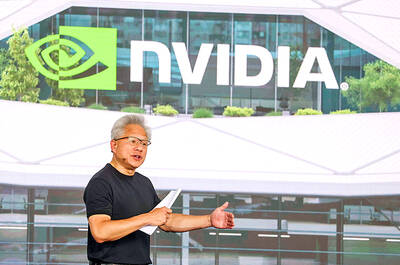
‘BOOMING’: ’ The number of partners we have here is incredible. You can see from their stock prices. They’re doing so well, they’re so happy,’ Jensen Huang said Nvidia Corp’s spending in Taiwan has ballooned to about US$150 billion a year, 10 times the US$10 billion to US$15 billion the company spent five years ago, Nvidia chief executive officer Jensen Huang (黃仁勳) said yesterday, suggesting Taiwan’s strategic importance in the global artificial intelligence (AI) supply chain. “Taiwan is the epicenter of the AI revolution. This is where the chips come, packaging comes. This is where the systems are made. This is where AI supercomputers were created,” Huang said at a meeting for the company’s employees in Beitou-Shilin Technology Park (北投士林科技園區) in Taipei, the planned site of Nvidia’s Taipei headquarters. “Taiwan
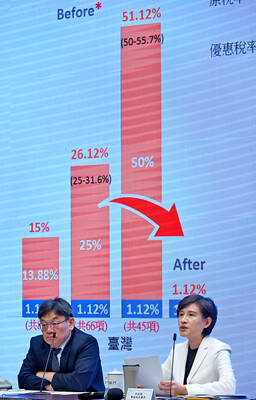
GREATER REACH? Auto parts and wood products would face tariffs of up to 15%, matching those targeting the EU, Japan and South Korea, Vice Premier said The US has announced that preferential tariff treatment for Taiwan’s non-semiconductor Section 232 goods would take effect retroactively from May 1, the Executive Yuan said yesterday. The US government yesterday posted a notice on the Federal Register’s public inspection Web site previewing tariff concessions for Taiwan under a memorandum of understanding (MOU) on Taiwan-US investment after two months of negotiations. The MOU signed on Jan. 15 stipulated three major preferential tariff arrangements: a 15 percent “reciprocal” tariff rate for Taiwan without stacking most-favored nation (MFN) rates; preferential Section 232 treatment for semiconductors and related products; and preferential Section 232 treatment for non-semiconductor


 RSS
RSS