


New Party leaders yesterday strongly expressed their anger with the People First Party (PFP), alleging that the party was trying to take over the New Party to win more seats in the year-end elections.
After Feng Ting-kuo (馮定國), a New Party lawmaker from Taichung County, announced he was joining the PFP on Thursday, high-ranking PFP officials revealed yesterday that the party's chairman, James Soong (宋楚瑜), had already suggested inviting a few New Party heavyweights to represent his party in the legislative election.
"Soong expects to nominate the New Party's former convener, Wang Chien-shien (
Hsieh, however, said in answer to reporters' questions yesterday that she believed all three politicians would decline Soong's invitation.
"Wang and Kao are both founding members of the New Party, and Chou has already registered to receive our party's nomination," Hsieh said, "and their loyalty will prove that the party has the ability to continue its political life."
Other New Party leaders yesterday severely attacked Feng for leaving and warned the PFP not to continue trying to poach the New Party's elite into its ranks.
"Feng wants to sell the party out for his own personal interests. We appeal to the PFP not to nominate such a person and we hope that Feng will lose the election," New Party Taipei City councilor Lee Ching-yuan (李慶元) said in a statement, read on behalf of all New Party councilors.
Wang also issued a news release last night saying that Soong's remarks not only severely hurt the New Party but also insulted him.
"A positive contest between all political parties is good for Taiwan's democracy," Wang said in the news release, "and therefore any intention to cause the New Party to disappear [by merging it with the PFP] is immoral."
"I am not sure what James Soong meant by his invitation to New Party leaders," Wang said. "Does he want to eliminate the New Party? I hope Soong can exercise more justice than trickery."
Wang wrote a private letter to Feng in which he said that Feng's behavior was worse than that of a dog.
The PFP, however, denied that its party chairman had made any deal with Hsieh or even expressed such an intent in private.
"We welcome anybody who wants to join us. But the nomination procedure is fair and does not favor people who defect from other political parties," said PFP spokesman Liao Tsang-sung (
The New Party's influence has gradually declined since its poor showing in the 1998 legislative election. Analysts say that with only nine seats in the legislature, the party faces the prospect of a PFP merger or takeover.
Hsieh vowed the party would make a good showing in the election.

‘NO SECURITY RISK’: The Railway Bureau reassured the public that the technicians’ activities were limited to technical guidance and did not involve sensitive systems The Railway Bureau yesterday said it had invited eight Chinese technicians to assist with an airport MRT construction project. The bureau issued the confirmation after an Internet user said Chinese nationals had entered the construction zone of Taiwan Taoyuan International Airport’s Terminal 3 project. They asked why “individuals from an enemy state” were allowed access to such a major national infrastructure project, which raised serious concerns over Taiwan’s industrial safety, sensitive systems and information security. The bureau’s Northern Region Engineering Branch Office said subcontractor Taiwan Handle Industrial Co (台灣手把工業) of the Taoyuan airport MRT’s “Contract No. CU05 Project A14 Station Civil, MEP &

A US uncrewed surface vessel (USV) encountered multiple Chinese warships during an autonomous transit of the Taiwan Strait, US defense company Seasats said in a statement on Wednesday. Seasats announced that a Lightfish USV had completed the first autonomous transit of the Taiwan Strait. Over five days, the USV traversed the entire length of the Strait while constantly monitoring surface vessel traffic, the company said. The Lightfish encountered multiple Chinese warships, one of which was a Chinese People’s Liberation Army Navy (PLAN) Type 056 corvette, it said. The Chinese vessels were operating “well within Taiwan’s exclusive economic zone without transmitting their identity via the

Taiwan is still in the process of assessing the possibility of recruiting workers from Eswatini, the Ministry of Foreign Affairs said yesterday, adding that its goal is to help Eswatini upgrade its vocational training centers. If there are plans to recruit workers from Eswatini, safeguarding national security, protecting public health and ensuring the employment rights of Taiwanese would be prerequisites, Department of West Asian and African Affairs Director-General Yen Chia-liang (顏嘉良) told a news conference. Key considerations would also include filling labor shortages in specific industries, and fostering bilateral professional and technical exchanges, he said. Yen was asked about the progress of labor
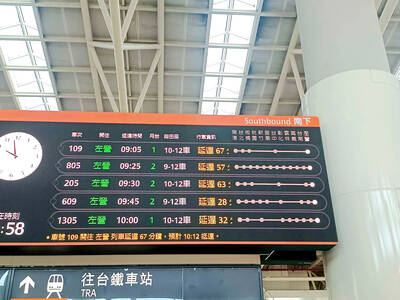
The nation’s usually punctual high-speed rail system yesterday was hit by major disruptions after all scheduled services were canceled and replaced with three hourly trains offering only non-reserved seating, affecting more than 200,000 passengers. Preliminary findings indicate the disruption was caused by a faulty power module in a track switch control cabinet, Taiwan High-Speed Rail Corp (THSRC) said, adding that as a full system inspection could only be conducted after operations end for the day, a decision on whether normal service would resume today would be announced before the first train departs. During a routine inspection early yesterday, a switch signal abnormality


 RSS
RSS