


Last Tuesday, while Vice President-elect Annette Lu (
The tense atmosphere, in light of the second-in-command's complaints, added fuel to rumors of a growing rift between herself and Chen over the distribution of power in the new order.
Then, as Chen concluded the address he had come to deliver and tension caused by Lu's remarks had died down somewhat, KMT legislator Liao Hwu-peng (
"Congratulations!" he said to Chen and Lu, shaking their hands, before turning around and leaving just as suddenly.
The incident, which drew giggles from a roomful of surrounding reporters, provided much-needed comic relief, effectively diffusing what had been until then an awkward and uncomfortable moment.
While some observers may have found Liao's interruption out of place, insiders interpreted the clown-like move as part of a deliberate publicity stunt amid a power shuffle in the legislature following the KMT's presidential election loss.
"He's just trying to gain as much as he can while the current legislature remains in chaos," said a KMT legislator who preferred to remain anonymous.
LIAO THE FREE AGENT
The "chaos" the lawmaker alluded to can be seen in moves by various party caucuses to look for alliances or any kind of cooperation with their counterparts following the presidential election -- especially following the establishment of failed candidate James Soong's (宋楚瑜) People First Party (PFP).
Although some KMT legislators said their party -- which still holds a nominal majority -- can continue to influence the lawmaking process and thus check the executive branch and the DPP president, critics said public posturing by the party will be of little use unless KMT legislators are themselves united.
But unity is precisely what is evading the KMT legislative caucus.
Liao himself has been busy talking up the probability of joining the PFP because, in his words, "the prospects for KMT reform appear slim." Liao told the Taipei Times that if he crossed the floor, ten other KMT legislators could well follow suit.
Liao also debunked the functional majority -- 116 seats out of the total 225 -- as "a false majority ... an unsubstantiated majority" that could easily evaporate.
When serving as the KMT's party whip in the Legislature five years ago, Liao, together with some other KMT legislators, were often dubbed by observers as "experts" on how to maximize personal gains at the KMT's expense by threatening to take its votes elsewhere.
At that time, the KMT outnumbered opposition parties by a margin of only some half a dozen seats, so that the loss of any KMT votes risked the KMT's power in the legislative chamber.
Five years later, Liao appears to be making use of the same threat.
WHO WANTS LIAO?
Liao's posturing, however, has received a mixed response from both the KMT and the PFP.
Lin Jung-rong (
"These KMT lawmakers should think thoroughly about what they are doing before joining the other side," Lin said.
Sources have said that at an internal KMT meeting last week, acting chairman Lien Chan (
But PFP lawmakers themselves are divided over how to handle Liao. Chiu Chuang-liang (邱創良), the PFP's legislative caucus convener, said the time is right for Liao to join the PFP, adding Liao would join the party sometime before Chen's inauguration on May 20.
But another PFP legislator, who refused to be named, said he could not welcome Liao into the PFP's legislative caucus if he were accepted into the party.
"Give me a break -- I would never allow him to tarnish our image. He is a dirty person. We're trying to set a precedent for change, okay?" he said.
The PFP legislator also showed the Taipei Times a party document stating entry into the PFP legislative caucus requires the consent of at least half of the existing caucus members.
Nicknamed "red envelop Peng" (
But the former teacher from Yunlin county, bringing with him complex factional loyalties and interests, has often found himself embroiled in financial scandals and corruption throughout his political career.
A NEW BID FOR INFLUENCE
Liao is not the only lawmaker working overtime to consolidate power. KMT lawmaker Liu Ping-wei (劉炳偉), also a former speaker of the Taiwan provincial assembly, has been working behind the scenes to corral his own voting bloc.
Forced to lay low a year ago after a financial scandal involving his family's Hai Shan group (海山集團) was made public -- triggering a small scale run on a bank and jitters on the stock market -- Liu is now busy planning to re-enter the fray by setting up a legislative "think tank" which has so far won support from some 55 lawmakers.
"He wants to form an alliance as a way to begin afresh in the Legislative Yuan to exert his influence once again," Huang Shui-hwa (
Huang said "Liu's past experience" has enabled a majority of legislators contacted to reply with an immediate "yes" to an invitation to join the new sub-group, to be called the New Taiwan Policy Research Foundation (
Once established, the group would become the biggest inter-party body in the Legislature, and one that would include KMT, PFP and DPP members, Huang said.
Liu Wen-hsiung (
But another, unnamed PFP legislator said it resembled other, similar groups in the past, which all faded with time.
"Look at the Chin-Cheng Association (
"Some have agreed to join Liu's group simply because of old provincial assembly friendships. But we are not ready to be controlled like pieces in some board game," the lawmaker said.
Whether Liao and Liu can make a comeback in the legislature remains to be seen, but their scramble while the balance of power teeters in the Legislative Yuan points to a strong desire to position themselves on the highest ground possible when the dust finally settles.

‘NO SECURITY RISK’: The Railway Bureau reassured the public that the technicians’ activities were limited to technical guidance and did not involve sensitive systems The Railway Bureau yesterday said it had invited eight Chinese technicians to assist with an airport MRT construction project. The bureau issued the confirmation after an Internet user said Chinese nationals had entered the construction zone of Taiwan Taoyuan International Airport’s Terminal 3 project. They asked why “individuals from an enemy state” were allowed access to such a major national infrastructure project, which raised serious concerns over Taiwan’s industrial safety, sensitive systems and information security. The bureau’s Northern Region Engineering Branch Office said subcontractor Taiwan Handle Industrial Co (台灣手把工業) of the Taoyuan airport MRT’s “Contract No. CU05 Project A14 Station Civil, MEP &

A US uncrewed surface vessel (USV) encountered multiple Chinese warships during an autonomous transit of the Taiwan Strait, US defense company Seasats said in a statement on Wednesday. Seasats announced that a Lightfish USV had completed the first autonomous transit of the Taiwan Strait. Over five days, the USV traversed the entire length of the Strait while constantly monitoring surface vessel traffic, the company said. The Lightfish encountered multiple Chinese warships, one of which was a Chinese People’s Liberation Army Navy (PLAN) Type 056 corvette, it said. The Chinese vessels were operating “well within Taiwan’s exclusive economic zone without transmitting their identity via the

Taiwan is still in the process of assessing the possibility of recruiting workers from Eswatini, the Ministry of Foreign Affairs said yesterday, adding that its goal is to help Eswatini upgrade its vocational training centers. If there are plans to recruit workers from Eswatini, safeguarding national security, protecting public health and ensuring the employment rights of Taiwanese would be prerequisites, Department of West Asian and African Affairs Director-General Yen Chia-liang (顏嘉良) told a news conference. Key considerations would also include filling labor shortages in specific industries, and fostering bilateral professional and technical exchanges, he said. Yen was asked about the progress of labor
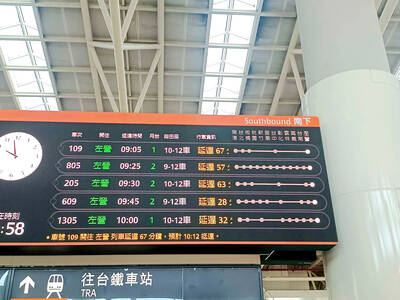
The nation’s usually punctual high-speed rail system yesterday was hit by major disruptions after all scheduled services were canceled and replaced with three hourly trains offering only non-reserved seating, affecting more than 200,000 passengers. Preliminary findings indicate the disruption was caused by a faulty power module in a track switch control cabinet, Taiwan High-Speed Rail Corp (THSRC) said, adding that as a full system inspection could only be conducted after operations end for the day, a decision on whether normal service would resume today would be announced before the first train departs. During a routine inspection early yesterday, a switch signal abnormality


 RSS
RSS