


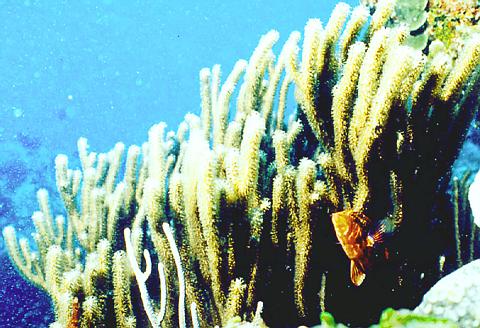
Scientists studying coral reefs in Nanwan (
Such bleaching can be caused by disease or adverse changes in the environment around coral colonies, such as increased levels of UV radiation and excessive water temperatures.
At the time, the Third Nuclear Power Plant (
FILE PHOTO
The scientists, Fang Li-hsing (
The bleaching, they said, could be detected as far as 1.5km west of the pipes, and as deep as six meters below the surface, according to data collected by seven monitoring instruments deployed near the pipes.
At the time, coral bleaching was a newly-discovered phenomenon; work on its causes and effects has progressed steadily since.
FILE PHOTO
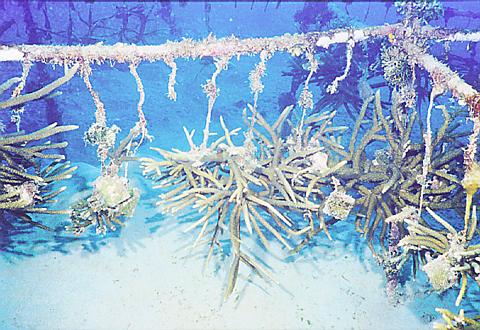
More than a decade later, Soong Ker-yea (宋克義), a professor of marine biology at the university, is continuing the tough tasks of both monitoring the site's ecological systems and attempting recovery work on the coral.
Current situation
Scientists and officials at the nuclear power facility are cautious when assigning blame to the problem.
"First of all, I should stress that damage to coral reefs in Taiwan's waters can be attributed to both natural and man-made factors," Soong said at a recent press conference held by officials at the nuclear power plant.
He explained that several problems, including over-fishing, water pollution, poaching of both coral and marine animals in addition to the construction of a causeway nearby had acted together to destroy some of the coral.
Composed of the calcified exoskeletons of colonies of marine polyps, coral reefs are among the richest, most productive ecosystems on the planet.
"Coral reefs, which are home to at least 35,000 marine species, exist in only 3 percent of the world's waters," Soong said, adding that Taiwan itself was surrounded by coral reefs.
Soong has begun a coral reef recovery program with assistance from Taipower. It involves work both in the field and in laboratories equipped to observe the properties of growing coral.
Showing reporters photographs taken in waters nearby, Soong said that the program would be able to propose measures to prevent more such environmental catastrophes, and find remedies to halt the deterioration of affected coral reefs.
Soong said that coral bleaching is a growing problem around the globe, and that up to70 percent of existing coral could actually disappear within 40 years, based on data from the US National Oceanic and Atmospheric Administration (NOAA), which has been engaged in global coral reef monitoring work for several years.
"We realize that coral reefs are being destroyed at an alarming rate, but it's hard for us to know precisely where and how much coral bleaching is happening, because of difficulties monitoring conditions underwater," Soong said.
Soong said that several foreign studies have strongly implicated gradual warming of the world's oceans as a major cause of coral reef bleaching.
"Coral is protected from UV light by chlorophyl-containing algae in a symbiotic relationship. But the algae is sensitive to elevated water temperatures, which hinder the process of photosynthesis in the organisms," Soong said.
Less algae means more damaging UV light can reach the coral, resulting in the death of coral colonies.
Hot water from nuclear power plants, he added, has been identified as the main reason for coral bleaching in areas near the Nanwan facility since the phenomenon was brought to light for the first time in Taiwan 11 years ago.
Sharing the blame
Aside from concerns over potential radiation leaks, nuclear power plants are still being targeted by environmentalists for their adverse effects on coral reefs.
In 1987, authorities at the Third Nuclear Power Plant, working together with academics, initiated a comprehensive monitoring and restoration project in coastal areas in southern Taiwan,
"The heat damage to coral reefs and the impact on marine ecology caused by hot water from the plant by itself is limited.
"We have taken action to control variations in the temperature of the water around affected reefs to within 4℃, which is bearable for coral," said Tu Yueh-yuan (杜悅元), director of Taipower's environmental protection department (台電環保處).
"In addition, we are working with the Tungkang Fisheries Research Institute (
"We have been very careful about [coral bleaching]. It's not reasonable to ask for the removal of the power plant just for the sake of the coral," said Tu, adding that the site was chosen for construction of the nuclear plant 15 years ago, before plans were made for Kenting National Park (
Taipower officials added that other factors also blamed for the coral bleaching should be investigated.
Officials said that due to the now-booming sightseeing business in Kenting -- which draws more than 3 million tourists every year -- increased sewage discharge in the area has polluted the waters, causing additional damage to nearby coral.
They added that proper environmental protection should be carried out by collaboration among different governmental administrative units.
A good example, they said, was a recently-completed sewage treatment network in the Nanwan area.
Construction of the sewerage system cost NT$610 million and has been in operation since last January. It can treat 3,000 tonnes of sewage daily, they said.
"Everyone should play their part in protecting our treasured environment," said Chen Pu-tsan (
Taiwan Semiconductor Manufacturing Co (TSMC, 台積電) on Wednesday said that a new chip manufacturing technology called “A16” is to enter production in the second half of 2026, setting up a showdown with longtime rival Intel over who can make the fastest chips. TSMC, the world’s biggest contract manufacturer of advanced computing chips and a key supplier to Nvidia and Apple, announced the news at a conference in Santa Clara, California, where TSMC executives said that makers of artificial intelligence (AI) chips will likely be the first adopters of the technology rather than a smartphone maker. Analysts said that the technologies announced on
NO RECIPROCITY: Taipei has called for cross-strait group travel to resume fully, but Beijing is only allowing people from its Fujian Province to travel to Matsu, the MAC said The Mainland Affairs Council (MAC) yesterday criticized an announcement by the Chinese Ministry of Culture and Tourism that it would lift a travel ban to Taiwan only for residents of China’s Fujian Province, saying that the policy does not meet the principles of reciprocity and openness. Chinese Deputy Minister of Culture and Tourism Rao Quan (饒權) yesterday morning told a delegation of Chinese Nationalist Party (KMT) lawmakers in a meeting in Beijing that the ministry would first allow Fujian residents to visit Lienchiang County (Matsu), adding that they would be able to travel to Taiwan proper directly once express ferry

CALL FOR DIALOGUE: The president-elect urged Beijing to engage with Taiwan’s ‘democratically elected and legitimate government’ to promote peace President-elect William Lai (賴清德) yesterday named the new heads of security and cross-strait affairs to take office after his inauguration on May 20, including National Security Council (NSC) Secretary-General Wellington Koo (顧立雄) to be the new defense minister and former Taichung mayor Lin Chia-lung (林佳龍) as minister of foreign affairs. While Koo is to head the Ministry of National Defense and presidential aide Lin is to take over as minister of foreign affairs, Tsai Ming-yen (蔡明彥) would be retained as the nation’s intelligence chief, continuing to serve as director-general of the National Security Bureau, Lai told a news conference in Taipei. Koo,

MANAGING DIFFERENCES: In a meeting days after the US president signed a massive foreign aid bill, Antony Blinken raised concerns with the Chinese president about Taiwan US Secretary of State Antony Blinken yesterday met with Chinese President Xi Jinping (習近平) and senior Chinese officials, stressing the importance of “responsibly managing” the differences between the US and China as the two sides butt heads over a number of contentious bilateral, regional and global issues, including Taiwan and the South China Sea. Talks between the two sides have increased over the past few months, even as differences have grown. Blinken said he raised concerns with Xi about Taiwan and the South China Sea, along with China’s support for Russia and its invasion of Ukraine, as well as other issues


 RSS
RSS