


The Taipei District Prosecutors' Office appears set to begin summoning officials from the finance ministry today for questioning over allegations of financial impropriety against independent presidential candidate James Soong (
The prosecutors' office is also likely to summon Soong himself, as well as his financial advisor, Chen Pi-yun (
KMT legislator Yang Chi-hsiung (
Yang has filed charges of tax evasion against Soong.
The case against Soong involves funds totalling more than NT$1 billion that were deposited in accounts belonging to his relatives, including his son, sister-in-law and her son, which Soong has since claimed were intended to be used to care for relatives of the late president Chiang Ching-kuo (蔣經國) as well as "party business."
Officials at the prosecutors' office said they had decided to begin the interrogatory sessions rather than waiting for further documents from the finance ministry.
The prosecutors' office will ask the ministry to supply additional information to clarify some points in its report.
The finance ministry has submitted a report on the Soong scandal to the prosecutors' office, but it does not include certain key evidence, including information on the seal Soong used for the "KMT secretary-general's account" he opened privately in the early 1990s.
At KMT headquarters, meanwhile, officials continued to attack Soong yesterday, saying he still has not clarified the origin and final destination of funds in the KMT secretary-general's account. The officials also asked him to disclose exactly how much money he actually remitted to the US between October and November, 1998, during the timethe provincial government was downsized.
Meanwhile, reports continues to emerge about so-called "donors" to party political funds.
The Chinese-language press reported yesterday that in December 1992, in the run up to the legislative elections, Soong received a check for NT$30 million without a designated payee from the local construction tycoon Liang Po-hsun (
Soong immediately put the donation into his KMT secretary-general's account, the report said.
The money was withdrawn from that account in early 1993 and used to buy securities at the Chunghsing Bills Finance Corp, the report said.
As the amount of Liang's donation was ten times the legal ceiling for corporate donations to political parties, investigative authorities are probing possible tax evasion and misappropriation by Soong, the report said.

National Taiwan University (NTU) yesterday said it disqualified a person from an entrance examination for using AI smart glasses to cheat, along with two others for making untruthful statements in their curriculum vitae. The three applicants were given null scores, Taiwan’s highest-ranked university said, calling on prospective students to be honest in the admissions process. NTU registrar Lee Hung-sen (李宏森) said that the cheating applicant wore a hat and thick-rimmed glasses to the second written exam for medical school, claiming that they felt cold. Suspicions were aroused when the applicant stared oddly at the test for long stretches while steadily bringing the paper

The Tourism Administration yesterday announced that it would reward repeat international visitors with incentives of up to NT$8,000 to boost inbound tourism. The incentives are available to all international tourists, it said, adding that repeat visitors would be rewarded with NT$5,000 and would receive an additional NT$3,000 if they bring travel companions. The nation received 2,990,657 inbound visitors during the first quarter, marking a 3.8 percent increase from the same period last year, agency data showed. Japanese nationals are among groups visiting Taiwan the most. About 1.48 million Japanese tourists arrived last year, a year-on-year increase of more than 12
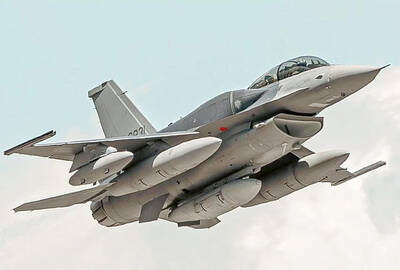
66 FIGHTER JETS: The aircraft is likely undergoing preparations for its transfer to Taiwan — a significant step forward in the nation’s modernization program, a lawmaker said The first of Taiwan’s order of F-16V Block 70 aircraft has been sighted in Texas ahead of delivery, Democratic Progressive Party (DPP) Legislator Wang Ting-yu (王定宇) said. Taiwan’s first F-16V Block 70 two-seat aircraft, tail number 6831, was seen flying from Lockheed Martin’s production facility in Greenville, South Carolina, to Naval Air Station Joint Reserve Base Fort Worth in Texas, Wang wrote on Facebook yesterday. The plane is likely undergoing preparations for its transfer to Taiwan, marking a significant step forward in the Republic of China Air Force’s modernization program, Wang said, citing military analysts. The F-16V Block 70 is a new-build version
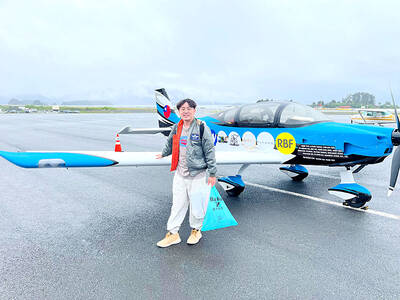
Taiwanese aviator Roger Lin (林睿哲) returned to Taiwan on Saturday after completing a nine-day round-the-world journey in a single-engine aircraft, becoming the first Taiwanese pilot to achieve the feat. Lin departed on June 5 from Los Angeles, California, and continued through Alaska, Japan, Taiwan, the Philippines, Indonesia, Malaysia, Thailand, Nepal, Jordan, Norway, Iceland and Canada before landing at the Taipei International Airport (Songshan) via Los Angeles and Japan. Lin shared numerous photos and videos of his journey on a Facebook page titled “Pilot Roger’s Around the World Flight,” including a video showing his aircraft flying over the Danjiang Bridge and


 RSS
RSS