


Hsiao Teng-piao (蕭登標), a former Chiayi County Council speaker who has been on the run from police since 1996, failed to show up at the Legislative Yuan yesterday.
His non-appearance disappointed a unit of heavily-armed police awaiting his arrival.
Hsiao, who has been on the run since police targeted him during a large-scale anti-gangster crusade in 1996, faces five charges should he be arrested.
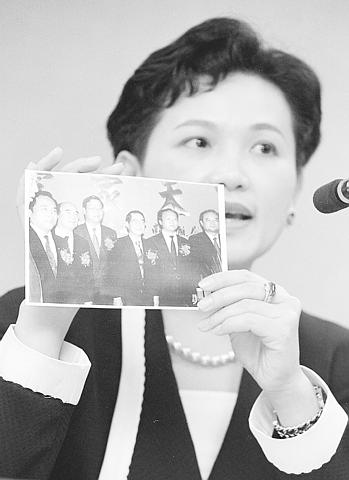
PHOTO: CHIANG YING-YING, TAIPEI TIMES
Despite having been in hiding for than two years, Hsiao has unwittingly become involved in a political war-of-words between Premier Vincent Siew (
Liao has hinted that the premier is closely connected to gangster forces, of which Hsiao's family is allegedly included.
Hsiao, through his niece Hsiao Shui-li (
But the presence of large numbers of police and media is believed to have kept him away.
"I'll definitely be coming out soon and report myself to prosecutors. And for the time being, I am going to make everything crystal clear and rebuke every accusation my [political] enemies have made against me," Hsiao said in a written statement yesterday.
Hsiao claimed he and Liao, both from Chiayi, were once good friends and had regularly frequented hostess bars during Liao's tenure in the Executive Yuan.
Hsiao alleged that Liao had targeted him in the anti-gangster crackdown as a political ploy against his family. Liao said his family dominated local politics in Chiayi and stood in the way of the political ambitions of Liao's family members.
At the time of the crackdown, which significantly improved Liao's reputation as justice minister, claims were made that suspects were often arrested and jailed without going through the proper legal system.
Speaking on behalf of Hsiao, lawyer Chen Chun-cheng (
Hsiao is insisting on his right to due process and a fair trial, Chen said.
"If he had been sent to Green Island [maximum security prison], he wouldn't have had any chance to defend his case. It's never been his intent to stay in hiding. All he hopes for is that he can be guaranteed due process," Chen said.
Hsiao, who served as a Chiayi County councilor and then as a speaker, was the first major scalp of the 1996 crackdown.
But despite having an arrest warrant out on him, Hsiao managed to evade capture under immunity laws which prevent elected councilors from being arrested as long as their assemblies are in session.
Hsiao has frequently made public appearances since his indictment and has strongly denied the charges made against him. The charges range from blackmail and fraud to gambling.
In February 1998, on the eve of the vote for speakership of the Chiayi County Council, Hsiao abruptly announced he was withdrawing his candidacy. He has not been seen in public since.
Over the last few days, Liao has vehemently attacked Premier Siew over the KMT's selection of him as running mate for Lien Chan (
Premier Siew dismissed Liao from the position of justice minister last year, following a spate of scandals against Liao's subordinates.

The National Chungshan Institute of Science and Technology yesterday showcased its locally developed variants of the Vision 60 robotic patrol dog, which it plans to deploy on the nation’s outlying territories in the South China Sea. The variants were produced under the Joint Lab project — created by the institute and domestic companies — and assembled with domestically produced motors, lenses and artificial intelligence (AI) systems alongside licensed tech from the US, Missile and Rocket Systems Research Division deputy director Jen Kuo-kang (任國光) told the media event at a military base in Taipei’s Dazhi (大直) area. Taiwan has built up its strengths

RIGHT DIRECTION: Taiwan’s efforts to prevent forced labor include a proposal to ‘fully prohibit’ employers from withholding workers’ documents, an official said Taiwan is to establish a mechanism to restrict imports of goods linked to forced labor, the Executive Yuan said yesterday, after the US proposed imposing additional tariffs on Taiwanese goods over labor concerns. “The Ministry of Labor and the Ministry of Economic Affairs are to establish an interministerial review procedure,” Executive Yuan spokesperson Michelle Lee (李慧芝) said at a news briefing in Taipei. “The government is to use the Foreign Trade Act [貿易法] as the legal basis to restrict imports of goods produced with forced labor” and bring its supply chain governance more in line with international standards on human rights, resilience

NOT IMMEDIATE: Taiwan has a chance to appeal the proposed 10 percent tariff before it starts, while other countries face a 12.5 percent tariff from the trade office Taiwan is among 60 economies determined by the US to have failed to impose or enforce a ban on the importation of goods produced with forced labor, according to a notice released on Tuesday by the Office of the US Trade Representative (USTR), which proposed imposing an additional 10 percent or more tariff on them. The USTR in a statement said that following an investigation, it had determined under Section 301 of the Trade Act of 1974 that the failure of the 60 economies to impose and effectively enforce a prohibition on the importation of goods produced with forced labor is

TIT-FOR-TAT: The US allegedly revoked the visa of a Chinese national working at Xinhua News Agency in the US in response to Beijing’s expulsion of Vivian Wang The Presidential Office yesterday condemned China for expelling a New York Times correspondent from Beijing following the newspaper’s interview with President William Lai (賴清德), saying the move highlighted Beijing’s suppression of press freedom and its threat to international news media. Taiwan has noted a series of recent incidents in which Beijing used similar tactics to “threaten and pressure international media outlets and journalists,” Presidential Office spokeswoman Karen Kuo (郭雅慧) said in a statement. “This concerns not only press freedom and freedom of expression, but also the safety of journalists, and Taiwan and relevant partners are paying close attention to the situation,” she


 RSS
RSS