


Nov. 9 marked the 30th anniversary of the fall of the Berlin Wall, an iconic physical representation of the Iron Curtain. The event led to the reunification of East and West Germany and the eventual collapse of the communist regimes in the Soviet Union and Eastern Europe.
The Iron Curtain was an ideological and physical separation of communist Eastern Europe from the West following World War II.
The term “iron curtain” was popularized after it was used by former British prime minister Winston Churchill in a landmark speech in the US in March 1946. “From Stettin [now called Szczecin] in the Baltic to Trieste in the Adriatic, an iron curtain has descended across the continent,” declared Churchill, then leader of the opposition Conservatives. His comments were seen as an opening salvo in the Cold War that pitted the Soviet Union and the West against each other for more than four decades.
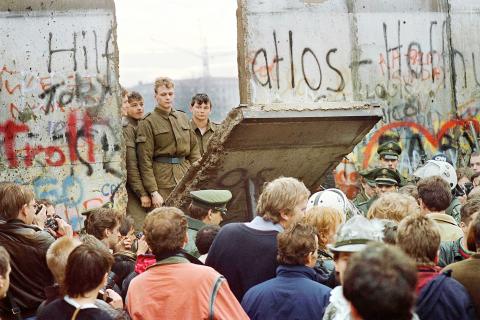
Photo: AFP
照片:法新社
The term had been coined earlier. Russian writer Vasily Rozanov, in his 1918 book The Apocalypse of Our Time, wrote “an iron curtain is being lowered, creaking and squeaking, at the end of Russian history.”
The ideological barrier between Soviet-controlled Eastern Europe and the West gradually became a physical one spanning thousands of kilometers. To stop citizens from fleeing to the West, Soviet-dominated Eastern European countries began erecting various forms of barriers using barbed-wire, ditches and concrete walls. The separations were controlled by alarms, watchtowers, mines and soldiers.
Socialist Hungary put up the first section in 1949, building a 260km barbed wire fence along its border with Austria.
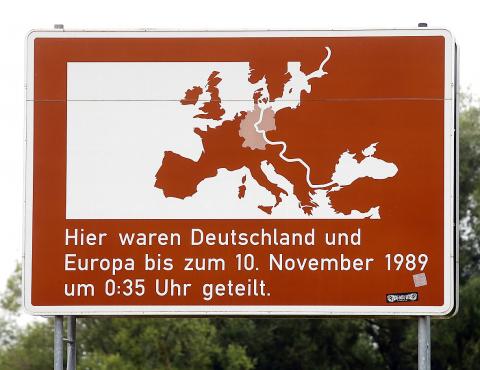
Photo: Reuters
照片:路透
The Berlin Wall was an icon of the Iron Curtain. In 1952 Soviet-satellite East Germany constructed a 10m-wide barbed wire buffer along the entire length of its border with West Germany.
However, people were still able to get across in the divided city of Berlin, with about 3 million fleeing the East via this route between 1952 and 1961. To stop this important loss of manpower, East Germany in 1961 began constructing a wall. Made of reinforced concrete and wire mesh, the Berlin Wall stretched for 155km.
Eastern European citizens were only allowed to visit the West under strict conditions and those who tried to cross over without permission did so at great risk. About 600-700 people died trying to escape East Germany, about 140 at the Berlin Wall.
The first crack in the Iron Curtain appeared in May 1989 when Hungary decided to start opening its border with Austria. On Aug. 19 the frontier was to be symbolically opened for a few hours for a Pan-European Picnic. More than 600 East Germans holidaying in Hungary took advantage and fled to the West. It was the first mass exodus since the 1961 construction of the Berlin Wall.
Soon afterwards Eastern Europe’s communist regimes started to tumble.
East Germans began to demonstrate, and on Nov. 9, 1989 the regime unexpectedly granted them the right to travel to the West freely. Thousands flocked to the wall, and disoriented border guards opened the checkpoints. Throughout the night, euphoric Berliners celebrated. Perching on the wall, they used pickaxes to knock out chunks.
Within two years the Soviet Union had imploded; the Iron Curtain falling with it.
(AFP with staff writer)
十一月九日是柏林圍牆倒塌三十週年。作為最有代表性的具象化鐵幕,柏林圍牆的倒下不但揭開了東西德統一的序幕,最後更導致蘇聯及東歐共產主義政府的瓦解。
「鐵幕」是第二次世界大戰後,共產主義東歐與西方在意識型態上和實際上的分隔。
「iron curtain」(鐵幕)一詞被廣泛使用,是由於前英國首相溫斯頓‧邱吉爾一九四六年三月在美國發表的一場具里程碑意義的演說。時任英國反對黨領袖的保守黨黨魁邱吉爾說道:「從波羅的海的斯德丁〔現稱斯塞新〕到亞得里亞海的第里雅斯特,鐵幕橫跨〔歐洲〕大陸垂降下來」。邱吉爾此語被認為是冷戰的開場白,開啟此後四十多年蘇聯和西方之間的冷戰對抗。
「鐵幕」一詞之杜撰其實還要更早些。俄羅斯作家瓦西里‧羅札諾夫在他一九一八年的書《我們時代的啟示》中寫道:「鐵幕正被降下,在俄羅斯歷史的盡頭嘎吱嘎吱尖聲作響」。
蘇聯控制的東歐跟西方之間的意識型態隔閡,逐漸成為橫跨數千公里的實體分界。被蘇聯支配的東歐國家為阻擋其國民逃向西方,開始用鐵絲網、壕溝和水泥牆架設各種形式的屏障,並以警鈴、瞭望塔、地雷和士兵戒備。
這分隔首次築起是在一九四九年,匈牙利社會主義政權在與奧地利的邊界架起了兩百六十公里長的鐵絲網藩籬。
柏林圍牆是鐵幕的代表。一九五二年,蘇聯的附庸國東德,沿著與西德間的整條邊界建造了十公尺寬的刺網緩衝帶。
但人們還是可以穿越分裂的柏林市──在一九五二年到一九六一年之間,大約有三百萬人經由此路線逃離東柏林。為阻止這嚴重的人力流失,東德於一九六一年開始建造隔離牆。柏林圍牆由鋼筋混凝土和金屬絲網所築成,長達一百五十五公里。
東歐公民必須符合嚴格的條件才能夠造訪西方,未獲許可而試圖越境的人則冒了很大的風險。大約有六百至七百人因試圖逃離東德而死,約一百四十人死於柏林圍牆。
鐵幕的第一個裂縫在一九八九年五月出現──匈牙利決定開始開放與奧地利的邊界。為配合和平示威活動「泛歐野餐」,該邊境原本只是要在八月十九日象徵性地開放數小時。六百多名在匈牙利度假的東德人便趁機逃往西方。這是一九六一年柏林圍牆樹立以來東德人民首次大規模出走。
此後不久,東歐各國的共產主義政權開始崩潰。
東德人開始示威,一九八九年十一月九日,東德政權出乎意料地授予人民自由前往西方的權利。數千人湧向隔離牆,不知所措的邊防軍打開了檢查哨站。欣喜若狂的柏林人整夜歡呼雀躍、坐在牆上,並用尖鋤把牆一塊塊打下。
此後兩年間蘇聯內爆,鐵幕也隨之瓦解。
(台北時報林俐凱編譯)
Follow Up
讀後練習
True or False
1. The term “Iron Curtain” was coined by former UK prime minister Winston Churchill.
2. The Berlin Wall was heavily controlled by guards, watchtowers and deadly traps to prevent people from fleeing East Germany. ?
3. The Berlin Wall was not the first physical manifestation of an “Iron Curtain” built by the East European communist states.
4. The Berlin Wall divided capitalist East Germany and communist West Germany.
5. The fall of the Berlin Wall triggered the collapse of East European communist regimes and the Soviet Union.
(Lin Lee-kai, Taipei Times)

A: Apart from the Taipei Music Center’s exhibit and concert, US pop rock band OneRepublic and rapper Doja Cat are touring Kaohsiung this weekend. B: OneRepublic is so popular that after tonight’s show at the K-Arena, they are set to return to Taiwan again in March next year. A: And Doja will also perform at the same venue on Sunday, right? B: Yup. Her collab with Blackpink’s Lisa and singer Raye for the song “Born Again” has been a huge worldwide success. A: Doja even made it on Time magazine’s “100 Most Influential People” list in 2023. She’s so cool. A: 本週末除了北流的特展和演唱會外,美國男團共和世代和饒舌歌手蜜桃貓朵佳也將來台開唱。 B: 共和世代因太受歡迎,繼今晚高雄巨蛋的演唱會後,預計明年3月即將再度來台巡演唷。 A: 朵佳本週日將在同場地開唱,對不對?

Tango unfolds in a dimly lit room, where a haunting melody ushers two dancers into a close embrace. Here, music and movement merge into a silent yet passionate conversation, expressing longing, memory and shared purpose. What makes tango truly magical is the deep interaction and spontaneous improvisation between partners. Tango began in the late 19th century in Buenos Aires, Argentina’s bustling capital. Born in the poor working-class neighborhoods and busy port areas, this dance emerged from a melting pot of cultures. European immigrants, African slaves and local residents all contributed to its unique character. From these rich influences, tango

A: What show are you watching online? B: I’m watching “Fly Me to the Moon & Back” – an exhibition launched by the Taipei Music Center (TMC) to commemorate the late singer Tom Chang. A: Known for his sky-high notes, Chang is praised as one of the best singers in the 1990s. His death at the age of 31 was a major loss indeed. B: And I’m so glad that we went to the TMC’s 90s-themed concert last Friday. I finally saw the iconic “Godmother of Rock” WaWa perform live. A: This year-end show also featured singers Princess Ai, Bii, Wayne Huang, PoLin and

Just like fingerprints, your breathing patterns may serve as a definitive identifier. In a recent study, scientists have demonstrated an astonishing 96.8% accuracy in identifying individuals based on their respiratory patterns. This revelation could open up new possibilities in biometrics and personalized health monitoring. The notion of using individual breathing patterns as a distinct biological signature has long been a topic of discussion within the respiratory science community, yet a practical method for measurement remained elusive. This changed with the invention of a tiny, wearable device capable of extended recording. Researchers deployed a lightweight tube designed to fit inside


 RSS
RSS