


It may not change how you buy bananas, but scientists have voted to redefine the value of a kilogram, in what they called a landmark decision that will boost the accuracy of scientific measurements. Since 1889, a kilogram has been defined by a shiny lump of platinum-iridium kept in a special glass case and known as the International Prototype of the Kilogram. It is housed at the headquarters of the International Bureau of Weights and Measures (whose French acronym is BIPM), just outside Paris.
Members of the BIPM, which groups 60 nations, agreed on Nov. 16 after a week-long meeting at the nearby Palace of Versailles to redefine the kilogram in terms of a tiny but unchanging value called the “Planck constant.” They also voted to update definitions for the ampere (electrical current), the kelvin (thermodynamic temperature) and the mole (amount of a substance).
All modern mass measurements are derived from the kilogram, whether micrograms of pharmaceutical medicine or gold dust, kilos of fruit or fish, or tonnes of steel. The problem is that the prototype doesn’t always weigh the same. Even inside its three glass bell jars it picks up microparticles of dirt and is affected by the atmosphere. Sometimes it needs cleaning, which can affect its mass.
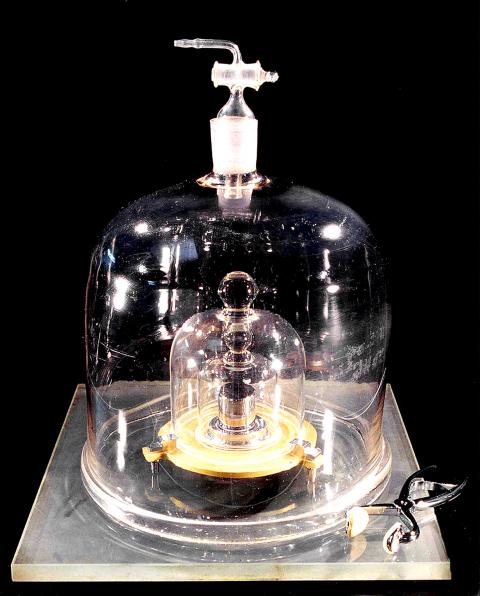
Photo: EPA
照片:歐新社
That can have profound implications. If the prototype were to lose mass, atoms would in theory weigh more since the base kilogram must by definition always weigh a kilogram. Scientists have been trying for decades to define a constant value for the kilogram that is derived from immutable physics, in the same way they have done for other standard units (SI units) overseen by the BIPM.
For example, a meter isn’t 100 centimeters, it’s actually “the length of the path travelled by light in a vacuum during a time interval of 1/299,792,458 of a second.” The “Planck constant,” which derives from quantum physics, can be used along with a Kibble balance, an exquisitely accurate weighing machine, to calculate the mass of an object using a precisely measured electromagnetic force.
“The SI redefinition is a landmark moment in scientific progress,” said Martin Milton, director of the BIPM. “Using the fundamental constants we observe in nature as a foundation for important concepts such as mass and time means that we have a stable foundation from which to advance our scientific understanding, develop new technologies and address some of society’s greatest challenges.”
Barry Inglis, who heads the committee for weights and measures, said the implications were immense. “We will now no longer be bound by the limitations of objects in our measurement of the world, but have universally accessible units that can pave the way to even greater accuracy, and even accelerate scientific advancement,” he said.
It is arguably the most significant redefinition of an SI unit since the second was recalculated in 1967, a decision that helped ease communication across the world via technologies like GPS and the Internet. The new definitions agreed by the BIPM will come into force on May 20, next year.(Reuters)
這個改變或許不會影響你買香蕉的方式。不過,在日前一項被譽為有望提升科學測量準確度的劃時代決定中,科學家表決通過對一公斤的數值重新定義。自一八八九年以來,一公斤的重量由一塊鉑銥合金定義,這塊閃閃發光的金屬稱作「國際公斤原器」,被保存在特別的玻璃櫃中,目前存放於巴黎近郊的國際度量衡局(法文首字母縮寫為「BIPM」)總部。
來自大約六十個國家的國際度量衡局會員,日前齊聚鄰近的凡爾賽宮,召開長達一星期的會議,並於十一月十六日做出決議:根據微小卻不會變動的「普朗克常數」數值,重新定義一公斤。會員們也決議更新安培(電流)、克耳文(熱力學溫度)以及莫耳(物質的量)等單位的定義。
無論是藥學醫療或是砂金使用的微公克(一公克的百萬分之一)、買水果或是賣魚時使用的公斤,還是鋼鐵的公噸,現代的各種質量測定都衍生自公斤。問題在於,「國際公斤原器」無法一直維持相同的重量。就算保存在三層鐘型玻璃罩裡面,原器還是會沾染灰塵的微粒子,也會受大氣影響。有時原器需要清潔,這又會影響其質量。
這個問題的牽涉層面相當廣泛:如果原器損失質量,理論上原子就會變重,畢竟這個基礎公斤在定義上就是重達一公斤。數十年來,科學家一直試圖藉由恆常不變的物理學,用一個固定的數值定義公斤,這也是他們先前在國際度量衡局監督下為其他標準單位(國際單位制)完成的相同目標。
舉例而言,一公尺並非一百公分,實際上應為「光在真空中於兩億九千九百七十九萬兩千四百五十八分之一秒內行進的距離」。從量子力學中導出的「普朗克常數」可以和極度精確的秤重儀器「基布爾秤」一起應用,藉由精準測量出的電磁力來計算一個物體的質量。
國際度量衡局的局長馬汀‧米爾頓表示:「對於國際單位制的重新定義是科學進展過程中的重大里程碑。」他也進一步指出:「藉由運用我們在自然中觀察到的物理常數,作為質量、時間等重要概念的根基,這意味著我們能夠在穩固的基礎上取得科學知識進展、發展新科技,並且應對社會上最艱困的挑戰。」
國際度量衡委員會的會長貝瑞‧英格里斯指出,這項決議背後的含義重大:「從今以後,我們對世界的測量將不會受限於物體的侷限性,反而能夠擁有舉世可得的各種單位,為更加精準的測量鋪下坦途,甚至是加速科學發展。」
就國際單位制而言,這項決議可以說是自一九六七年重新計算「秒」後,最具意義的重新定義。當年重新計算「秒」的決議,協助了全球定位系統和網路等科技發展,讓全球的通訊系統大獲進展。國際度量衡局此回通過的多項新定義將自明年五月二十日生效。(台北時報章厚明譯)
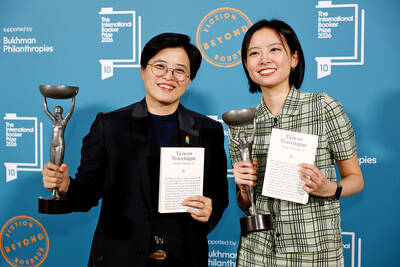
Taiwan Travelogue, the novel by Taiwanese author Yang Shuang-zi and translated into English by Lin King, won the prestigious International Booker Prize in London on May 19. It marks the first time a Taiwanese literary work has received the International Booker Prize, setting a historic milestone both for Taiwanese literature and for the award itself. Prior to this achievement, Taiwan had only once appeared on the Booker radar, when Taiwanese author Wu Ming-yi was longlisted for the Booker Prize in 2018 with The Stolen Bicycle. The International Booker Prize honors works of fiction translated into English and published in the UK or Ireland.
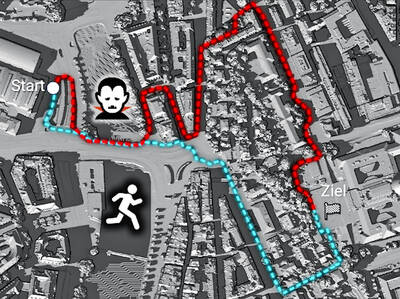
As climate change and urbanization push city temperatures higher, walking outdoors is becoming increasingly uncomfortable in many parts of the world, especially when prolonged time spent in sunlight is involved. As a result, outdoor lovers are now seeking cooler, shaded walking routes. However, most mainstream map apps still do not __1__ shaded footpaths. Enter routing.osm.ch — a Swiss web-based route planner that introduces a novel solution to this problem. Its “Vampire mode,” named after the legendary creatures’ fear of being __2__ natural light, was developed by a Swiss research team led by Professor Stefan Keller. The platform combines open data from
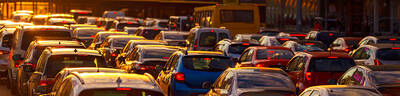
Cities around the world are testing “robotaxis,” hoping that autonomous vehicles will ease traffic and reduce emissions. However, recent analyses suggest these expectations may be overly optimistic. According to consulting firm Kearney, robotaxis could actually make congestion worse rather than better. Because self-driving rides are expected to be cheaper and more convenient than traditional taxis, more people may choose them over walking, biking, or using public transportation. This shift would put more cars on already crowded roads. Another concern is “deadheading,” which refers to robotaxis traveling without passengers between rides. Since autonomous fleets need to reposition themselves throughout the day, these
1. 該協會於全球九十個國家擁有逾一百萬名會員。 ˇ The association consists of over 1 million members in 90 countries. χ The association consists in over 1 million members in 90 countries. 註:consist of 是「由……組成」,而consist in是「在於」、「就是」,比較下列句子: Our department consists of three sections. Success consists in perseverance. Happiness consists in doing one’s duty. 2. 我們的任何錯誤將來都可能帶來麻煩。 ˇ Any mistakes on our part now may lead to problems later on. χ Any mistakes on our part now may lead into problems later on. 註:說「導致」、「引起」用lead to,如to lead to trouble,to lead to disaster,to lead to problems,to lead to something unpleasant等。表示「向某物內部的動向」可用into,如go into a room,to come into a building,to get into trouble等。 3. 這本書是E.M.福斯特的作品,不是喬治.歐威爾。 ˇ This book was written by E. M. Foster, not


 RSS
RSS