


Who says skirts are for women only? National Cheng Kung University (NCKU) is holding a “manskirt week” from today until Friday in order to dispel the mythical relationship between dress and gender. President for Student Affairs Tung Yuk-ying and male student Yang Hua-wei took the lead by putting on skirts and strolling around the university campus. Their use of real actions to show their firm support won them praise from a lot of students, who rushed to take pictures with them.
NCKU’s “manskirt week” is going to degender clothing by organizing activities in school, including asking people to donate old skirts, setting up stands for men to put on skirts, take pictures and check in on Facebook, and encouraging people to share their thoughts on its Facebook page — NCKUmanskirt. They invite male students to take part and also welcome female students to go along and support the boys.
The organizers invited Tung, President for Student Affairs and an icon of manhood in the school, and Yang, a male student, to put on skirts to hype up the event, hoping that this would inspire faculty and students to reflect upon and explore the issue of gender equality. Tung made a special effort to borrow a dark blue A-line skirt from his wife, while Yang borrowed a loose blue floral skirt from his girlfriend. Both men were bold enough to put on the skirts and take a walk around the campus. Seeing this, many teachers and students rushed to take pictures with them.
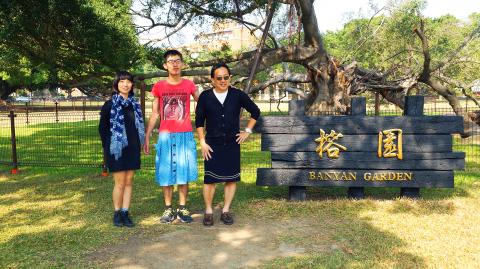
Photo: Liu Wan-chun, Taipei Times
照片:自由時報記者劉婉君
Tung says that in the past when he saw a man wearing a skirt on the street he would feel a sense of admiration for the man’s lack of fear of how people might look at him. This time it is him that is putting on a skirt, and the first thought he had about it was “This is so cool.” Moreover, there is a joy in openly defying social customs. However, when he wears a skirt he has to be careful all the time about how he sits and walks so as to avoid being too revealing, which makes him feel that what each sex should wear is a stereotype imposed by society and a form of bondage. He hopes that the public can dispel the myths about gender.
Tung says that the “manskirt week” is a very meaningful event. Apart from encouraging discussion about whether men can wear skirts, it can also lead to reflections and dialogue on the limitations imposed by social customs, opening the door to subjects such as gender equality.
Yang says that times have changed and so should social customs. The “manskirt week” has been organized to encourage people to explore the stereotypes of clothing and gender. “We should have the freedom to choose whatever we want to wear,” says Yang. “Hopefully, one day, in the surroundings of NCKU, the scene of billowing skirts will no longer be confined to women.”
(Liberty Times, translated by Ethan Zhan)
誰說裙襬飛揚只能女性限定?國立成功大學將從今日至週五舉辦「男裙週」,打破對服裝的性別迷思。學務長董旭英並與男學生楊華瑋率先穿上裙子逛校園,以行動力挺,獲得學生叫好歡迎,爭相合影。
成大「男裙週」透過活動在校園內提倡服裝去性別化,內容包括募集二手裙、擺攤供穿裙拍照打卡、「成大男裙週」粉絲專頁分享心得文等,歡迎男同學踴躍參加,歡迎女同學來加油打氣。
主辦單位邀請校內象徵男性權威的代表性人物學務長董旭英與男學生楊華瑋一起穿上裙子為活動造勢,希望引發師生們一同省思,深入探討平權議題。董旭英特地向太太借來深藍色的A字裙,楊華瑋也向女友借了藍色的碎花寬裙,兩人一起大方地換上裙子逛校園。不少師生看到,都紛紛上前要求合照。
董旭英說,以前看到有男性穿著裙子走在路上,內心都很佩服他們不怕異樣眼光的勇氣,現在換上自己穿裙子,第一個感想是「好涼快」,有一種公開挑戰社會文化的欣喜。 不過,穿裙子必須隨時注意坐姿、走路姿態,避免穿幫,讓他感到男女服裝是社會對性別的刻板印象,也是一種束縛,希望大家能破除性別迷思。
董旭英認為,「男裙週」是很有意義的活動,除了討論男性穿裙議題外,也可以引發對社會文化限制的反思與對話,進而深入探討多元性別平等議題。
楊華瑋表示,時代改變,有些社會規範也要改變,「男裙週」希望探討服裝帶來的性別刻板印象,「我們應該要能自由自在的選擇想穿的服裝。期待有朝一日,成大周邊裙襬飛揚的景色,不再是女性限定。」
(記者劉婉君/台南報導)

When people think of archaeologists, they often picture adventurers discovering ancient tombs filled with treasure, much like Indiana Jones. However, the reality of archaeology is far from the dramatic scenes shown in movies. Archaeologists are scientists who study the past by uncovering and analyzing the physical remains left by humans. Instead of simply digging for treasure, their work combines history, science and detective skills to reveal stories hidden beneath the earth for centuries. The work of archaeologists requires diverse skills spanning multiple disciplines. They must possess knowledge of history, anthropology, geology and even chemistry. During excavations, archaeologists carefully dig
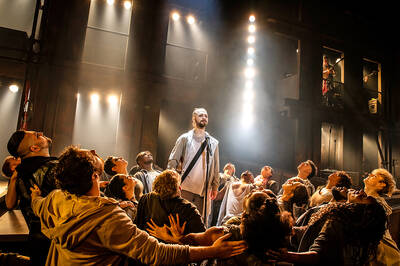
A: The classic musical “Jesus Christ Superstar,” co-produced by Andrew Lloyd Webber and Tim Rice, is making its Taiwan debut at the National Theater during the Dragon Boat Festival long weekend. B: Isn’t the rock musical, based on the “Passion” of Jesus, hailed as one of Webber’s “four major musicals?” A: Yup, the others are “Evita,” “Cats” and “The Phantom of the Opera.” B: What other shows are there during the holiday weekend? A: A symphony concert for Disney’s “Frozen” is also set for Saturday. It will feature live performance by the National Symphony Orchestra and even top-tier Disney

A: In June alone, there are multiple film concerts for not only “Frozen” but also “Attack on Titan” and “Top Gun: Maverick.” B: Wow, film concerts are so popular. But a TV music competition reality show is even more popular now. A: Are you talking about “Ride the Wind 2026” — Season 7 of the “Sisters Who Make Waves” series featuring female celebrities? B: Yup, and four “Taiwanese sisters” are competing this season, including Jessie Chiang, Jill Hsu, Pets Tseng and even “Taiwan’s No. 1 beauty” Stephanie Hsiao. Among all sisters, Pets is a favorite to win. A:

#本文由生成式 AI 協作,本刊編輯編修 Flavor isn’t just created by the seasonings used in a dish but also by the wild backstory attached to it. In some cases, a great dish isn’t the result of careful planning but of an unexpected burst of inspiration. The Ex-Boyfriend Toast In 2025, the variety show Earth Arcade turned this toast into a trending topic. Cast member Lee Young-ji reacted with playful shock at the absurd name, which got everyone talking about it. The story behind the toast dates back to 2018, when a netizen swallowed her pride to contact her ex-boyfriend for his delicious recipe. She carefully


 RSS
RSS