


On Jianguo Rd Sec 2 in Minsyong Township, Chiayi County there is a statue of late president Chiang Kai-shek, which was placed inside the main doorway of a recycling depot after having been reclaimed. Because the statue reaches over 3 meters tall, the head reaches above the top of the door in an eye-catching manner and so has playfully been named as the “door god.” An employee of the recycling depot surnamed Wang says some children don’t know who Chiang is and mistakenly thought it was a statue of Sun Yat-sen. It has turned into a signpost for the recycling depot, says Wang.
A year ago, the depot purchased wooden building materials from a demolition contractor which had demolished a disused village for military dependents in Yunlin County’s Huwei Township. It was then that Wang discovered the abandoned statue of Chiang made from fiberglass, although the paintwork was already peeling off badly. However, Wang decided there was a value to a commemorative statue of Chiang, since he was the first president of Taiwan. Wang therefore agreed with the contractor to purchase the whole lot together. After giving the statue a fresh coat of paint, it looked like new again.
Wang says she was worried the statue would be blown over during the recent typhoon that ravaged Taiwan, so used ropes to tie it down.
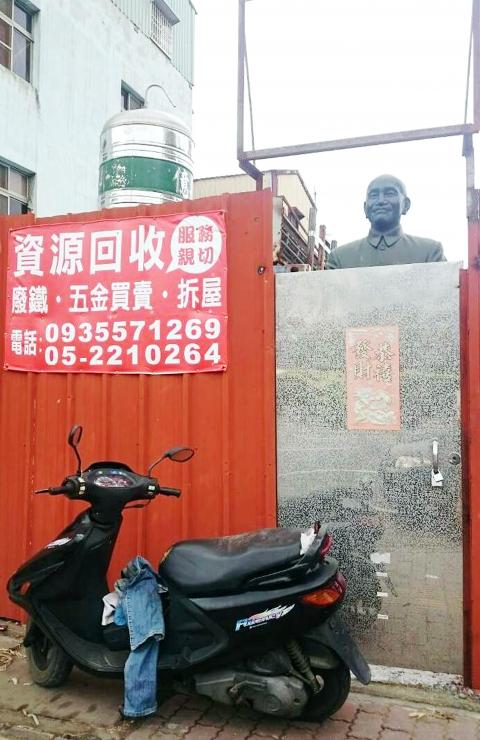
Photo: Yu Hsueh-lan, Taipei Times
照片:自由時報記者余雪蘭
The statue appears somewhat out of place, surrounded by piles of assorted recycled materials and seems a world apart from Chiang’s powerful image while in power. Wang says a passerby walked in to inquire whether they could purchase Chiang, offering NT$30,000, but she hopes to be able to sell the statue for an even higher price.
(Liberty Times, translated by Edward Jones)
嘉義縣民雄鄉建國路二段有一家資源回收場回收一尊蔣介石雕像後擺在大門內,因高達三公尺,高出門牆一顆頭,相當醒目,被戲稱是「門神」。回收場業者王姓婦人說,有些小朋友不認識蔣介石,誤以為是孫中山,現已成為回收場的地標。
王女說,一年多前從雲林縣虎尾一處已遷移的眷村向承包拆除工程的包商收購拆下來的建築木料時,發現被醒目的蔣介石像,材質為玻璃纖維,已嚴重落漆,但她覺得蔣氏是台灣第一位總統,其紀念像應有價值,經包商同意一併收購。重新上漆後看起來像新的一樣。
日前颱風來襲,王女怕蔣介石像被吹倒,還用繩子栓住,周邊堆置各種回收物,場景看起來很突兀,與過去蔣家執政的威風模樣有天壤之別。王女表示,有民眾路過看到雕像,進來詢問可否讓售,開價三萬多元,但她希望賣到更好的價格。
(自由時報記者余雪蘭)
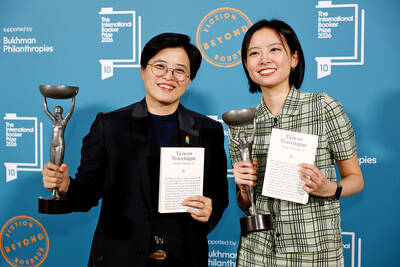
Taiwan Travelogue, the novel by Taiwanese author Yang Shuang-zi and translated into English by Lin King, won the prestigious International Booker Prize in London on May 19. It marks the first time a Taiwanese literary work has received the International Booker Prize, setting a historic milestone both for Taiwanese literature and for the award itself. Prior to this achievement, Taiwan had only once appeared on the Booker radar, when Taiwanese author Wu Ming-yi was longlisted for the Booker Prize in 2018 with The Stolen Bicycle. The International Booker Prize honors works of fiction translated into English and published in the UK or Ireland.
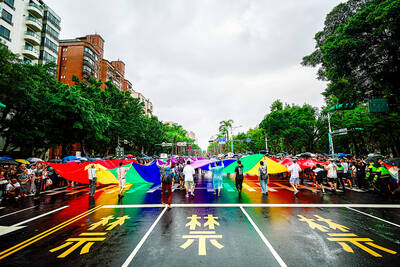
A: While Taiwan is celebrating the 7th anniversary of legalizing same-sex marriage, a poll shows that the support rate for same-sex marriage rose sharply from 37.4 percent seven years ago to 69.9 percent last year. B: Actually, I’m a bit curious about the size of Taiwan’s LGBT population. A: I’m not sure. But if we take a Gallup poll in the US as an example, 9.3 percent of American adults identified as LGBT in 2024. B: Wow, is it because the Americans are relatively open? In many other countries, the figures hover around 5 percent. A: Based on this,
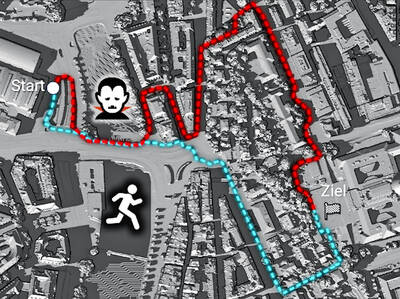
As climate change and urbanization push city temperatures higher, walking outdoors is becoming increasingly uncomfortable in many parts of the world, especially when prolonged time spent in sunlight is involved. As a result, outdoor lovers are now seeking cooler, shaded walking routes. However, most mainstream map apps still do not __1__ shaded footpaths. Enter routing.osm.ch — a Swiss web-based route planner that introduces a novel solution to this problem. Its “Vampire mode,” named after the legendary creatures’ fear of being __2__ natural light, was developed by a Swiss research team led by Professor Stefan Keller. The platform combines open data from
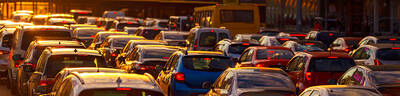
Cities around the world are testing “robotaxis,” hoping that autonomous vehicles will ease traffic and reduce emissions. However, recent analyses suggest these expectations may be overly optimistic. According to consulting firm Kearney, robotaxis could actually make congestion worse rather than better. Because self-driving rides are expected to be cheaper and more convenient than traditional taxis, more people may choose them over walking, biking, or using public transportation. This shift would put more cars on already crowded roads. Another concern is “deadheading,” which refers to robotaxis traveling without passengers between rides. Since autonomous fleets need to reposition themselves throughout the day, these


 RSS
RSS