


Wang Yu-kai is a 19-year-old young man, who lives in Yuanlin. When he was a child, his parents passed away in separate traffic accidents. It had been his dream to tattoo his parents’ image on his body. After working at part-time jobs for four years, he eventually saved more than NT$10,000 for the tattoo fee. In early July, he paid a visit to the tattoo shop and imprinted his parents’ image on his body forever.
When his parents passed away in traffic accidents, Wang was only five years old. He was raised by his grandpa and grandma. His classmates called him “the orphan without a father or mother.” Whenever there was a setback in his life, he would feel an urge to take out his parents’ pictures from a drawer and tearfully spur himself on.
In his first year in junior high school, a tattoo shop was opened next door, which planted the seed in his mind to get a tattoo of his parents. He summoned up the courage to ask for the price, and the shop owner offered him NT$12,500 at a discount because the owner was touched by his affection for his parents. The image of his parents and the cost of the tattoo were deeply imprinted in the young man’s heart.
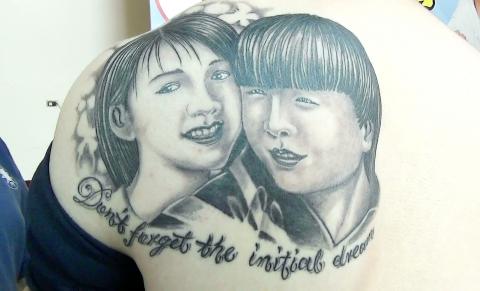
Photo: Yen Hung-chun, Taipei Times
照片: 自由時報記者顏宏駿攝
After entering the Department of Restaurant Management at Da Der Commercial and Technical Vocational School, he worked hard at part-time jobs, including restaurants, beverage shops, oyster omelet shops, and had saved quite a fortune. However, the health of his grandpa and grandma was gradually deteriorating. He took out his savings to pay the medical bills and nursing expenses for his grandparents.
Last year, Wang graduated from school and had saved several hundred New Taiwan dollars each month. When he received his salary on July 1, he was full of excitement and ran directly to the tattoo shop. After seeing the old pictures of his parents, the tattoo artist spent four and a half hours to complete the work. Since Wang’s parents died relatively young, they looked like two youngsters in the tattoo, but Wang was very satisfied with it. Under the tattoo, he wrote “Don’t forget the initial dream” in English.
Now with his parents sitting on his shoulder, Wang said he missed his parents so very much. He wanted to say to them, “With just a hazy memory of you, I have come a long way. Thank you for letting me learn about independence. I will bring your expectations with me and, step by step, pursue my dream.” I made a promise to my parents that I will open a restaurant in my own style, said Wang.
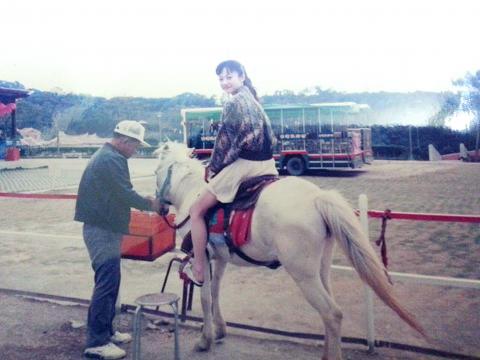
Photo: provided by Wang Yu-kai
照片:由王煜凱提供
(Liberty Times, translated by Ethan Zhan)
家住員林鎮現年十九歲的王煜凱,年幼時父母相繼因車禍去世,一直想把父母的影像刺在身上。四年來靠著打工,總算存了一萬多元的刺青費;七月初上刺青店,把父母的身影永遠留在身上。
父母車禍身亡時,王煜凱才五歲大。他靠著阿公、阿媽拉拔長大,是同學口中「無父無母的孤兒」。每當生活中遇到挫折,他就會不自主地從抽屜拿出父母的相片啜泣,砥礪自己。
上國一那年,隔壁開了一間刺青店,當時就萌生刺下父母身影的念頭。他鼓起勇氣問價格,老闆算他「孝順友情價─12500元」。父母的身影和刺青的價碼深深的烙印在煜凱的心裡。
進入達德商工餐飲科就讀後,他拚命打工,做過餐廳、飲料店、蚵仔煎店…,存了不少錢,但阿公、阿媽身體漸漸走下坡,他把存下來的零用錢拿出付阿公、阿媽的醫藥和看護費。
去年他從達德商工畢業,每個月存幾百元。今年七月初一一領到工錢,就興高采烈地奔向刺青店,拿出父母昔日的照片,由刺青師傅以四個半小時的時間完成大作。由於煜凱的父母早逝,影像中的父母多了年輕時的「萌」樣,但煜凱非常滿意,在人像的下方他用英語寫下「Don’t forget the initial dream(勿忘初衷)」。
把父母背在肩上的王煜凱說,他很想念父母,好想對他們說,「靠著對你們模糊的記憶,我一步步走過來,謝謝您們,讓我學習獨立。我會帶著您們的期望,一步一步追逐夢想。」他說,「我向父母承諾,要開一間屬於自己風格的餐廳」。
〔記者顏宏駿/彰化報導〕

The debate surrounding Taipower’s recent corporate identity reboot has gone well beyond the design community. The controversy began after Taipower replaced the familiar “Taiwan Power Company” wording — widely regarded as the calligraphy of Yu You-ren (1879-1964), former Control Yuan president and master calligrapher — with a modern logotype by designer Aaron Nieh’s team, Aaron Nieh Workshop. Taipower said the change was not a wholesale replacement of old signage, but an “optimization of its identity system,” aimed at meeting the needs of digital media, electronic bills, apps, social media graphics and various small-format applications. Existing physical markings, such as building
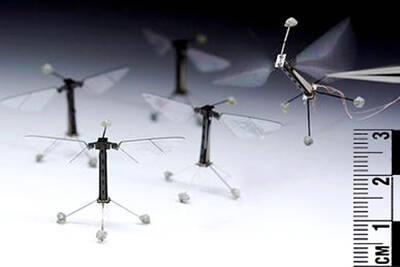
As bee populations around the world continue to decline at an alarming rate, scientists are developing an innovative solution: robotic bees. Recent advances at research institutions like Massachusetts Institute of Technology (MIT) in the US have produced tiny flying robots capable of performing pollination tasks similar to those of real bees. These tiny machines represent an impressive technological achievement. MIT’s latest models can hover in the air for over 1,000 seconds and perform complex movements, demonstrating the agility needed for successful pollination. The robots are designed to mimic the flight patterns of natural bees, offering potential support to agriculture

Continued from yesterday(延續自昨日) https://www.taipeitimes.com/News/lang For the most part, the idea of “Blue Monday” has been rejected as a myth. Some mental health experts also say there is a danger in labeling a certain day as the most depressing time of the entire year. Some argue that if people expect to feel sadder on the third Monday in January, this belief alone may increase their anxiety. One group that is worried about the negative effect of believing in Blue Monday is Samaritans. A mental health charity based in the UK, Samaritans is working to turn Blue Monday into “Brew Monday.” In this

A: Taiwan legalized same-sex marriage on May 24, 2019, so this week marks the seventh anniversary of that milestone. By the end of 2024, a total of 32,126 LGBT couples had tied the knot. B: How many of them got married to foreign partners? A: In 2024, there were 504 cross-border same-sex marriages. By the end of that year, there were 130 cross-strait same-sex marriages between Taiwanese and Chinese — accounting for only about 0.4 percent of the total. B: I’ve heard that a seven-year marriage brings the “seven-year itch.” I bet some couples regret their decisions now. A:


 RSS
RSS