


Japan’s 2012 New Year’s Eve concert featuring Ludwig van Beethoven’s Symphony No. 9 in D minor, Op. 125 will be conducted by Kenneth Hsieh, a Canadian conductor of Taiwanese descent, for the first time in Tokyo on Friday. Two years ago, Japanese conductor Yutaka Sado, who has conducted the year-end concert for 18 consecutive years, made Hsieh his successor of choice. This year Hsieh is finally picking up the baton to conduct the year’s most important concert in Japan. The news is exciting for his fans both in Taiwan and Canada, and some of them have even booked tickets to fly to Japan to attend his concerts.
In addition to the concert with the Japan Philharmonic Orchestra at the Tokyo Bunka Kaikan on Friday, Hsieh will also conduct the Japan Century Orchestra in a second concert, which will be broadcast live on television, at the Osaka Symphony Hall in Osaka next Wednesday.
According to Hsieh, Beethoven’s Symphony No. 9 lasts about 70 minutes without intermission, making it more challenging than other symphonies. Hsieh said he has been concentrating mostly on how to coordinate the solo vocalists’ parts and the symphony parts in the final movement and how to bring the whole piece to its climax as the entire chorus joins in.
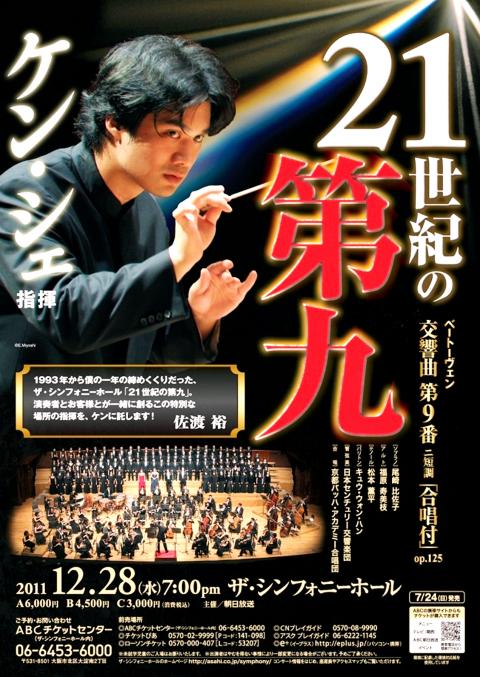
Photo: Chang Ling-chu, Taipei Times
照片:自由時報記者張伶銖
In an interview, Hsieh mentioned the global impact of the European sovereign debt crisis, in particular on Europe’s classical music market. He said the European debt crisis has affected his previously scheduled concert plans in Italy. He also expressed concerns about how the crisis might influence the mood of classical music enthusiasts as they attend concerts.
Next year Hsieh’s performances will primarily be based in Japan and Vancouver, Canada. Apart from having confirmed that he is conducting both the 2012 and 2013 New Year’s Eve concerts in Japan, he will also give at least three performances with the Vancouver Metropolitan Orchestra, which he established, as the orchestra enters its 10th year.
(LIBERTY TIMES, TRANSLATED BY LIN YA-TI)
即將於本週五在東京登場的「日本新年音樂會--路德維希‧范‧貝多芬的《第九號D小調作品第一百二十五號交響曲》音樂會」,首度由台裔指揮家謝建得擔任指揮。連續十八年擔任指揮的日本指揮家佐渡裕,早在兩年前即已屬意由謝建得「接棒」,今年終於如願擔任日本年度最重要的一場音樂會指揮。此消息令在台灣及在加拿大的樂迷興奮不已,有的並已訂好機票,準備追隨他去日本欣賞音樂會。
除本週五在東京文化會館與日本愛樂交響樂團的演出外,謝建得還將於下週三在大阪交響樂音樂廳與日本世紀交響樂團合作演出另一場,在大阪的音樂會,將有電視轉播。
謝建得說,指揮貝多芬《第九號交響曲》,將是七十分鐘不間斷的演出,比起其他樂曲更具挑戰性。最後一個樂章中,如何令獨唱者與交響樂間產生協調,以及在大合唱加入時,將全曲帶入高潮,則是他花最多心思準備的部分。
受訪時,謝建得提及這次歐洲主權債券危機對全球、尤其是對歐洲古典音樂市場的影響。他說,歐債危機其實已影響他在義大利原來已經談妥的演出計劃,他擔心這次危機會影響樂迷進音樂廳欣賞古典音樂的心情。
至於明年,謝建得主要演出計劃仍將在日本及加拿大溫哥華,除了已確定二○一二年與二○一三年的日本新年音樂會,繼續由他指揮外,他在溫哥華創立的大都會管絃樂團明年進入第十年,將至少有三場音樂會。
(自由時報記者張伶銖)

In 2023, an 80-year-old woman in Taipei suffocated her paralyzed son after over five decades of caring for him. Turning herself in immediately, she confessed that worsening health and anxiety about who would care for him after her death had driven her to act. The court, acknowledging her difficult situation, sentenced her to two-and-a-half years in prison while recommending a presidential pardon. This rare judicial recommendation drew a complicated social response. Supporters argue that the mother’s half-century of caregiving renders her deserving of compassion instead of incarceration, believing that allowing her to live her final years in dignity and

A: Over 130,000 college graduates are about to enter the workforce upon graduation. B: According to a survey, the top 10 most desired careers among Taiwanese are: independent content creator, civil servant, information engineer, financial professional, medical worker, content planner, flight attendant, news anchor, designer and fitness trainer. A: What are the “dream jobs” for young Gen Zers? B: The top three for men are YouTuber, pro gamer and engineer. For women, they are writer, social media editor and YouTuber. A: Every profession has its champion. Just look at Taiwanese fire dancer Yang Li-wei — who was on fire

★ Bilingual Story is a fictionalized account. 雙語故事部分內容純屬虛構。 The mango looked perfect. It sat on the fruit stand like a small sunset, red on one side and gold on the other. “I’ll take this one,” said Daniel. The fruit seller shook her head. “Not that one.” Daniel was surprised. “Why not? It looks beautiful.” “Yes,” she said, “but beautiful is not always ready.” She picked up another mango and held it near his nose. “First, smell here.” Daniel smelled the top of the mango. It was sweet and warm. “Good mangoes have a smell,” she said. “Next, feel the weight.”

1. 他非常討厭偽君子。 ˇ He has a deep hatred for hypocrites. χ He has a deep hatred to hypocrites. 註︰表示「對某人懷著愛、恨」等, 常用 have a love for/of, have a hatred for/of。 例如: We have a love for/of science. The working people have a hatred for/of all forms of exploitation. 2. 問題的答案其實不難找。 ˇ The answer to this question is not difficult to find. χ The answer of this question is not difficult to find. 註︰中文中的「的」在英語中不一定都用 of 來表示,有時須用 to。其他的例子如下: 我把房間的鑰匙弄丟了。 I lost the key to the room. 中間矗立著烈士紀念碑。 In the center stands the monument to the martyrs. 這部電影的續集你看過沒有? Have you seen the sequel to the movie? 3. 比起那家餐廳,他更喜歡這家。 ˇ He prefers this restaurant to that one. ˇ He likes


 RSS
RSS