


A Cuban cigar roller began last Monday rolling a 70m cigar in an attempt to nearly double his previous Guinness world record, a spokesman said.
Working eight hours a day for nine days, 67-year-old Jose Castelar Cairo, better known as Cueto, is hoping to break his 2009 record of a 43.38m stogie.
He hopes to complete his latest feat today and display it at the International Tourism Fair, which runs Monday-Saturday this week. It would be his fifth record in more than half a century of cigar-rolling.
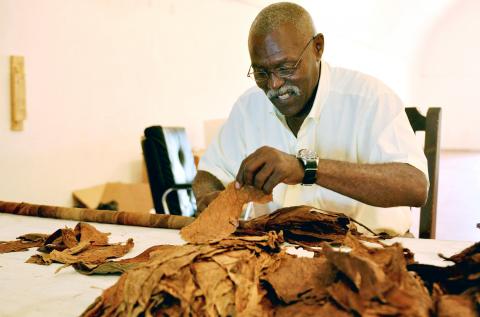
Photo: AFP
照片:法新社
“Cueto said that as long as he lives, the Guinness record has to be in Cuba,” said his spokesman Amado de la Rosa. “He is very lively now and will get tired as the days go by, but he hopes to reach his goal.”
The athletic-looking sexagenarian first learned to make cigars when he was 14 years old.
Hailing from the central province of Villa Clara, Castelar counts among his clients a Saudi prince and a wealthy Mexican businessman. He has two children with his wife Maria Diago.
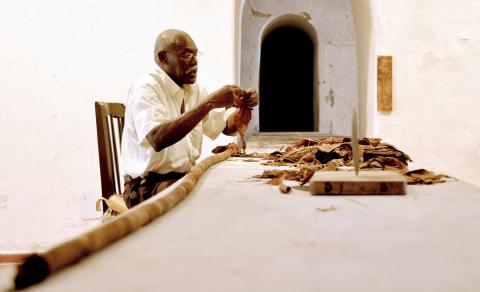
Photo: AFP
照片:法新社
Handmade Cuban cigars are considered to be the finest in the world. Tobacco is one of the communist island’s top exports, along with nickel, biotech products, sugar, coffee and fruit.
(AFP)
一位發言人說,古巴捲雪茄專家上週一開始捲一支七十公尺長的雪茄,試圖以近兩倍的長度,打破他先前的金氏紀錄。
六十七歲外號為奎托的何賽‧卡斯特拉‧開羅,連續九天每天工作八小時,期望能打破他二零零九年四十三點三八公尺雪茄的紀錄。
他希望能在今天完成他最新的壯舉,並將其傑作展示在本週一到週六舉行的國際旅展上。這可能會是他半百的捲雪茄生涯中,第五度破紀錄。
他的發言人阿瑪多‧德拉羅莎說,「奎托說只要他還有一口氣,金氏世界紀錄非古巴莫屬。」德拉羅莎接著說,「他目前仍精力充沛,但隨著時間流逝,體力也會隨之變差,不過他希望能達到他的目標。」
有運動家體格的這號六十幾歲人物,十四歲時首次學習製作雪茄。
來自中部的比拉喀拉拉省的卡斯特拉,其主顧有一位沙烏地王子與一位墨西哥商業鉅子。他有兩個小孩,還有他的妻子瑪麗亞‧迪亞哥。
手工古巴雪茄被認為是世界上最頂級的。菸草是這個共產島國最大的出口貨品之一,其他包含鎳、生物技術產品、糖、咖啡與水果。
(法新社/翻譯:林亞蒂)
Warning: Smoking can damage your health.吸菸有害健康
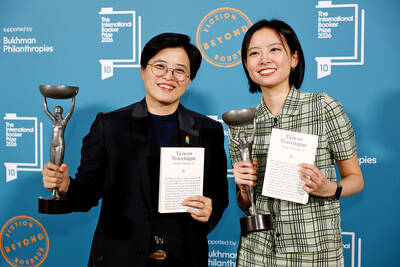
Taiwan Travelogue, the novel by Taiwanese author Yang Shuang-zi and translated into English by Lin King, won the prestigious International Booker Prize in London on May 19. It marks the first time a Taiwanese literary work has received the International Booker Prize, setting a historic milestone both for Taiwanese literature and for the award itself. Prior to this achievement, Taiwan had only once appeared on the Booker radar, when Taiwanese author Wu Ming-yi was longlisted for the Booker Prize in 2018 with The Stolen Bicycle. The International Booker Prize honors works of fiction translated into English and published in the UK or Ireland.
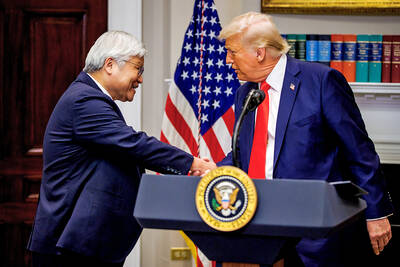
A: Time magazine recently released its list of “The 100 Most Influential People of 2026.” It’s categorized into six groups: Artists, Pioneers, Titans, Icons, Leaders and Innovators. B: TSMC chairman C.C. Wei made the list this year. Which category is he in? A: Wei is actually among the Pioneers, with figures including Disney CEO Josh D’Amaro and MrBeast — the first YouTuber ever to surpass 400 million subscribers. B: Led by Wei, Taiwan’s “silicon shield” TSMC is the sixth-largest company in the world. A: As Nvidia founder Jensen Huang wrote in his introduction, “C.C. Wei is truly one of the
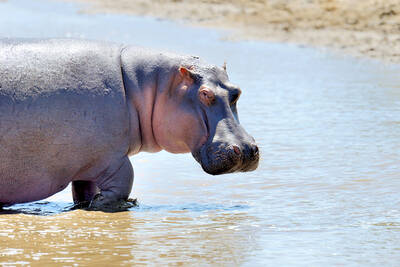
The animal kingdom is full of surprises that challenge our understanding of biology. From remarkable feeding mechanisms to extreme defense strategies, some creatures possess traits so unusual that they seem like pure fiction. Here are four fascinating examples that show nature’s endless creativity. The humble snail may appear simple, but its mouth tells a different story. Snails possess a ribbon-like tongue called a radula, densely covered with anywhere from 1,000 to 12,000 tiny teeth. This structure works like a cheese grater, allowing them to scrape and grind food with surprising efficiency. Far from being passive creatures, snails are actually

A: In the 2026 Time 100 list, besides TSMC chairman C.C. Wei in the Pioneers category, Blackpink’s Jennie also stands out in the Artists group. B: What about the Titans and Icons? A: The Titans include legendary fashion designer Ralph Lauren, Google CEO Sundar Pichai, and Intel CEO Tan Lip-bu. The Icons include actor Wagner Moura, Olympic gold figure skater Alysa Liu and singer Victoria Beckham. B: What about the Leaders and Innovators? I bet US President Donald Trump and Chinese President Xi Jinping are on the list. A: You got it. Other Leaders include Japanese PM Sanae


 RSS
RSS