


Three Singaporean activists were sentenced to between seven and 15 days in jail for wearing clothes with a picture of a kangaroo dressed as a judge.
John Tan, Isrizal bin Mohamed Isa and Muhammad Shafi’ie Syahmi bin Sariman were each also ordered to pay court costs of S$5,000 (NT$109,300).
High Court Justice Judith Prakash had earlier found the trio in contempt of court after they were accused of wearing shirts bearing the kangaroo pictures on certain dates in May, within and near the court building.
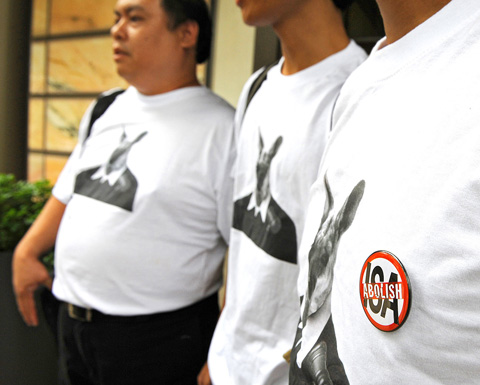
PHOTO: AFP
Their action coincided with a hearing to assess damages in a libel case filed by Singapore’s founding father Lee Kuan Yew and his son Prime Minister Lee Hsien Loong, a government news release said earlier.
Tan, sentenced to 15 days’ jail, is the SDP’s assistant secretary general. Isrizal and Shafi’ie each received seven-day sentences.
“I think that there is no alternative in this case but to impose a sentence of incarceration,” Prakash said.
She took a dim view of the protest, noting that none of the men had apologized and said their action did not amount to fair criticism.
They were not immediately taken to jail. Prakash gave time for Isrizal to settle his affairs and for Shafi’ie to complete his national military training.
They are to surrender themselves on Dec. 12.
Deputy Solicitor General Jeffrey Chan argued that the worst insult someone can level against the judicial system is to call it a “kangaroo court,” the Straits Times reported earlier.
Isrizal said the image on the T-shirt was not a kangaroo but a wallaby, the report said.(AFP)
新加坡三名行動份子,因穿印有袋鼠披法官袍圖案的T恤,而被判刑監禁七日至十五日不等。
此外,陳約翰、依斯裡扎和慕哈末三人各被判罰新幣五千元(新台幣十萬九千三百元)的訴訟費用。
這三人被控今年五月某幾天,刻意穿著印有袋鼠圖案的T恤接近及進入法院,之後被高等法院法官茱迪絲.普拉卡西裁定為藐視法庭。
新加坡政府稍早發佈的新聞稿指出,這三人穿著袋鼠T恤旁聽新加坡之父李光耀和其子現任總理李顯龍提告的誹謗案庭訊。
新加坡民主黨助理秘書長陳約翰被判十五天監禁;依斯裡扎和慕哈末兩人則各判入獄七天。
普拉卡西法官說:「我認為這個案件唯一的判決就是處以監禁。」
她無法苟同這種抗議方式,並強調他們三人事後都毫無悔意,且並未得到該有的指責。
他們沒有即刻發監執行。普拉卡西法官允許依斯裡扎先處理完手頭上的事情,而慕哈末也可以先服完兵役再入獄服刑。
他們必須於十二月十二日自行報到。
《海峽時報》稍早報導,副檢察長傑佛瑞.陳說,「袋鼠法庭」是批評司法體系不公最嚴厲的辱罵。
報導指出,依斯裡扎說T恤上的圖案是沙袋鼠,不是袋鼠。(法新社�翻譯:袁星塵)

A: The Taipei Xiahai City God Temple’s cultural festival runs from Saturday to early July. Do you want to go? B: In addition to the City God and his wife, the temple worships dozens of deities — including the Matchmaker God,“Yuexia Laoren” (“Yue Lao.”), literally “old man under the moon.” So are you going to pray for a match? A: You got it. The Matchmaker God matches people together, just like a Chinese Cupid. My friend went to worship the matchmaker and met “Mr. Right” that very same day. B: It’s that effective? Can my gay friends pray to

A: Is the Matchmaker God, “Yuexia Laoren” (“Yue Lao”), at the Taipei Xiahai City God Temple that effective? How do people pray for love? Should I tell him my preferred type first? B: Yes, you should. Then request a lucky red string, so he can help you find a match at the other end of the string. What’s your type? A: My ideal type is someone like violinist Ray Chen. Actually, I’ll be attending his recital at the National Concert Hall tomorrow. B: Are you talking about the renowned Taiwanese-Australian violinist? Wow, your standards are so high. You’ll have

A record 48 teams and millions of fans are set to descend on the US, Canada and Mexico for the first World Cup co-hosted by three nations, the largest and most logistically complex edition of the tournament ever staged. The action got under way at Mexico City’s iconic Estadio Azteca on Thursday last week, with co-hosts Mexico taking on South Africa, launching a sprawling, nearly six-week-long spectacle that will culminate in the final at New Jersey’s 82,500-seat MetLife Stadium on July 19. Can Lionel Messi, at the age of 38, settle any lingering debate about his status as the greatest

Demand for secondhand electric vehicle (EV) batteries has risen sharply in Australia, transforming the landscape of salvage auctions. Once largely ignored, written-off EVs now attract buyers primarily interested in their powerful lithium batteries. These batteries can be repurposed for solar storage, off-grid power systems, or temporary energy use at events like music festivals. The auction house Pickles reports selling about 100 salvaged EVs monthly, with sales up 200% year on year. Specialists note that even batteries reduced to 70% capacity remain useful, offering quieter and cleaner alternatives to diesel generators. Repurposed units are also seen as an important part of Australia’s renewable


 RSS
RSS