


The Parappana Agrahara prison in Bangalore has an unusual problem. The prisoners like the food so much that they don't want to leave! The prison is crowded with 4,700 prisoners, which is double the proper amount.
Young offenders are also saying they are older so they can go into the adult prison.
The reason is the healthy food served by ISKCON, or the International Society for Krishna Consciousness, a Hindu organization.
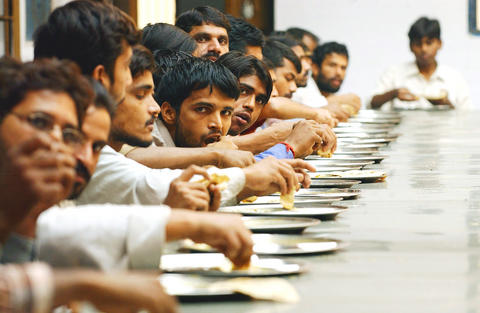
PHOTO: AFP
ISKCON, commonly known as the Hare Krishna movement, started serving its pure-vegetarian food in the jail on May 21 under contract from the prisons department.
Lunch and dinner typically include piping hot rice, two vegetables and a spicy lentil dish called sambar, and buttermilk. A dessert is added on festival days and national holidays like Independence Day, and also once a week.
"When we are getting tasty, nutritious food three times a day here, why should we go out and commit crimes?" asked prisoner Raja Reddy, who has been arrested 20 times in 30 years for theft, robbery and burglary.
印度班加羅爾的帕拉帕納.阿格拉罕拉監獄面臨了不尋常的困擾。受刑人相當喜歡牢裡的餐點,一點也不想出獄!這所監獄目前擠滿了四千七百位受刑人,較合容量多了一倍!
少年受刑人謊報年齡,以便進入成人監獄。
這一切都是因為印度「國際奎師那意識協會」所供應的健康飲食。
國際奎師那意識協會一向以「哈瑞奎師那」運動聞名,與監獄單位擬定合約後,五月二十一日開始供應全素食餐點。
典型的午晚餐包括熱騰騰的米飯、兩種蔬菜,及一種稱為「sambar」的辣扁豆菜餚與白脫牛奶。每週供應一次甜點,節慶與獨立紀念日等國定假日還有額外的甜點可吃。
三十年來因竊盜、搶劫與闖空門進出監獄二十次的受刑人拉亞.瑞迪問︰「我們每天在這裡享用三次美味營養的食物,何苦還出獄犯罪呢?」(翻譯︰賴美君)

The debate surrounding Taipower’s recent corporate identity reboot has gone well beyond the design community. The controversy began after Taipower replaced the familiar “Taiwan Power Company” wording — widely regarded as the calligraphy of Yu You-ren (1879-1964), former Control Yuan president and master calligrapher — with a modern logotype by designer Aaron Nieh’s team, Aaron Nieh Workshop. Taipower said the change was not a wholesale replacement of old signage, but an “optimization of its identity system,” aimed at meeting the needs of digital media, electronic bills, apps, social media graphics and various small-format applications. Existing physical markings, such as building

Since 2005, the third Monday in January has come to be known as “Blue Monday.” In other words, that day is believed to be the most depressing day of the year. This concept seems logical at first. After all, Monday marks the start of the school or workweek after two days of rest and fun. Also, blue is a color that is often associated with sadness. Furthermore, in many parts of the world, January is a time when the weather is cold, rainy, and gloomy. But is there any scientific proof that this January day is truly sadder than any of

Continued from yesterday(延續自昨日) https://www.taipeitimes.com/News/lang For the most part, the idea of “Blue Monday” has been rejected as a myth. Some mental health experts also say there is a danger in labeling a certain day as the most depressing time of the entire year. Some argue that if people expect to feel sadder on the third Monday in January, this belief alone may increase their anxiety. One group that is worried about the negative effect of believing in Blue Monday is Samaritans. A mental health charity based in the UK, Samaritans is working to turn Blue Monday into “Brew Monday.” In this

1. 他兩天後回來。 ˇ He will return in two days. χ He will return after two days. 註︰從現在開始,說「多久以後」,應該用 in,不用 after,例如: He plans to finish the work in three months. I am sure we will hear from him in a few days. 請注意 in a few days、in three months 許多人誤以為是「幾天內」、「三個月內」,其實是「幾天後」、「三個月後」。 如指「某個時刻或日期或事件以後」,可用 after。例如: I will be back after four o’clock.(或 after 4 August,或 after lunch)。 2. 他要在那牆上開一扇門。 ˇ He wants to put a door in that wall. χ He wants to put a door on that wall. 註︰門不是掛在牆上,也不是靠在牆上,而是開在牆裡,應該用 in。 比較下列各句: There is a painting on the wall. Why is that plank of wood leaning against the wall? The thief made a hole in the wall. 3. 我在報上看到這個消息。 ˇ I


 RSS
RSS