


Kurdish officials said on Tuesday that Kurdish guerrillas have been acting as guides and scouts inside Iraqi-controlled territory, helping small teams of American soldiers to enter Iraq for missions behind the Iraqi lines.
Larger groups of Kurdish soldiers were seen moving into at least four front-line villages around Kirkuk and Mosul on Tuesday, feeding speculation that Kurdish forces would be asked to play a significant role in any US effort to open a northern front against the Iraqi army. The original plan to deploy a large US force was derailed by Turkey's refusal to allow the use of its ports and roads.
Kurdish officials also said that US Special Operations forces and Kurdish fighters are within days of launching a ground offensive against Ansar al-Islam, a militant Islamic movement. The group, which the State Department says has ties to al-Qaeda, controls a small pocket of territory sandwiched between Kurdish-controlled northeastern Iraq and Iran.
Combined with the continued attacks by allied warplanes on Iraqi positions around the cities of Kirkuk and Mosul, the pace of activity here seemed to quicken. Senior Kurdish officials in northern Iraq have expressed surprise at what they said was the slow pace of the US-led offensive, not only in the north but in southern Iraq too.
"Unless you show some visible gains, people will be emboldened," Hoshyar Zebari, a senior official in the Kurdistan Democratic Party, said of the Baghdad government and its supporters. "There will be more resistance."
Kurds who served in the Iraqi army during the Persian Gulf War contrasted the relatively light air war in the current campaign with the 38 days of pre-invasion bombardment they endured in 1991.
"From early morning until late evening, this intense bombing, I could not even move," said a Kurdish official who spoke on condition that he not be identified. "I myself left my unit and went home."
Kurds on Tuesday also appeared to have negotiated successfully with an Islamic group that posed potential risks to US soldiers in the anticipated battle against Ansar al-Islam. The group, Komali Islami Kurdistan, occupies a town and military positions adjacent to territory held by Ansar al-Islam.
US cruise missiles struck Komali military offices and barracks last weekend, raising concerns that the group, which has maintained relationships with both Ansar and the main Kurdish groups, would be driven into Ansar's ranks. Komali is believed to have between 700 and 1,200 guerrillas.
Komali, a comparatively moderate group that had never declared hostility toward the US, said on Tuesday that it had no idea why US forces attacked its bases. It said more than 40 of its members were killed, a figure smaller than the Kurdish authorities' estimate that more than 130 Komali fighters died.
Whatever the number, on Tuesday, after two days of talks brokered by Iranian intelligence officials, Komali announced that it was moving to a village away from the front.
A senior Komali member, Anwar Mohammad, said the move was not a surrender so much as a practical necessity "so we don't give another excuse for the Americans to attack."
Four militants from Ansar al-Islam infiltrated Kurdish front lines near Halabja on Monday night and attacked a Kurdish post in the village of Anab, not far from where US soldiers have been meeting Kurdish commanders.

NO-LIMITS PARTNERSHIP: ‘The bottom line’ is that if the US were to have a conflict with China or Russia it would likely open up a second front with the other, a US senator said Beijing and Moscow could cooperate in a conflict over Taiwan, the top US intelligence chief told the US Senate this week. “We see China and Russia, for the first time, exercising together in relation to Taiwan and recognizing that this is a place where China definitely wants Russia to be working with them, and we see no reason why they wouldn’t,” US Director of National Intelligence Avril Haines told a US Senate Committee on Armed Services hearing on Thursday. US Senator Mike Rounds asked Haines about such a potential scenario. He also asked US Defense Intelligence Agency Director Lieutenant General Jeffrey Kruse

NOVEL METHODS: The PLA has adopted new approaches and recently conducted three combat readiness drills at night which included aircraft and ships, an official said Taiwan is monitoring China’s People’s Liberation Army (PLA) exercises for changes in their size or pattern as the nation prepares for president-elect William Lai’s (賴清德) inauguration on May 20, National Security Bureau (NSB) Director-General Tsai Ming-yen (蔡明彥) said yesterday. Tsai made the comment at a meeting of the Legislative Yuan’s Foreign Affairs and National Defense Committee, in response to Democratic Progressive Party (DPP) Legislator Wang Ting-yu’s (王定宇) questions. China continues to employ a carrot-and-stick approach, in which it applies pressure with “gray zone” tactics, while attempting to entice Taiwanese with perks, Tsai said. These actions aim to help Beijing look like it has
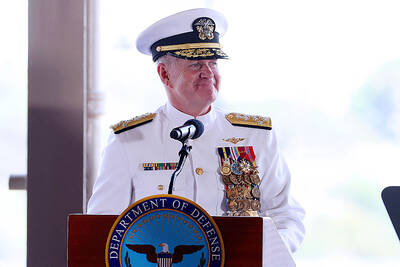
China’s intrusive and territorial claims in the Indo-Pacific region are “illegal, coercive, aggressive and deceptive,” new US Indo-Pacific Commander Admiral Samuel Paparo said on Friday, adding that he would continue working with allies and partners to keep the area free and open. Paparo made the remarks at a change-of-command ceremony at Joint Base Pearl Harbor-Hickam in Hawaii, where he took over the command from Admiral John Aquilino. “Our world faces a complex problem set in the troubling actions of the People’s Republic of China [PRC] and its rapid buildup of forces. We must be ready to answer the PRC’s increasingly intrusive and

INSPIRING: Taiwan has been a model in the Asia-Pacific region with its democratic transition, free and fair elections and open society, the vice president-elect said Taiwan can play a leadership role in the Asia-Pacific region, vice president-elect Hsiao Bi-khim (蕭美琴) told a forum in Taipei yesterday, highlighting the nation’s resilience in the face of geopolitical challenges. “Not only can Taiwan help, but Taiwan can lead ... not only can Taiwan play a leadership role, but Taiwan’s leadership is important to the world,” Hsiao told the annual forum hosted by the Center for Asia-Pacific Resilience and Innovation think tank. Hsiao thanked Taiwan’s international friends for their long-term support, citing the example of US President Joe Biden last month signing into law a bill to provide aid to Taiwan,


 RSS
RSS