


Taiwan yesterday confirmed one additional COVID-19 case, bringing the national total to 45, the Central Epidemic Command Center (CECC) said.
The 45th patient is a woman in her 50s who had been hospitalized in the same ward as Taiwan’s 34th novel coronavirus patient, the CECC said.
She had not traveled abroad in the past few months. She was admitted to the hospital on Feb. 14 due to an unrelated ailment and spent time in the same ward as the other patient, although in a different room, before being discharged on Feb. 20, it said.
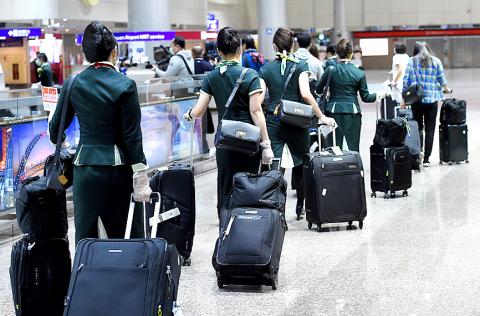
Photo: Chu Pei-hsiung, Taipei Times
The woman was found to have contracted the disease after health authorities on Sunday screened the people with whom the 34th patient might have come into contact with, it said.
She was confirmed as being infected following a second positive test on Thursday and was put in a negative-pressure isolation room, the CECC said.
Meanwhile, the CECC said that an Australian composer who tested positive for COVID-19 posed a low risk of community spread during his time in Taiwan from Feb. 23 to Monday.
Photo: Ritchie B. Tongo / EPA-EFE
The composer — who the CECC did not name — performed at the National Concert Hall in Taipei on Friday and Sunday last week.
Australian authorities on Thursday confirmed him as a new coronavirus case after he disembarked from EVA Air (長榮航空) Flight BR315, which departed from Taipei on Monday and landed in Brisbane on Tuesday.
Centers for Disease Control Deputy Director-General Chuang Jen-hsiang (莊人祥), who is also a CECC official, said that 147 people were identified as having come into contact with the composer in Taiwan, including 103 who have been ordered into home quarantine.
The 103 included 19 orchestra members, eight reporters, 17 hotel staff, 15 drivers, three personal acquaintances of the composer’s, and 12 crew and six passengers on the flight, he said.
Twenty-three people who attended the performances were on the home-quarantine list, too, as they sat within 2m of the composer, according to video footage, he said.
Other audience members are advised to closely monitor their health and seek medical attention if any symptoms occur, he said.
Not being able to reach the composer, the CECC could not confirm whether he had worn a mask on the flight, but he had spent most of his time in Taiwan not wearing one, Chuang said.
The composer’s schedule here was business-related for the most part, including rehearsals from Tuesday to Thursday last week, followed by the two performance days, said Minister of Health and Welfare Chen Shih-chung (陳時中), who heads the CECC.
Apart from consulting a doctor on Thursday last week, the composer mostly traveled between the hotel and the performance venue, Chen said.
Those who drove him have been ordered into home quarantine after being identified via video footage, Chen said, adding that the composer did not use public transportation.
The composer departed the UK and transited in Bangkok before arriving in Taiwan, where officials collected his details after he reported having a cough, but entry was approved as he exhibited no symptoms.
With many people who attended the performances being teachers, they are advised not to return to work immediately, but to monitor their health at home, Chen said.
In other developments, the CECC yesterday said that 19 Taiwanese evacuees from the Diamond Princess cruise ship in Japan would be discharged from quarantine today.
The move comes after none of them were confirmed as having contracted COVID-19 after a third round of testing, it said.
The previous two rounds of testing, which also came back negative, were conducted immediately after their return aboard a charter flight from Tokyo on Feb. 21.
They were put in isolation in separate rooms at a quarantine center.

National Taiwan University (NTU) yesterday said it disqualified a person from an entrance examination for using AI smart glasses to cheat, along with two others for making untruthful statements in their curriculum vitae. The three applicants were given null scores, Taiwan’s highest-ranked university said, calling on prospective students to be honest in the admissions process. NTU registrar Lee Hung-sen (李宏森) said that the cheating applicant wore a hat and thick-rimmed glasses to the second written exam for medical school, claiming that they felt cold. Suspicions were aroused when the applicant stared oddly at the test for long stretches while steadily bringing the paper
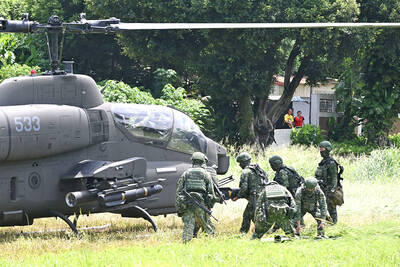
MILITARY ISSUES: A partisan divide between the Cabinet and the legislature ‘raised questions about Taiwan’s ability to adequately fund its defense,’ the report said Taiwan’s defense budget, military personnel numbers and resilience are challenges to its ability to meet national defense goals, the US Naval Institute said in a report published on Tuesday. In response to the perception of a growing military threat posed by China, Taiwan has embarked on an effort to enhance the capabilities needed to deter an attempt by Beijing to annex the nation by force, the institute said in the US Congressional Research Service report, titled Taiwan: Defense and Military Issues, which was filed on Thursday last week. Taiwan’s defense budget increased by about 7.5 percent from 2024 to last year, it

66 FIGHTER JETS: The aircraft is likely undergoing preparations for its transfer to Taiwan — a significant step forward in the nation’s modernization program, a lawmaker said The first of Taiwan’s order of F-16V Block 70 aircraft has been sighted in Texas ahead of delivery, Democratic Progressive Party (DPP) Legislator Wang Ting-yu (王定宇) said. Taiwan’s first F-16V Block 70 two-seat aircraft, tail number 6831, was seen flying from Lockheed Martin’s production facility in Greenville, South Carolina, to Naval Air Station Joint Reserve Base Fort Worth in Texas, Wang wrote on Facebook yesterday. The plane is likely undergoing preparations for its transfer to Taiwan, marking a significant step forward in the Republic of China Air Force’s modernization program, Wang said, citing military analysts. The F-16V Block 70 is a new-build version
NOT JUST NUMBERS: What matters to intelligence work is crucial, reliable information, so even a few credible leads can be highly valuable to national security, a legislator said The National Security Bureau (NSB) yesterday said it has finished the establishment of an information-reporting channel for Chinese nationals, the aim of which is to broaden intelligence gathering on China’s political, military, economic and social developments. Chinese nationals can submit information on the Web page, https://report.nsb.gov.tw, the NSB said in a statement. The move aims to expand the bureau’s diverse intelligence sources and is pursuant to the National Intelligence Services Act (國家情報工作法), it said, adding that it referenced practices adopted by intelligence agencies in the US, the UK and Israel. An increasing number of people are approaching Taiwanese agencies to provide information, as


 RSS
RSS